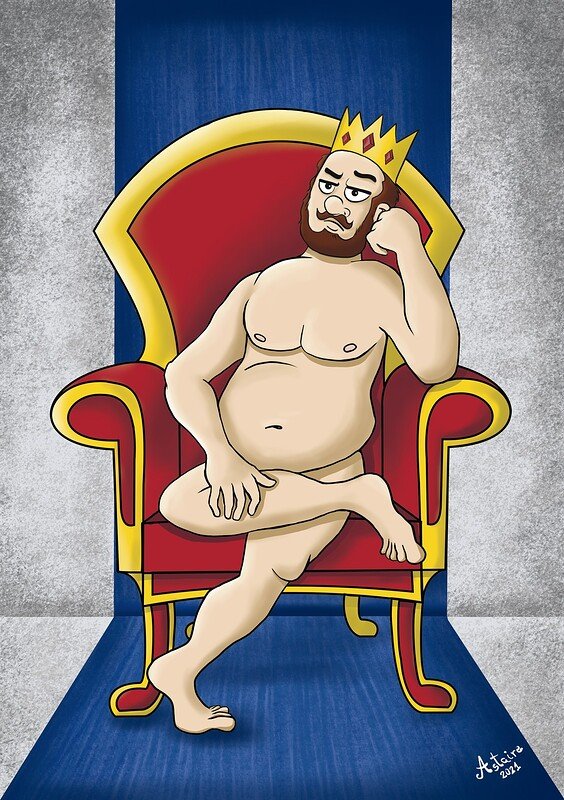
Every child knows the story: a vain emperor parades through town in “invisible” clothes, and an entire crowd of adults — too polite, too frightened, too invested in the fiction — applauds his imaginary robes. It takes a child, too young to know better, to say the obvious out loud: the king is naked.
Power has always had this peculiar effect on the people standing near it. And nowhere is the lesson older, or sharper, than in the ancient story of Saul and David: a person can keep the throne long after he has lost the moral authority to sit on it.
Saul once had humility. He was the man who hid among the baggage on the day they crowned him king — genuinely reluctant, genuinely unassuming. But power has a way of curdling insecurity into something far more dangerous. Confronted with his failures, Saul didn’t sit with the discomfort of being wrong. He explained. He justified. He managed the optics. He cared more about how he looked to the people than about repairing what he’d broken.
David, years later, committed the graver sin — he desired another man’s wife, then arranged that man’s death to have her. But when he was finally confronted, David didn’t spin, didn’t deflect, didn’t reach for a single excuse. He said three words: “I have sinned.” Nothing about that admission erased the crime, or cancelled what came after. But it revealed the one thing that separates leaders: accountability begins exactly where excuse-making ends.
Two men. Two catastrophic failures. Two entirely different reflexes when caught. That difference has outlived both by three thousand years — because it still explains almost everything wrong with power today.
Power as Property
Somewhere along the way, we started treating public office as private inheritance. Authority became personal privilege. Positions built for service quietly became platforms for self-preservation. And the people handed real influence began acting as though the title itself came with immunity — from criticism, from scrutiny, from correction.
It never did.
A governor is not exempt from accountability because he won an election. A minister doesn’t become unquestionable because he was appointed. A legislator isn’t rendered infallible by representing a constituency. Neither position nor wealth makes anyone untouchable — it just means the people around him have gotten too frightened, or too comfortable, to tell him the truth.
Power was always an assignment. Somewhere, someone convinced us it was an entitlement.
The Room Full of Yes
Here is one of the most dangerous things that can happen to any leader: being surrounded exclusively by people who agree with him. Praise-singers protect the ego. Truth-tellers protect the legacy. But a leader who can’t stomach disagreement eventually loses the ability to tell the two apart — criticism starts sounding like betrayal, scrutiny like persecution, accountability like an ambush. The room becomes an echo chamber. Everyone insists the emperor’s robes are magnificent, while outside the palace walls, the kingdom quietly falls apart.
The higher a person climbs, the harder it becomes to resist believing his own publicity machine.
We’ve watched this exact pattern loop through politics, religion, business, and tradition alike. Leaders who arrived with real goodwill grow defensive the moment their record is questioned. Institutions start protecting individuals instead of protecting their own credibility. An entire cottage industry springs up around the powerful — professionals at telling them precisely what they want to hear, expert at turning legitimate questions into conspiracy and inconvenient facts into propaganda. Eventually, the leader arrives at the most dangerous belief available to any human being: that he is no longer capable of being wrong.
A Standard We Can Actually Meet
Let’s stop demanding perfect leaders — that standard was always fictional. Every human fails somewhere; every leader will too. What’s worth demanding instead is smaller, and far more powerful: leaders who can recognise wrongdoing, own it without theatrics, correct course, and submit to real accountability. There’s an entire universe of difference between making a mistake and building a career defending it.
The better model here isn’t the leader who commands the most attention — it’s the one who spends power in service of others rather than in worship of self. Our political culture keeps measuring greatness by convoy length, security headcount, or how many people rise when someone enters a room.
A sharper measure exists: not how much power someone holds, but what he does with it. Not how many people fear him, but how many lives are measurably better because he had the chance. Not how long he clings to office, but what’s still standing after he’s gone.
Surviving Is Not the Same as Succeeding
Staying in office is not proof of good leadership. A person can survive politically for decades and still fail morally the entire time. A government can serve out its full term and leave every institution it touched weaker than it found it. Longevity isn’t legacy. Popularity isn’t integrity. Power isn’t leadership. And political survival is nowhere close to moral approval or impact.
The moment survival becomes the actual goal, every principle turns negotiable. Institutions become tools. Friends become beneficiaries. Critics become enemies. Truth becomes an inconvenience to be managed. Accountability becomes something to defeat rather than something to welcome. And yet every single office eventually runs out. Every convoy eventually stops. Every title, eventually, moves on to someone else.
What Would Actually Help
We need leaders surrounded by people brave enough to say, “Sir, this is wrong” — and secure enough to hear it without punishing the messenger. Leaders who understand that criticism can be an act of loyalty, not treason. Leaders who can say “I was wrong,” change direction, and not experience it as humiliation — because an apology rarely weakens authority. Far more often, it’s the thing that restores it.
But this cuts both ways. It’s remarkably easy to demand accountability from power — right up until the accused shares our party, our tribe, our faith, or our surname. Then accountability quietly becomes tribalism wearing a suit. If we actually want better leaders, we need to become better citizens first — applying one single moral standard, regardless of whose side is currently on trial.
Leadership without accountability is simply permission to abuse. Integrity can’t just be a line in a speech — it has to survive the moment nobody is watching, nobody is applauding, and nobody would ever find out either way. Because there is always an audience larger than the electorate, larger than the party, larger than whatever the internet is currently shouting about.
The Question Every Throne Eventually Asks
History keeps teaching the same lesson on repeat: a person can hold power and still lose the trust that once justified holding it. It also teaches that failure doesn’t have to be the final chapter, if a person remains capable of genuine accountability. And it teaches, over and over, that the most durable form of power is the kind spent on other people rather than on oneself.
Every career ends. Every tenure ends. Every title, eventually, gets handed to someone else. The convoy stops. The applause stops. And the person who once commanded a room stands, like everyone eventually must, to answer for exactly what they did with what they were given.
The question waiting there was never about how many people saluted him, how powerful he became, or how long he occupied the chair.
The real question is smaller, and immeasurably harder: what did you actually do with the power you were given in trust?
**Ken Ihedioha, writes from Lagos
