Ladies and gentlemen, please relax.
The 2027 presidential election is practically settled.
All that remains is for INEC to organise the small ceremony called “Election Day”, provide ballot papers, open polling units, allow Nigerians to queue in the sun, count some votes and announce the result.
The real work, apparently, has already been done.
The magic number is 32.
That is roughly the number of state governors who, according to current political alignments and declarations, are on the side of President Bola Tinubu and the APC going into 2027. The APC Governors’ Forum has publicly declared that its members will support the President’s re-election and all APC candidates around the country.
And that, in Nigeria’s peculiar political arithmetic, is what pundits call an unassailable starting position.
You see, constitutionally, a governor has one vote.
Just one.
Exactly like the okada rider at the junction.
Exactly like the civil servant who has not been paid on time.
Exactly like the market woman who has spent half her morning looking for small change.
Exactly like the unemployed graduate who has discovered that his university degree is now useful mainly for framing.
One person. One vote.
But operationally?
Ah!
A governor is not merely a voter.
A governor is a voting ecosystem.
He has commissioners.
He has special advisers.
He has local government chairmen.
He has political appointees.
He has loyalists.
He has contractors.
He has contractors’ contractors.
He has people who have people who know people.
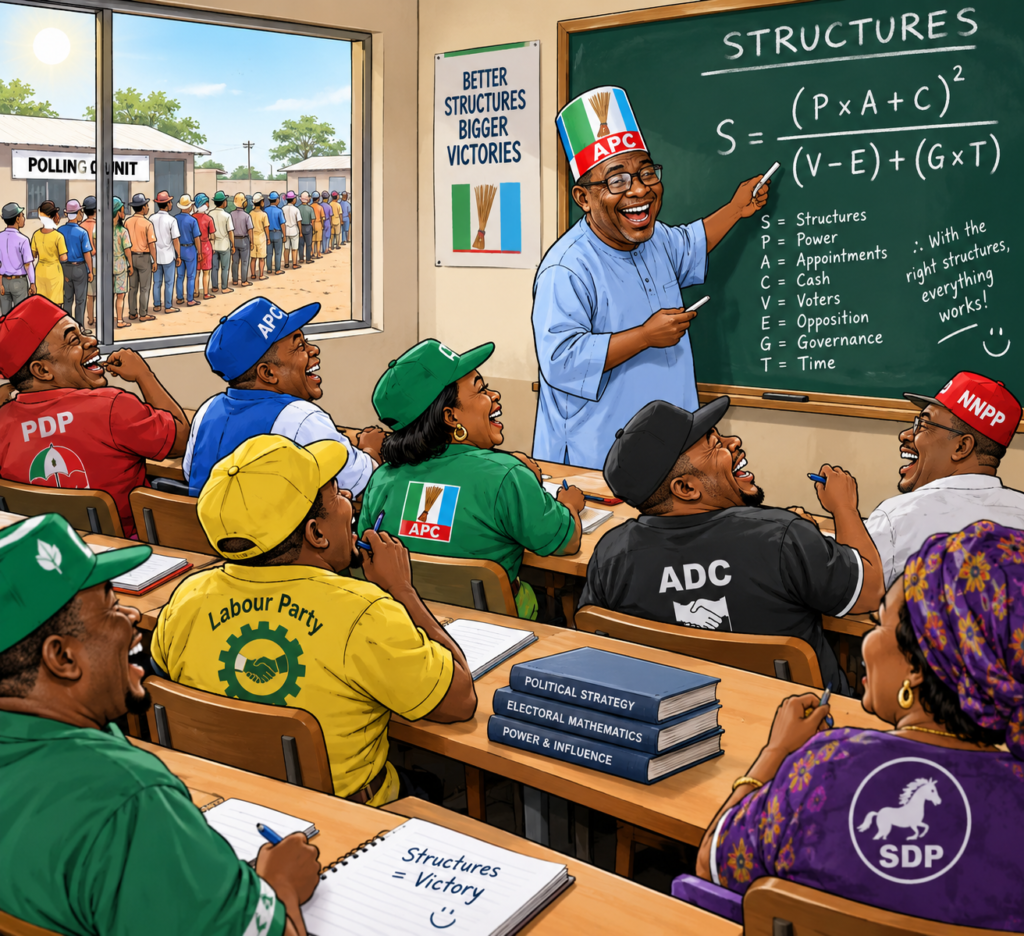
He has the magnificent Nigerian political invention known simply as “structure.”
Structure!
What a beautiful word.
It sounds so innocent and scientific.
Like “agriculture”.
Like “infrastructure”.
In Nigeria, nobody quite knows what it means until election season arrives.
Then suddenly everybody understands.
Structure is what happens when political power acquires legs, vehicles, money, uniforms, appointments, phones, agents and enough influence to make an ordinary citizen reconsider the wisdom of becoming an opposition voter.
This is the real power of structure: intimidation by sheer presence. Everyone knows that political appointees and party faithful can hardly outnumber the independent voters in the population. But while ordinary citizens rarely speak with one voice, structure can be mobilised to shout ten times louder. Its objective is simple: make so much noise that citizens begin to believe their votes do not count.
If enough people are intimidated into staying away from the polling booths, structure wins before the first ballot is cast. But if the people turn up in numbers and outnumber the party faithful, then the machinery must simply move to Plan B: results are written elsewhere and announced through proxies embedded within the electoral system, including the electoral umpire, INEC.
This is structure in all its magnificence: not merely the machinery for winning votes, but the machinery for making some votes irrelevant, and conjuring up final figures that favor those in the control room.
It is the political equivalent of having a very large family at a wedding.
You may have only one mouth.
But everybody knows you came with 47 people.
That is why a governor’s one vote can, under the logic of Nigerian political arithmetic, become millions of “votes”.
Not necessarily because millions of citizens sat down and said:
“Governor, please take my vote. You have done well.”
No.
That would be too democratic.
The more sophisticated arrangement is that everybody is encouraged to understand where the political wind is blowing.
And in Nigeria, people are remarkably good at reading weather.
Especially when the thunder comes with an appointment letter.
Or a contract.
Or a constituency project.
Or a promise.
Or a visit from a security agency.
Or a gentle reminder that government has a very long memory.
So, if 32 governors (and Abuja) are firmly aligned with the President and his party, why bother with the remaining 4?
In Calculus, that insignificant remainder is called Epsilon (E) – a number greater than zero but smaller than any real positive number. In Statistics, it is called Negligible. In an Equation, it is called a Trivial number.
If every governor can produce, say, one million votes, that is already 32 million.
And that is being on the conservative side. Some governors have pledged much more than one million. Including states where the total number of registered voters is less than half a million!
If the numbers become inconveniently large, well, this is Nigeria.
We are a nation that has never allowed arithmetic to stand between politics and optimism.
And President Tinubu, being a former governor himself, understands the importance of political arithmetic.
Eight years in Lagos teaches you something about the political arithmetic of structures that no university professor can fathom.
Years of building alliances teach you something about mega-structures.
By 2027, therefore, the strategy is beautifully simple:
Secure the governors. Secure the structures. Secure the party. Secure the election. Case closed.
The voters?
Ah, yes.
The voters.
We must not forget the voters.
They are rather important.
They are the people who are supposed to put the ink on the ballot paper.
They are also the people who have this annoying habit of asking questions.
Questions like:
“Where is the food?”
“Where is the job?”
“Why has everything become so expensive?”
“Why is my electricity still behaving like a Christmas light?”
“Why can’t my children find work?”
“Why am I paying more for transportation?”
“Why has my business collapsed?”
“Why is the government telling me the economy is improving while my kitchen is telling me something else?”
These are dangerous questions.
Especially during an election season.
Because elections are supposed to be about the future.
But Nigerian voters have a nasty tendency to remember the past.
And this is where the whole magnificent 32-governor structure encounters a small problem.
Performance.
Nobody seems to have invited Performance to the strategy meeting.
Perhaps Performance was stuck in traffic.
Perhaps Performance was waiting for a government vehicle that did not arrive.
Perhaps Performance was told to submit an application in triplicate.
But Performance remains stubbornly relevant.
Because the people do not live for free in State Houses like the governors. Or inside PowerPoint presentations.
They live in ordinary houses where they pay rent.
They buy food.
They send children to school.
They get sick.
They look for jobs.
They board buses.
They run small businesses.
They queue for fuel.
They struggle with electricity.
They worry about insecurity.
And they know exactly how much a loaf of bread costs.
You can tell a citizen that GDP has grown.
He may nod politely.
Then he will ask:
“How much is rice?”
You can tell him that inflation is moderating.
He will say:
“How much is transport?”
You can announce that foreign reserves are improving.
He will ask:
“Can I afford my child’s school fees?”
This is what economists call a communication gap.
The government says there is economic recovery.
The citizen says show me the recovery.
And therein lies the little difficulty with the grand 2027 strategy.
Political structures can organise loyalists and proxies.
They can mobilise people.
They can intimidate opponents.
They can even make people attend rallies wearing identical caps.
But there is one thing political structure cannot completely manufacture:
genuine satisfaction.
You can manufacture a rally.
You cannot manufacture enthusiasm.
You can manufacture a crowd.
You cannot manufacture hope.
You can manufacture banners.
You cannot manufacture prosperity.
And you certainly cannot manufacture the feeling inside a Nigerian mother who has just discovered that her monthly income can no longer buy what it bought last year.
This is why elections remain such troublesome things.
They involve citizens.
Citizens outnumber party faithfuls, political appointees and agents.
Citizens have memories.
Memories are made from experiences.
And experiences have a strange way of refusing party directives.
Still, let us assume for a moment that the political machinery is perfectly coordinated.
Governors are loyal.
Party structures are humming.
Campaign vehicles are everywhere.
Posters are multiplying.
Rallies are magnificent.
Delegates are smiling.
The faithful are faithful.
Then comes Election Day.
Now we have another little problem.
The audience.
Elections are no longer performed exclusively for Nigerians.
There are journalists.
There are civil society organisations.
There are domestic observers.
There are international observers.
There are opposition party agents.
There are smartphones.
There are livestreams.
There are WhatsApp groups.
There are TikTok videos.
There are citizens who have suddenly become investigative journalists because they own a phone with a reasonably good camera.
The old days when something happened in a polling unit and only three people knew about it are disappearing.
Today, something happens at 10:17 a.m. in a village somewhere and by 10:19 a.m. somebody in London has seen it.
By 10:21 a.m., somebody in Abuja has commented.
By 10:25 a.m., somebody in America has analysed it.
By noon, somebody has turned it into a meme.
Democracy has acquired CCTV.
And this brings us to the final problem.
The refugee-camp problem.
Imagine a nanny responsible for a large camp of hungry children.
Food arrives from international donors.
The nanny takes some home.
Sells some.
Distributes some to relatives and friends.
Keeps some locked up in a store.
And serves the hungry children only a few morsels each.
Eventually, the donors announce:
“We are coming to inspect the camp.”
Suddenly, there is panic.
The children must be washed.
The tents must be cleaned.
The remaining food must be rearranged.
The children must be taught what to say.
“Are you well?”
“Yes!”
“Do you have enough food?”
“Yes!”
“Are you happy?”
“Yes!”
“Do you love the nanny?”
“Yes!”
“Very much?”
“Very much!”
Everybody rehearses.
The nanny smiles.
The inspectors arrive.
The cameras come on.
The children line up.
Then one small boy, who has apparently not attended the rehearsal, raises his hand.
“Madam?”
“Yes, my child?”
“Why are we hungry?”
Silence.
That is the dangerous child.
The one who did not receive the memo.
Nigeria’s 2027 election could have its own version of that little boy.
He could be a trader.
A student.
A pensioner.
A civil servant.
A farmer.
A young graduate.
A business owner.
A parent.
He may not know anything about political structures.
He may not understand the sophisticated mathematics of governors.
He may not know which political godfather is supporting which political son.
He may not even care.
He only knows that his life has become harder.
And when somebody tells him that everything is improving, he may look around his own life and ask:
“For whom?”
That is the question no political structure can answer on behalf of a citizen.
So, yes, the APC may have an extraordinary organisational advantage going into 2027.
Yes, the President has secured significant political support among governors, and the ruling party is openly presenting that alignment as a major component of its campaign strategy.
But there is a difference between controlling political structures and controlling the political consciousness of millions of Nigerians.
The first is a matter of organisation.
The second is a matter of lived experience.
And experience is stubborn.
It does not attend party meetings.
It does not collect mobilisation allowances.
It does not wear a branded cap.
It simply sits quietly inside the voter and waits for the ballot paper.
That is why the 2027 election may be more complicated than the arithmetic of 32 governors suggests.
INEC has already fixed the presidential and National Assembly elections for 16 January 2027, with the governorship and State Assembly elections scheduled for 6 February.
Between now and then, there will be rallies.
There will be endorsements.
There will be defections.
There will be counter-defections.
There will be political marriages.
There will be political divorces.
There will be political couples who reconcile publicly after quarrelling privately.
There will be men who were yesterday described as political liabilities becoming tomorrow’s indispensable allies.
There will be promises.
There will be statistics.
There will be slogans.
There will be “structures”.
And, somewhere beneath all this noise, there will still be the Nigerian voter.
The poor voter.
The hungry voter.
The angry voter.
The hopeful voter.
The confused voter.
The politically sophisticated voter.
The politically indifferent voter.
The voter who has decided.
And the voter who has not.
They will all eventually enter that little polling booth.
Alone.
No governor will enter with them.
No commissioner.
No godfather.
No party chairman.
No political structure.
Just the voter, the ballot paper and whatever remains of his or her conscience and memory.
And that, ladies and gentlemen, is the inconvenient part of the 2027 mathematics.
The governor may have structure.
But the voter still has a thumb.
And occasionally, the thumb has ideas of its own.
**Victor Anazonwu is a public affairs analyst and writes from Lagos.
