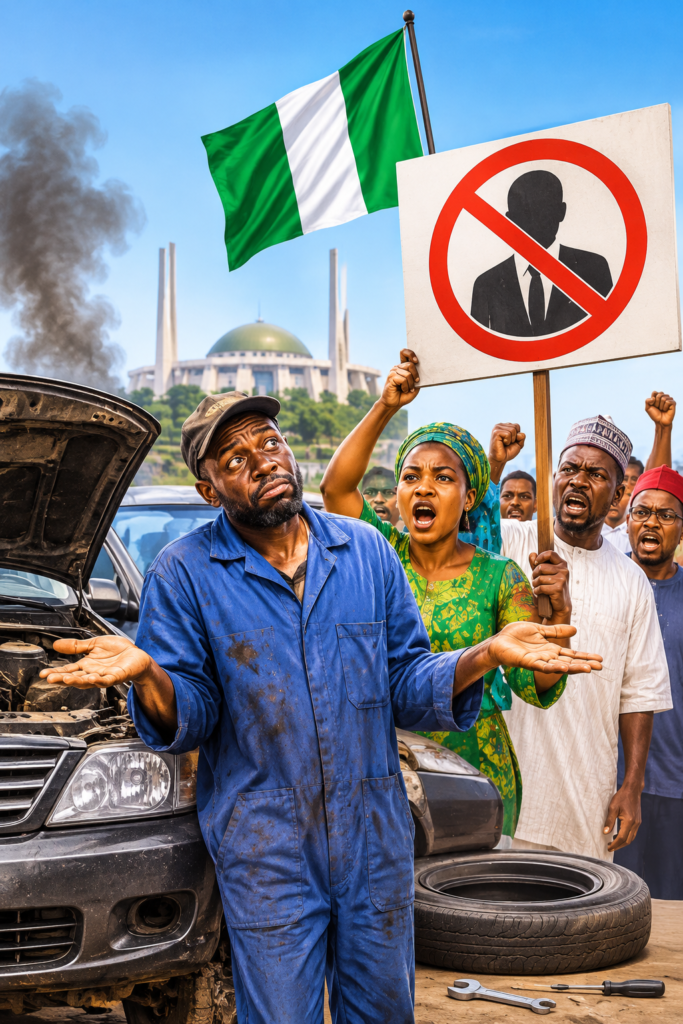
Imagine, if you will, hiring a mechanic to fix your car’s sputtering engine. Instead of a routine tune-up, he removes the tyres, dismantles the engine, sells the battery to cover his “management fees”, fills the fuel tank with refined palm kernel oil and then hands you an invoice for “total overhaul and structural reform”.
When you complain that the vehicle is now on fire and actively rolling down a ravine, his apprentices gather around to inform you that walking builds character. Besides, they insist, the only reason you are complaining is that you secretly wanted the mechanic from the neighbouring workshop to drive you to work instead.
This is where we find ourselves today in Nigeria.
After nearly four years of the Tinubu presidency, a curious myth persists among a few remaining defenders of the realm: they believe the sole reason millions of Nigerians want President Bola Ahmed Tinubu out of office is an obsessive desire to hand the keys of state to Peter Obi. They say Asiwaju should not be disgraced out of office.
They are fundamentally wrong. This isn’t about Peter Obi or Bola Tinubu. It never was just about any one man. It is much bigger than that. It is about whether the car belongs to the mechanic or to the man who hired him to fix it. It is about whether Nigeria belongs to Nigerians or to Tinubu and the APC who were hired to fix it.
That is perhaps the most important question to be resolved by the 2027 elections. Its answer will matter long after any one of us has left the stage.
Obi is merely the standby mechanic who, so far, has shown the most promise of restoring the broken vehicle of the Nigerian state to working order.
If President Tinubu manages to hold on to power, by whatever form of political alchemy, after a tenure that has redefined the bottom of the barrel, it will signal something far more catastrophic than a lost election cycle.
It will mean that Nigeria and its over two hundred million citizens have been effectively emasculated, defeated and subjugated by a handful of their own countrymen operating under the banner of the All Progressives Congress (APC).
Worse still, we will have surrendered our collective moral right to democratically remove any future leader on account of atrocious governance.
Here is the logic: if a performance this disastrous cannot earn a leader a pink slip, then what ever will? We would have effectively voted to institutionalize incompetence, canonise grand corruption and sign away our sovereignty as free citizens of a constitutional republic.
In 2015, President Goodluck Jonathan was widely considered to have failed Nigeria on one of the most important parameters of leadership: national security. Whatever the verdict on his economic record, his administration was widely perceived as weak and indecisive in confronting terrorism and securing Nigerian lives. He and his party, the PDP, were consequently voted out of office. Rightly so.
Today, Presidents Muhammadu Buhari and Bola Tinubu, both of the APC, have presided over successive administrations whose records, by most popular assessments, have fallen short of expectations in virtually every major parameter of national development: security, the economy, infrastructure, national cohesion, healthcare, education and international relations.
Yet the same political party that helped relieve Jonathan of his duties twelve years ago is asking Nigerians to renew its mandate, despite presiding over circumstances in which millions more have become poorer and less secure.
Very strange logic indeed!
Enforcing accountability by voting President Tinubu out of office in 2027 would send a memo, written in bold, indelible ink, to whoever steps into the Villa next: You are replaceable.
That memo will apply to Peter Obi and the NDC, to Atiku Abubakar and the ADC, or to anyone else who presumes to govern Nigeria. It will restore a fundamental truth of democratic governance: the office of the citizen is the highest in the land. The elected leader is an employee, not an overlord; the people are the bosses who hire, evaluate and, through the ballot, fire their political employees.
If Peter Obi, or whoever emerges from a free, fair and credible election, takes office and subsequently fails to live up to the people’s expectations, the constitutional trapdoor must open for that person just as readily. No exceptions. No excuses.
Perhaps this is also one way to compel our political parties to start identifying, attracting and recruiting competent people to stand for elections and run for public office. What we have today is a situation in which a few powerful gangs have captured our political party structures and, by extension, the Nigerian state. Consequently, neither competence nor character appears to be a serious qualification for political leadership. Those who emerge are often either the most ruthless or proxies handpicked by the most ruthless gang members.
Removing a failed administration and dismantling this flawed political arrangement are not acts of partisanship. Neither should they be matters of ethnic loyalty, group affiliation or sentimental attachment. They are acts of democratic hygiene. They constitute an urgent national assignment, an existential imperative and perhaps the most consequential opportunity to restore citizen power, self-respect and national pride.
Consider this: football clubs fire managers and terminate players’ contracts for losing key matches or failing to achieve agreed targets. Surely, countries engaged in the far more serious business of nation-building have even more compelling reasons to dismiss political leaders who consistently underperform.
Nothing else matters as much today. Because until the boss can fire the employee, the employee will continue to sell the battery and call it progress.
**Victor Anazonwu is a member of The Renaissance Online Magazine editorial board. He writes from Lagos.
