
Nigeria’s political arena is once again entering a season of strategic calculations, ideological repositioning and electoral permutations. Beneath the noise of rallies, defections, alliances and media propaganda lies a deeper reality: elections in Nigeria are no longer won merely by popularity, ethnicity or emotional enthusiasm. They are increasingly determined by arithmetic — the cold, complex and unforgiving mathematics of coalition building, regional penetration, voter retention, elite negotiation, turnout mobilisation and strategic timing.
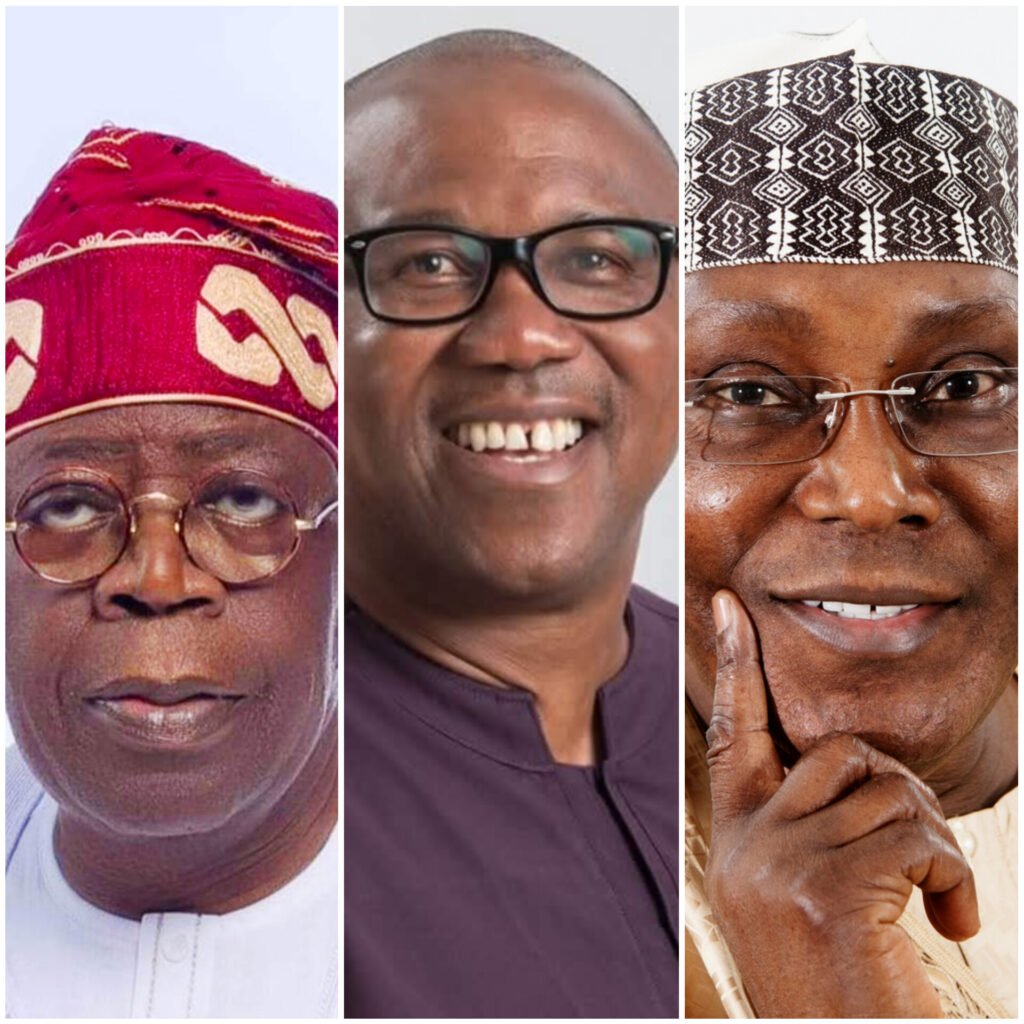
As the nation gradually moves toward another defining electoral cycle, three dominant political figures continue to shape the national conversation: President Bola Ahmed Tinubu, former Vice President Atiku Abubakar, and former Anambra State Governor Peter Obi. Each represents a distinct political tradition, voter coalition and national imagination. Each commands a different psychological constituency within the Nigerian federation. And each carries unique strengths and vulnerabilities into the coming contest.
The central question therefore is not merely who is popular, but whose arithmetic is stronger.
This is the real battlefield.
THE NIGERIAN ELECTORAL FORMULA:
To understand the likely trajectory of the coming presidential contest, one must first understand the structure of electoral victory in Nigeria.
Presidential elections in Nigeria are not determined by simple majority alone. The constitutional framework demands not only numerical superiority but also broad geographical spread. A candidate must secure the highest votes and also obtain at least 25 percent of votes in two-thirds of the states of the federation and the Federal Capital Territory.
This requirement transforms presidential politics into a national engineering exercise.
A candidate may dominate emotionally online and still lose structurally offline.
A candidate may control major urban populations and still fail due to insufficient rural penetration.
A candidate may command elite support but lack grassroots enthusiasm.
And a candidate may possess massive northern numbers yet struggle to gain southern legitimacy.
This is why political arithmetic matters more than political noise.
TINUBU: THE POWER OF STRUCTURE:
President Bola Ahmed Tinubu entered power not merely as a candidate but as the embodiment of one of the most sophisticated political structures in modern Nigerian history.
For over two decades, Tinubu invested in political infrastructure across multiple regions of Nigeria. Unlike many politicians who focus solely on elections, Tinubu focused on building networks — governors, legislators, party officials, technocrats, financiers, youth organisations, media loyalists and strategic grassroots coordinators.
This long-term investment produced what may arguably be the most resilient political machine currently operating within Nigeria.
Tinubu’s greatest strength remains structure.
Even critics of the President acknowledge that he understands political organisation better than most contemporary Nigerian politicians. His ability to negotiate power blocs, absorb opposition figures and consolidate elite consensus continues to give him a formidable advantage.
The ruling All Progressives Congress also enjoys the institutional benefits of incumbency. Control of multiple state governments, influence across national institutions and access to extensive party machinery provide Tinubu with strategic advantages that opposition figures cannot easily dismiss.
However, the Tinubu equation is not without complications.
The current economic realities facing Nigerians have created visible pressure on public perception. Inflation, subsidy removal shocks, currency instability, rising cost of living and widespread economic frustrations have weakened enthusiasm among many ordinary citizens.
The crucial question therefore becomes whether Tinubu can convert structural dominance into emotional legitimacy.
Historically, incumbents in Nigeria benefit from state power. Yet history also shows that when economic pain deepens, incumbency can transform from advantage into burden.
Tinubu’s political survival may therefore depend on three major factors:
Whether the economy stabilises before the next elections.
Whether APC retains internal unity.
Whether the opposition remains fragmented.
If opposition forces remain divided, Tinubu’s arithmetic becomes significantly stronger.
But if a broad coalition emerges against him, the contest could become dramatically competitive.
ATIKU: THE ENDURANCE OF NORTHERN NUMBERS:
Few politicians in Nigeria’s democratic history have demonstrated the persistence and durability of Atiku Abubakar.
For decades, Atiku has remained one of the most recognisable political figures in the country. He possesses deep northern penetration, longstanding political relationships and significant financial influence.
His greatest strength remains demographic arithmetic.
Northern Nigeria continues to represent the largest voting population in the federation. Any serious presidential contender must either dominate the North or substantially divide it.
Atiku understands this reality.
Over the years, he has consistently positioned himself as a bridge between northern conservatism and southern accommodation. His political brand combines establishment experience with business-oriented pragmatism.
Unlike Peter Obi’s movement-driven politics, Atiku operates through elite consensus and traditional political negotiations.
He understands delegates.
He understands governors.
He understands party bargaining.
And perhaps most importantly, he understands the mechanics of national coalition building.
Yet Atiku’s greatest challenge is no longer recognition but fatigue.
A growing segment of younger Nigerians increasingly sees him as part of the old political establishment that has dominated Nigeria for decades. Many urban youths desire generational transition rather than continuity of the old order.
This perception creates a strategic dilemma.
Atiku still commands respect, especially across large northern constituencies and among experienced political actors. But enthusiasm levels among first-time voters and younger demographics are not as naturally strong.
Another challenge facing Atiku is the fragmentation of opposition politics.
In previous cycles, anti-incumbency sentiment often concentrated behind one major opposition candidate. Today, that energy is divided across multiple camps.
This division weakens Atiku’s arithmetic.
The former Vice President therefore faces a difficult strategic task: how to consolidate northern strength while simultaneously rebuilding southern trust and attracting younger voters.
His path to victory likely depends on constructing a grand coalition powerful enough to unify dissatisfied blocs across the federation.
Without such coalition engineering, the mathematics becomes complicated.
OBI: THE POLITICS OF EMOTIONAL MOBILISATION:
Peter Obi represents perhaps the most disruptive political phenomenon Nigeria has witnessed in recent democratic history.
His rise transformed national political conversations and introduced a new energy into electoral participation, particularly among urban youths, professionals, students and sections of the middle class.
Unlike traditional politicians whose influence grows primarily through patronage systems, Obi’s strength emerged from emotional mobilisation.
The so-called “Obidient Movement” was not merely a political campaign.
It evolved into a sociological movement.
It represented frustration against old political traditions.
It symbolised generational anger.
It channelled economic anxieties.
And it created a psychological rebellion against establishment politics.
This gave Obi extraordinary visibility.
For the first time in many years, millions of politically disillusioned Nigerians felt emotionally invested in the electoral process.
Yet emotional energy and electoral victory are not always identical.
The major challenge facing Obi remains structural penetration.
Nigeria’s electoral terrain is still heavily influenced by rural mobilisation, local political networks, polling-unit management, state-level coordination and entrenched party structures.
This is where traditional parties retain advantages.
Obi’s movement demonstrated impressive urban strength, digital influence and youth enthusiasm. However, translating that enthusiasm into nationwide polling-unit dominance remains a complex challenge.
Another strategic complication is regional perception.
Despite Obi’s national messaging, many opponents continue attempting to frame his movement within narrow regional narratives. Whether fair or unfair, such perceptions influence electoral calculations in parts of northern Nigeria.
For Obi to become truly competitive in a future presidential contest, several things become essential:
Expansion beyond urban centres.
Stronger northern alliances.
Deeper grassroots infrastructure.
Conversion of movement energy into permanent political machinery.
Strategic coalition building.
If Obi succeeds in broadening his national acceptance while preserving youth enthusiasm, his arithmetic could become significantly stronger than many establishment actors currently assume.
*End of Part 1. Watch out for Part 2 tomorrow.
ABOUT THE CENTRE FOR CONTEMPORARY STUDIES (CCS)
The Centre For Contemporary Studies (CCS) is an independent policy and strategic research institution dedicated to political analysis, governance studies, national development discourse and contemporary African affairs. Through critical interventions, projections and thought leadership engagements, CCS seeks to deepen democratic understanding and contribute meaningfully to conversations shaping the future of Nigeria and Africa. It is headed by YUSUF MUSA | CEO, (08033175453)
