
Well, who saw that coming?
Not France, that’s for sure.
Rayan Cherki captured the sense of shock and despair among the France players on a day when their World Cup dream died, in a 2-0 defeat to Spain that was as emphatic as the scoreline suggests.
“It’s an immense disappointment,” Cherki said. “We lost against ourselves. We didn’t lose against the referee, we didn’t lose against Spain, we lost against ourselves. You all know that everyone was scared of us. The only team who were capable of eliminating us was ourselves. Today is terrible.”
Asked what France lacked in their performance, Cherki replied: “Everything. We were beaten technically, we were beaten tactically, we were beaten in the duels.”
It was a scathing assessment. France, the World Cup favourites, were outplayed, outfought and outthought, which is a compliment to their opponents first and foremost. Not for the first time, Spain demonstrated that their controlled brand of football — a mix of patience, precision and penetration — is too much for France.
Two years ago, Didier Deschamps’ side were beaten 2-1 by Spain in a European Championship semi-final. Last summer, Spain won 5-4 against France in the Nations League last four. This victory, on the biggest stage of all, made it three semi-final victories in a row for Spain against the same opponents and, from a France point of view, it will be the most difficult to take.
This World Cup was supposed to be France’s time. The No 1 ranked team in the tournament, the most devastating forward line in world football, and a manager ready to sign off after 14 years in charge with the greatest prize in the sport — all roads pointed to New York for Sunday’s final.
Instead, France will travel to Miami for a third-place play-off, wondering how and why everything unravelled so badly on a Tuesday afternoon in Dallas, where a team that had lit up this tournament with its exhilarating attacking play, scoring freely and appearing to be unstoppable, looked unrecognisable.
Questions will be asked about Didier Deschamps’ tactics, in particular whether it was naive of the France manager to think that playing four out-and-out-attackers — an approach that had paid rich dividends up until now — would work against a team as good with the ball as Spain.
Kylian Mbappe appeared to be pointing to other problems afterwards. “Right from the start, we were pressing three against two… and we messed up there,” he said. “Against Spain, you have to press man for man.”
What is clear is that the France attack was impotent. They recorded 0.3 xG against Luis de la Fuente’s side — France’s lowest tally in a World Cup match since Opta began analysing the competition in 1966. Remarkably, France didn’t register a shot on target until the 82nd minute, when the substitute Desire Doue tried to lob the Spain goalkeeper Unai Simon from more than 30 yards out.
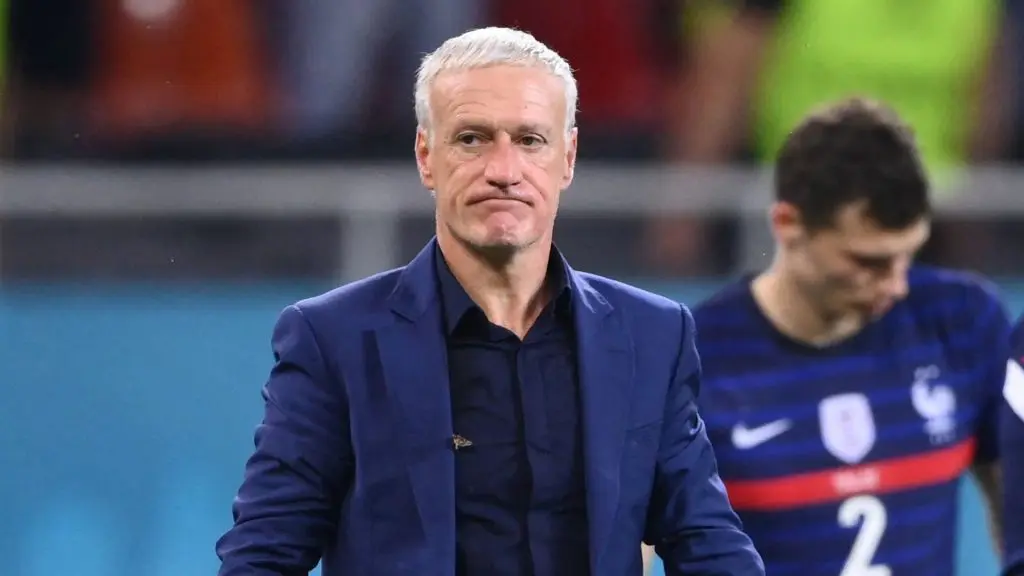
By that stage, Mbappe was wearing the expression of a man who knew that the game had slipped away. Ousmane Dembele, the 2025 Ballon d’Or winner, played one beautiful pass to Mbappe early on but was otherwise peripheral. Bradley Barcola was ineffective and withdrawn.
As for Michael Olise, the most creative player in the France team, and a footballer who has been such a joy to watch at this World Cup, he was nullified by Spain to such an extent that he was substituted with 18 minutes remaining.
Four years ago in Qatar, France found themselves in a similar situation against Argentina in the World Cup final, when they came back from 2-0 down to force extra-time. If that was a reason to give France hope against Spain, it was nowhere to be seen in their response.
Alarmingly, France got worse, not better. By the end of the game, Spain were playing keep-ball, toying with their opponents as ‘Oles’ reverberated around the stadium. It all added to France’s humiliation.
“It was a big expectation of France to win the World Cup,” Patrick Vieira, the 1998 World Cup-winner said in his role as a television pundit for UK broadcaster ITV Sport. “We are all really disappointed by the result but mostly by the performance.
“The French team didn’t turn up at all. Olise was the main man, we needed him to get on the ball but they stopped him playing.
“We needed our top players to perform and they didn’t do it. It wasn’t one or two, it was all of them collectively. It was really bad.”
Did France underestimate Spain? That seems unlikely given their past meetings.
Ultimately, France didn’t perform anywhere near their highest level, and there’s no easy answer for why that might be. Spain deserve credit, but it was still strange to see so many France players toiling.
Conceding an early goal, after Mikel Oyarzabal converted from the penalty spot, didn’t help and led to an interesting point being raised afterwards, when Cherki was asked whether France had suffered so much against Spain because it was the first time they had dealt with adversity at this World Cup.
Jules Kounde can only watch as Pedro Porro fires in Spain’s second goalMauro Pimentel/AFP via Getty Images
“It’s a very good question,” Cherki said. “There’s a bit of truth in that. Maybe when it’s too easy, we think we’re above the rabble.”
It felt as though everything that could go wrong for France did. Loose in possession and booked early on, Adrien Rabiot endured a game to forget. Withdrawn at half-time, on the back of another poor challenge just before the interval that could easily have led to a second yellow card, Rabiot was a danger to his own team.
William Saliba, playing through pain almost from the day he arrived at the World Cup and clearly a long way short of being fully fit against Spain, lasted only half an hour before collapsing to the floor and signalling that he was unable to continue.
As for Lucas Digne, some will feel that he was a little unfortunate to be punished for a foul on Lamine Yamal that led to the penalty. Others will wonder how Deschamps left Digne out there for so long against the Spain winger in a contest that felt like a total mismatch.
“The players are deflated,” Deschamps said. “We should’ve been more dangerous on the pitch and made the game more difficult for Spain.”
The France manager will depart after Saturday’s match — a decision that was made before the tournament started — with Zinedine Zidane set to take over.
The good news for France is that the majority of this gifted squad will still be around to play at the next World Cup.
The bad news is that four years is a long time to wait to put things right, as France know only too well.
*This report was culled from New York Times. Stuart James is a former professional footballer with Swindon Town, He has been writing sports ever since, including for The Guardian and The Athletic.
