There is a war in Nigeria that is not fought with guns on battlefields, though its casualties are no less numerous. It is not declared in manifestos or debated in parliament, though its unwritten protocols govern more lives than the constitution. It is a silent, intimate war, a war of all against all, and it rages in hospital wards and market stalls, in government offices and living rooms, in the hushed transactions between driver and passenger, between parent and child, between the desperate and the supposedly merciful. We have built a nation where to encounter another Nigerian is, more often than not, to encounter a predator or to become one. And until we name this pathology for what it is, every dream of national renewal will remain exactly that – a dream.
Every society has its predators. What leaves me genuinely stunned is how completely we have normalized it. We do not flinch. We do not pause. We do not even pretend to be ashamed. The nurse who sells donated medication meant for the indigent patient does so with the same casualness with which she checks a patient’s temperature. The doctor who performs unnecessary “surgeries” to inflate a medical bill discusses it over lunch as though it were a clever investment strategy.
The civil servant who demands a bribe to process a file that sits within arm’s reach treats it as a service fee for simply showing up to work. The house help who dilutes the cooking oil and pockets the difference, the commuter who pays a driver to overload a vehicle, the student who buys examination questions and the lecturer who sells them, the wife who skims from the household allowance, the husband who hides his true income, the child who invents school fees to extract from parents already broken by inflation. It is everywhere. It is everyone. And what frightens me most is that we have stopped seeing it as wrong. We have made it a way of life.
The embezzling minister makes headlines. The billionaire contractor who delivers substandard bridges earns our collective outrage. We point to the top, rightly, and demand accountability. But what we miss, what we have trained ourselves not to see, is the dense web of small betrayals beneath the headlines.
The web is us. It is the trader at Oyingbo Market who mixes sand with grain, the mechanic in Ladipo who invents faults in a perfectly sound engine, the pastor who monetizes hope by selling miracle water, the policeman at the checkpoint who turns public safety into a private toll booth. It is the fuel attendant who resets the pump before the customer looks, the pharmacy attendant who swaps prescribed drugs for cheaper counterfeits, the school principal who inflates enrollment figures to pocket government subsidies.
This is not corruption in the conventional sense. Corruption implies a deviation from a norm, a stain upon an otherwise clean fabric. What we face is something more fundamental. We face a total pattern of life in which both corruption and predation are not exceptions but the operating logic. In this pattern, every relationship is reconceived as an extraction opportunity. Every trust is a vulnerability to be exploited. Every service is a pretext for a surcharge. Every weakness in another person is a market opening. The sick do not need care; they need to be harvested. The grieving do not need comfort; they need to be billed. The hungry do not need food; they need to be overcharged. The ignorant do not need education; they need to be sold certificates. We have, in effect, nationalized the logic of the con.
Look closely at any sector and the evidence is overwhelming. In our hospitals, patients buy their own gloves and syringes while staff sell the hospital’s supplies to private clinics and pharmacies. Families abandon sick relatives at the gates of teaching hospitals to avoid paying bills. Doctors in public hospitals run private practices during official hours, leaving ward rounds to exhausted interns. Nurses demand payment before administering first aid or pain relief. In our schools, special centers flourish in every state, where invigilators look the other way while candidates copy answers sent via Bluetooth devices. Lecturers fail students deliberately to force them into buying handouts or offering other favors. Parents bribe their children’s way into secondary schools and still complain about falling standards. In our transport sector, touts (agberos) collect illegal levies from drivers who in turn overload vehicles and ignore safety checks to make up the shortfall. Police officers create checkpoints not to catch criminals but to harvest Naira notes from frustrated motorists.
Lagos commuters know the ritual of the one chance robber, the conductor who shorts change, the Uber driver who cancels the trip to charge outside the app. In our markets, measurement fraud is so common that buyers expect to receive less than they pay for. Palm oil is mixed with dye, rice is repackaged after expiration, and frozen chicken is thawed and refrozen until it poisons the poor. POS operators charge extra for withdrawals, and market associations extort traders who have already paid government levies. In our homes, gate men collude with robbers, nannies neglect children to run side businesses, drivers sell petrol from the family car, and house helps steal meat from the pot with the confidence of long practice.
Spouses maintain secret accounts while pretending to be broke, and children manufacture school projects and excursion fees to fund lifestyles their parents never approved.
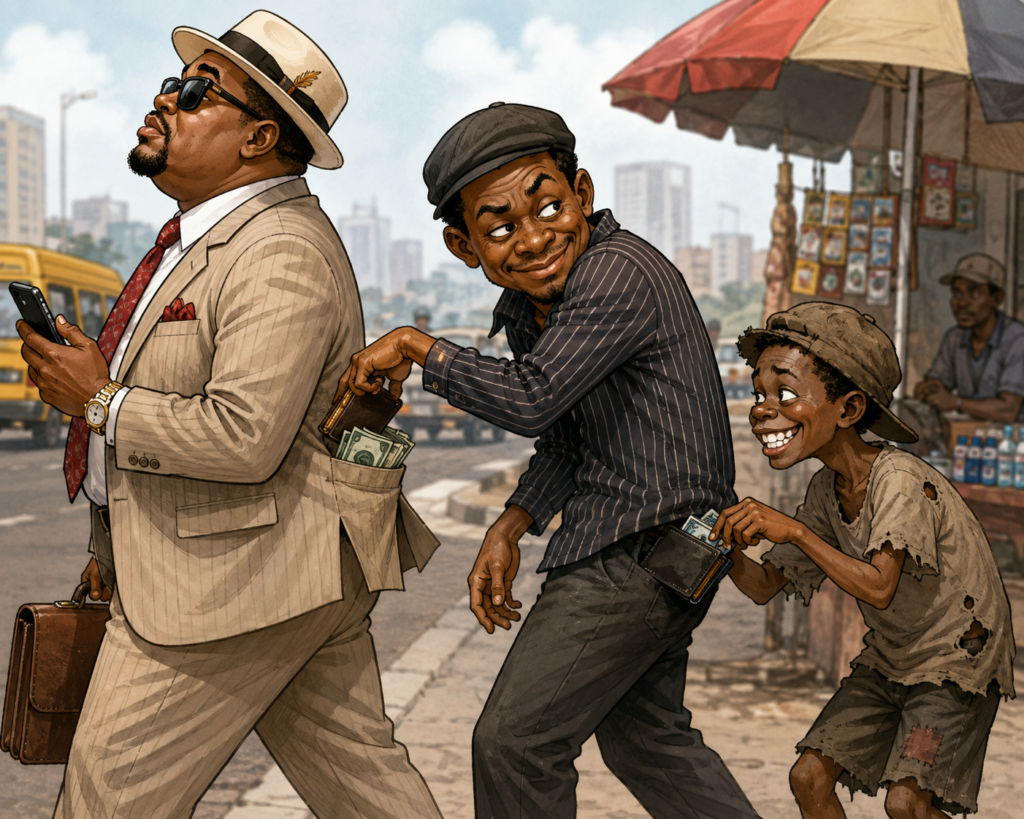
And here lies the true horror: this way of life is democratic. It does not discriminate by class or creed. The rich prey on the poor through policy and pricing. The poor prey on the rich through petty theft and domestic subterfuge. The middle-class preys on everyone through professional malpractice and intellectual dishonesty. We have achieved a perverse equality, an equal opportunity predation society, where the only variable is the scale of one’s opportunity, not the moral disposition to exploit it.
The lawyer who deliberately delays a case to drain a client’s resources is not different in kind from the roadside vendor who sells a phone charger that will fry the buyer’s device by morning. The accountant who cooks books for a multinational is kin to the landlord who collects two years’ rent for an apartment with no running water. The journalist who takes a brown envelope to kill a story about contaminated baby food shares the same moral currency as the hospital cleaner who steals a dying patient’s phone. We are all enrolled in the same economy of extraction.
What happens to a people who live this way for generations? What happens to the human capacity for empathy when every interaction is armored with suspicion? What happens to collaboration when every partner is assessed for their exploitability? What happens to social cohesion when the fundamental transaction between citizens is not mutual aid but mutual extraction? We are watching it happen.
We are watching the erosion of the very ground of our humanity, the ability to see another person as an end in themselves rather than a means to one’s own survival or enrichment. We have become a nation of brilliant tacticians in the art of the squeeze, but emotional illiterates in the grammar of care. We no longer know how to receive a stranger with open hands because we assume those hands are reaching for our pockets. We no longer trust a compliment because we assume it is a prelude to a request. We no longer believe in public service because we know it is merely private business conducted with government letterheads.
This pattern is what makes the pathology so resistant to the usual prescriptions. Electoral reform will not touch it. Anti-corruption agencies cannot reach it. Economic growth will not dissolve it. This is because the sickness lives in the interstices of everyday life, in the micro-transactions that constitute the texture of society. It lives in the shrug with which we accept that everybody is doing it. It lives in the knowing laughter with which we tell stories of outsmarting one another. It lives in the pride we take in being “sharp”, a word that once meant intelligent but now, in our context, almost exclusively denotes the capacity to exploit faster than one is exploited.
We celebrate the sharp guy. We raise our children to be sharp. We warn them not to be dull, by which we mean do not be the one who is exploited. We do not warn them not to exploit. That would be naive.
And so we must ask ourselves the hard questions that no policy paper can answer. What happened to us? What historical ruptures, what colonial deformations, what postcolonial betrayals, what economic brutalizations produced a people for whom predation feels like self-defense?
Or is it simpler than that? Is it that we have never, as a collective, undergone the moral reckoning that transforms a population of survivors into a society of citizens? A survivor takes what they can because tomorrow is uncertain. A citizen gives what they must because they trust in the reciprocity of the whole.
We have been surviving for so long that we have forgotten how to belong to one another. We have forgotten that a nation is not merely a geographic expression but a moral commitment, a daily choice to treat the other as kin rather than quarry.
The road back is not through legislation alone, though laws matter. It is not through prosperity alone, though dignity requires material security. The road back runs through the uncomfortable territory of collective confession. We must look at ourselves, not the abstract Nigerian government or Nigerian elite, but ourselves in our actual lives, and ask: Where am I the predator? Where have I normalized extraction? Where have I mistaken my cleverness for virtue? Where have I taught my children, by example, that the only safe posture in Nigeria is a predatory one? This is the interrogation that will suffice. Not the comfortable outrage directed upward, but the piercing self-examination directed inward and outward simultaneously.
We must see that the minister who steals billions and the house help who steals petty cash are not morally different; they are merely differently positioned within the same moral collapse. The collapse is the enemy. And the collapse is maintained by millions of daily choices to steal rather than to serve, to deceive rather than to disclose, to prey rather than to protect.
Nigeria will not be healed by heroes in high places. It will be healed, if at all, by the slow, unglamorous work of millions of ordinary people choosing, in their ordinary interactions, to stop the predation. It will be healed when the nurse decides the patient is a human being, not a revenue stream. When the driver decides the passenger’s safety matters more than the extra fare. When the civil servant decides a citizen’s dignity is worth more than a bribe. When the parent decides that honesty is a better inheritance than hustled wealth. When the lecturer decides that a student’s future is worth more than a few thousand naira. When the patent medicine trader decides that a child’s health is worth more than the profit from fake drugs. When we begin to see that every time we choose extraction over empathy, we are not merely being sharp. We are actively building the Nigeria we claim to lament.
The species that preys on each other is not a species for long. It collapses under the weight of its own suspicion. It devours its own future. Nigeria stands at this threshold. The question is whether we have the courage to see ourselves clearly, to name the war we are all fighting against one another, and to lay down the weapons of extraction that have become, for too many of us, extensions of our very hands.
The dream of a great Nigeria remains possible. But it begins with a choice, a million small choices, to stop preying on each other, and to remember, however faintly, what it means to belong.
Charles is a contrarian thinker writing from Lagos.
