
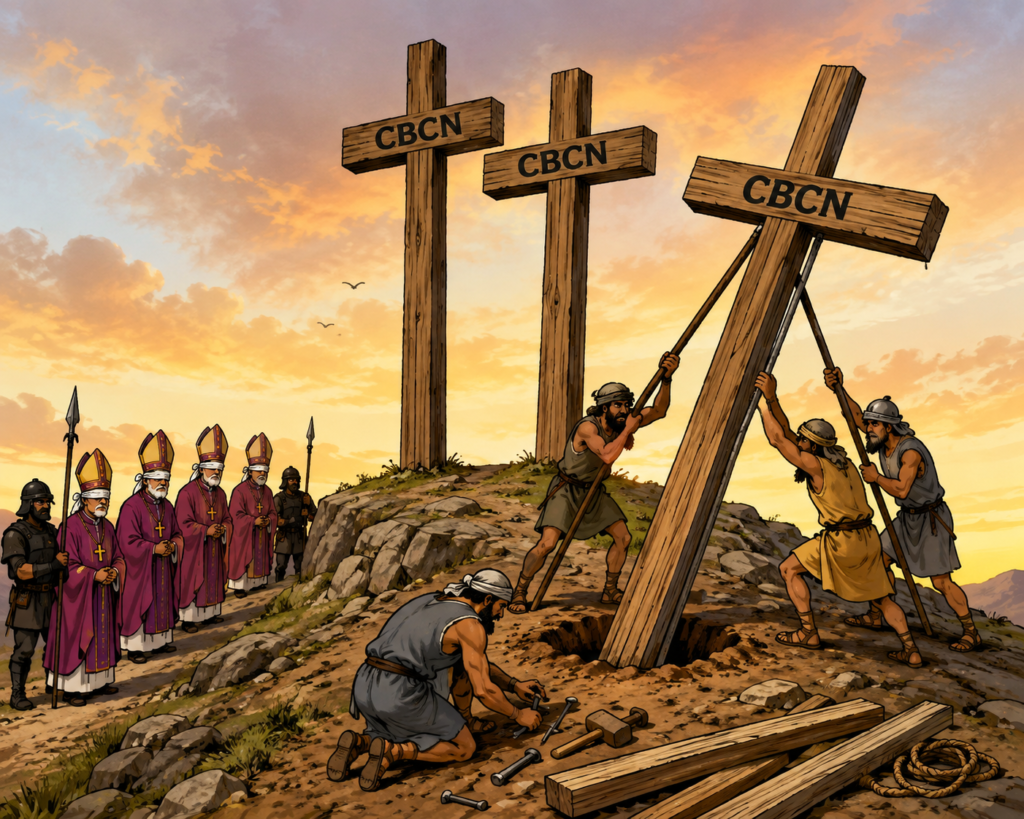
On July 28, 2026, the Catholic Bishops’ Conference of Nigeria (CBCN), led by its President, the Most Reverend Matthew Man-Oso Ndagoso, Archbishop of Kaduna, paid a courtesy visit to President Bola Ahmed Tinubu at the Presidential Villa in Abuja. It was not an unusual visit. For decades, the Catholic bishops have maintained a tradition of engaging successive governments — military and civilian alike — offering commendation where it is deserved and constructive criticism when the national interest demands it.
During the meeting, the bishops spoke candidly about the state of the nation. Their address was neither inflammatory nor partisan. Rather, it reflected the anxieties of millions of Nigerians who struggle daily with insecurity, economic hardship, and declining living standards. Their words were unmistakable: “When the security situation in the country is taken together with the deterioration and near collapse of the power sector, the sorry state of our roads, the economic hardship, one wonders how much of the renewed hope agenda flaunted by your administration is being realized. Mr. President, our nation is bleeding. The citizens are suffering and crying… They expect concrete action that engenders some change in their condition.” That statement neither insulted the President nor questioned the legitimacy of his government. It simply echoed what millions of Nigerians discuss every day — in markets, on commercial buses, in offices, classrooms, churches and homes.
A few days later, Cardinal John Onaiyekan appeared on ARISE Television and recounted the exchange with the President. According to the Cardinal, President Tinubu disagreed with the bishops’ assessment, insisting that the economy was improving and urging Nigerians to recognise the gains of his administration. Such differences of opinion are perfectly normal in every democracy. What should never be normal, however, is what followed.
Rather than respond to the substance of the bishops’ concerns, some presidential aides and political loyalists chose instead to attack Cardinal Onaiyekan personally. He was accused of abusing “clerical privilege”, dabbling in partisan politics and deliberately misrepresenting the President. Nothing could be further from the truth. The attacks on Cardinal Onaiyekan reveal less about the Cardinal than about those making them. They substitute abuse for argument, character assassination for reasoned engagement, and propaganda for honest public discourse.
Those who portray the Catholic Bishops’ Conference of Nigeria (CBCN) as an opposition platform either suffer from historical amnesia or have chosen to ignore the country’s political history. Long before Bola Ahmed Tinubu became President, the CBCN had earned a reputation as one of Nigeria’s most respected moral voices. Its interventions have never depended on the political party in power. They have depended on whether justice, human dignity and the common good were being protected. That consistency, not political convenience, is what gives the bishops moral authority today.
Cardinal John Onaiyekan did not suddenly discover his prophetic voice after Tinubu assumed office. His public record spans over four decades. As Bishop of Ilorin in the early 1980s, he joined the CBCN in condemning electoral malpractice, political violence and the erosion of democratic values during the Second Republic. Under General Muhammadu Buhari’s military regime, the bishops criticised detention without trial and restrictions on press freedom while insisting that even the fight against corruption must respect due process.
When General Ibrahim Babangida annulled the June 12, 1993 presidential election won by Chief M. K.O. Abiola, a Muslim, the CBCN condemned the annulment as a betrayal of democracy and rejected policies that imposed disproportionate hardship on ordinary Nigerians. The bishops challenged the Interim National Government under Ernest Shonekan, condemned the human rights abuses committed by General Sani Abacha, demanded the restoration of democratic rule, and consistently advocated for the release of Chief M. K.O. Abiola.
During General Abdulsalami Abubakar’s transition programme, they insisted on credible elections. Under President Olusegun Obasanjo, Cardinal Onaiyekan became one of the leading moral voices against the unconstitutional Third Term Agenda, while also criticising flawed elections, corruption and the crisis in the Niger Delta.
The bishops welcomed President Umaru Musa Yar’Adua’s admission that the 2007 elections were flawed but continued to press for electoral reforms and decisive action against poverty and insecurity.
They challenged President Goodluck Jonathan over Boko Haram, the Chibok schoolgirls’ abduction and corruption while applauding his statesmanship in conceding defeat after the 2015 election. Throughout President Muhammadu Buhari’s civilian administration, Cardinal Onaiyekan remained outspoken against worsening insecurity, herders’ violence, nepotism and weaknesses in the electoral process, even while acknowledging policies he considered beneficial.
Today, under President Tinubu, the message remains the same. The faces have changed. The principles have not. To accuse Cardinal Onaiyekan of partisanship is therefore to ignore four decades of consistent moral witness.
Curiously, many critics have ignored the portions of the bishops’ address where they praised President Tinubu. They commended the Nigerian Education Loan Fund (NELFUND) initiative for expanding access to higher education. They congratulated the administration on the successful rescue of kidnapped schoolchildren in Oyo State and acknowledged improvements in certain security operations. That is hardly the language of political opponents. It is the language of patriots. Responsible citizens commend what deserves commendation and criticise what demands correction. Constructive criticism is not hostility. It is citizenship.
Some have accused Cardinal Onaiyekan of venturing into politics. That argument betrays a profound misunderstanding of both the Church and democracy. The Church does not exist merely to celebrate Mass or administer the sacraments. From the Old Testament prophets to contemporary Catholic social teaching, defending justice, protecting human dignity and promoting the common good have always formed part of its mission. Nathan confronted King David. Elijah challenged King Ahab. John the Baptist rebuked Herod. Throughout history, courageous church leaders —from St. Óscar Romero in El Salvador to Archbishop Desmond Tutu in South Africa — have reminded rulers that political authority is accountable not only to history but also to God. The Catholic Bishops’ Conference of Nigeria stands firmly within that prophetic tradition.
Those who accuse Cardinal Onaiyekan of entering politics should also remember that he speaks with the same moral voice that resonates from the Vatican. Since his election, Pope Leo XIV has consistently appealed to world leaders to place human dignity above political calculations. During the recent escalation involving Iran and the continuing war in Gaza, he repeatedly called for restraint, dialogue and an immediate ceasefire. He lamented the enormous humanitarian suffering of innocent civilians and warned that military escalation would only deepen instability and multiply human misery. The Holy Father has not calibrated his moral interventions according to whether they would please or offend powerful governments. Whether speaking about Israel and Palestine, the United States, Iran, Ukraine or other global conflicts, his concern has remained constant: the sanctity of human life, justice and lasting peace. That is precisely what the Catholic Church has always done.
When governments adopt policies that produce unnecessary suffering or when political decisions undermine justice, peace and human dignity, the Church believes it has not merely the right but the moral obligation to speak. Silence, in such circumstances, would amount to moral failure. It is therefore neither extraordinary nor partisan that the Catholic Bishops’ Conference reminded President Tinubu that millions of Nigerians continue to endure severe economic hardship. Nor was it improper for Cardinal Onaiyekan to recount, truthfully and respectfully, the substance of that conversation.
There is, however, an irony that should not be overlooked. Many of those who applaud Pope Leo XIV for courageously challenging powerful nations over Gaza, Palestine, Iran, and the humanitarian consequences of war are among those condemning Cardinal Onaiyekan for speaking about hunger, insecurity, and poverty in Nigeria. Conversely, some who dismiss the Pope as interfering in politics are now accusing the Nigerian bishops of doing exactly what the universal Church has always done. Such selective outrage is not principled. It is political. One cannot celebrate the Church’s prophetic voice when it speaks in Rome and then seek to silence it when it speaks in Abuja. The message is the same. Only the geography has changed.
Ironically, President Tinubu himself built much of his democratic credibility by challenging military dictatorship and opposing authoritarian rule. A democrat, more than anyone else, should welcome dissent. Strong democracies are not weakened by criticism. They are strengthened by it. Governments should worry less about critical voices and more about the conditions that produce them. The CBCN did not create inflation. It did not manufacture unemployment. It did not collapse Nigerians’ purchasing power. It merely articulated realities already being experienced across the country. Silencing bishops will not reduce food prices or the price of a liter of fuel. Vilifying Cardinal Onaiyekan will not improve electricity supply. Attacking the Church will not make highways safer. Facts remain stubborn things.
There is something profoundly troubling about a government that chooses to attack the messenger instead of confronting the message. If presidential aides genuinely believe that the bishops exaggerated Nigeria’s economic condition, they have every democratic right to disagree. But disagreement should be supported with facts, not insults. Demonstrate, with evidence, how household purchasing power has improved. Explain when the sacrifices Nigerians are making will translate into measurable improvements in their daily lives. Engage the argument. Do not malign the messenger. Character assassination is not governance. It is an admission that one has run out of persuasive arguments.
History teaches us that nations rarely decline because courageous people spoke uncomfortable truths. They decline because leaders surround themselves with people who tell them only what they wish to hear. Every successful administration needs critics as much as it needs loyalists. The loyalist applauds achievements. The patriot identifies blind spots. The wise leader listens to both. The Catholic Bishops’ Conference of Nigeria has earned the moral authority to speak because it has consistently defended principles rather than political parties. Cardinal John Onaiyekan has challenged governments led by Shagari, Buhari (military), Babangida, Shonekan, Abacha, Abdulsalami, Obasanjo, Yar’Adua, Jonathan, Buhari (civilian) and now Tinubu. That is not partisanship. That is consistency.
If Pope Leo XIV can respectfully challenge the actions of powerful governments regarding Gaza, Palestine, and Iran, and the humanitarian consequences of war, without anyone questioning his spiritual vocation, why should Cardinal John Onaiyekan or the Catholic Bishops’ Conference of Nigeria be vilified for speaking about hunger, insecurity, and economic hardship in their own country?
The Church’s prophetic voice does not stop at national borders, nor does it fall silent at the gates of Aso Rock. Those attempting to crucify the CBCN and Cardinal Onaiyekan on the altar of lies should remember that history is almost always kinder to those who speak truth to power than to those who seek to silence them. Nigeria needs fewer attack dogs and more honest conversations. The bishops have started one. The government should have the courage to join it.
**Dr. Onyima is a veteran journalist and lecturer in media studies.
