Some of humanity’s greatest breakthroughs did not emerge from grand designs, but from simple observations. In 1928, Alexander Fleming returned to his laboratory from a vacation to find that a stray mold—Penicillium notatum—had contaminated a petri dish that was accidentally left open. The mold was killing surrounding bacteria. From that accident came penicillin, a discovery that has since revolutionized medical practice and saved millions of lives.
Nigeria’s electoral system today resembles an infected culture—riddled with malpractice, resistant to reform, and spreading cynicism across the body politic. Yet, like penicillin, the cure may not lie in another complex reform package or expensive technological fix. It may lie in something far simpler, older, and deeply rooted in our social fabric: oath-taking.
We are an intensely religious and, in many respects, deeply superstitious society. For generations, oaths have been used to establish innocence, enforce truth, and regulate behavior. Despite the veneer of modernity, and the effects of new world religions, these beliefs remain potent.
Most Nigerians either know or believe that if they solemnly swear by God, Allah, Ogun, Sango, Amadioha or any of their dreaded ancestral deities, the oath will stick. Whether by supernatural action, by subconscious manifestation, or both, this belief is real. It helped keep some of our precolonial societies sane and almost crime-free. Fear of divine or metaphysical consequences often succeeds where laws, institutions, and enforcement mechanisms fail.
So why not deploy this cultural reality against electoral malpractice?
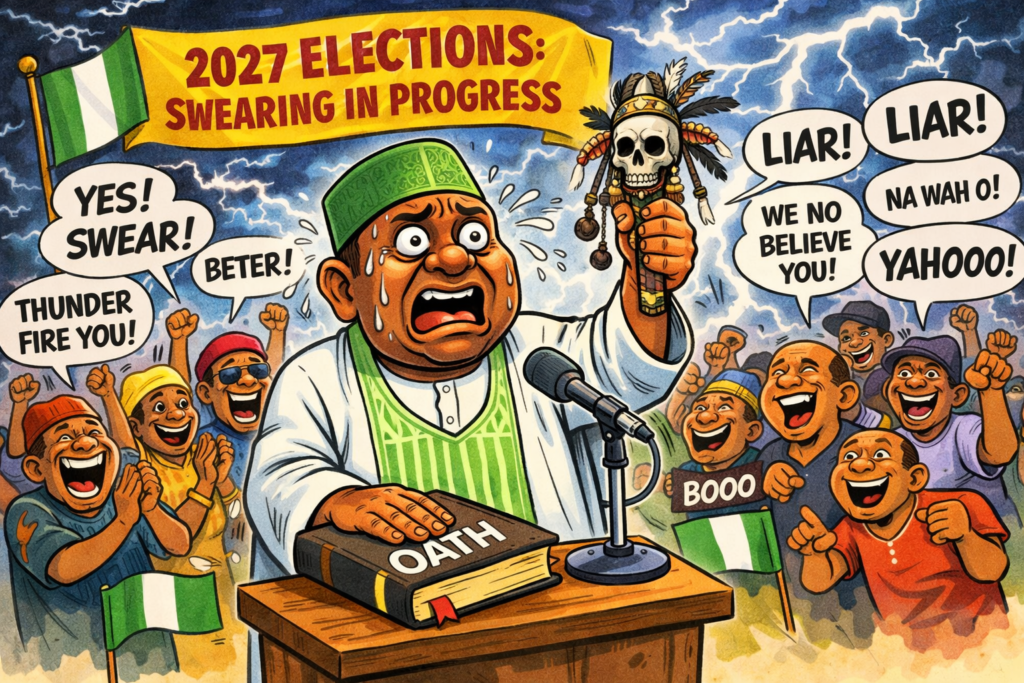
Imagine a legal requirement that every individual involved in the electoral process—candidates, party leaders and agents, officials of the Independent National Electoral Commission (INEC), security personnel, and even members of election tribunals—must publicly swear a binding oath. Not a ceremonial formality, but a solemn invocation of consequences: that any act of fraud, manipulation, suppression, or concealment will attract catastrophic repercussions upon themselves and, crucially, upon their families.
This would not be a vague pledge to “uphold the law” or a harmless civil oath of office. It would explicitly cover the full spectrum of electoral misconduct: voter intimidation, voter suppression, uneven distribution of voting materials, vote-buying, falsification of results, tampering with sensitive documents or equipment, selective enforcement of rules, and judicial compromise during election petition proceedings. It would also cover the now rampant practice of using moles and agents to destabilize opposition political parties in order to eliminate viable candidates from the ballot.
The oaths would be administered publicly, individually, and on record—televised, archived, and impossible to deny. The words would be ironclad. The invoked consequences dire.
There would be no option to abstain for candidates in elections or anyone involved in election-related duties, however remotely.
When potential electoral offenders find that neither they nor their beloved ones stand to reap any earthly benefits from their crimes, they will most likely stay away or do the right thing. When they realize that calamities lie in wait and future misfortunes may be blamed on their roles in subverting elections, they will probably refrain.
Critics may scoff. But consider the likely impact.
INEC would recruit only ad hoc staff willing to take such an oath. Compromised officials embedded within the electoral system could quietly withdraw. Political operatives accustomed to manipulating outcomes might suddenly discover a crisis of courage. Even ambitious candidates could reconsider their participation if victory required crossing a line they had publicly sworn never to cross—or face retribution.
In short, the system would begin to cleanse itself—not through enforcement, but through conscience and spiritual malware.
Call it social engineering, call it psychological deterrence, or call it cultural realism. Whichever way you look at it, it would cost virtually nothing and could succeed where billions of naira in electoral reforms have failed.
Nigeria’s electoral history is, at best, troubled. With the notable exception of the 1993 presidential election—widely believed to have been won by MKO Abiola against Bashir Tofa—few national elections since independence have commanded broad public trust. Even the only exception was ultimately annulled by the same forces of evil.
Each cycle brings familiar allegations: rigging, intimidation, judicial controversy, and outcomes that leave a bitter aftertaste.
Election petitions routinely climb the judicial ladder, often ending at the Supreme Court. Yet even apex judicial pronouncements rarely restore public confidence. Increasingly, the courts themselves are viewed not as arbiters, but as enablers of fraud, temples of injustice and participants in the crisis.
This is what makes the idea of an oath so compelling. It bypasses weak institutions and speaks directly to personal belief systems—where consequences are immediate, intimate, and inescapable.
Of course, the ultimate obstacle is political will. Those who benefit most from electoral malpractice are precisely those who would be required to authorize such a reform. It is difficult to imagine them embracing a mechanism that could dismantle the very system that sustains them.
And so, the question remains: will Nigeria’s political class permit a simple, homegrown solution to disrupt a complex, deeply entrenched problem? Almost certainly not. If we needed any proof of that, the recent attitude of the National Assembly, the Presidency and the electoral umpire towards the mandatory electronic transmission of voting results in the 2026 Electoral Reform Act says everything.
That is where the will and resolve of the Nigerian people as the ultimate owners of sovereignty comes to play. They could insist, for instance, that if the clause (for mandatory oath taking) is not included in a fresh emergency amendment of the Electoral Act, then the current government at state and federal levels should not bother to hold any elections at all in 2027. Instead, they should consider their governments dissolved by May 29, 2027, and all Executive Heads of Government should prepare to hand over to the most senior military officers in their areas of jurisdiction.
Penicillin did not eliminate disease overnight, but it changed the trajectory of modern medicine. Perhaps an oath—properly designed and courageously implemented—could do the same for Nigeria’s democracy.
Victor Anazonwu writes from Lagos.
