
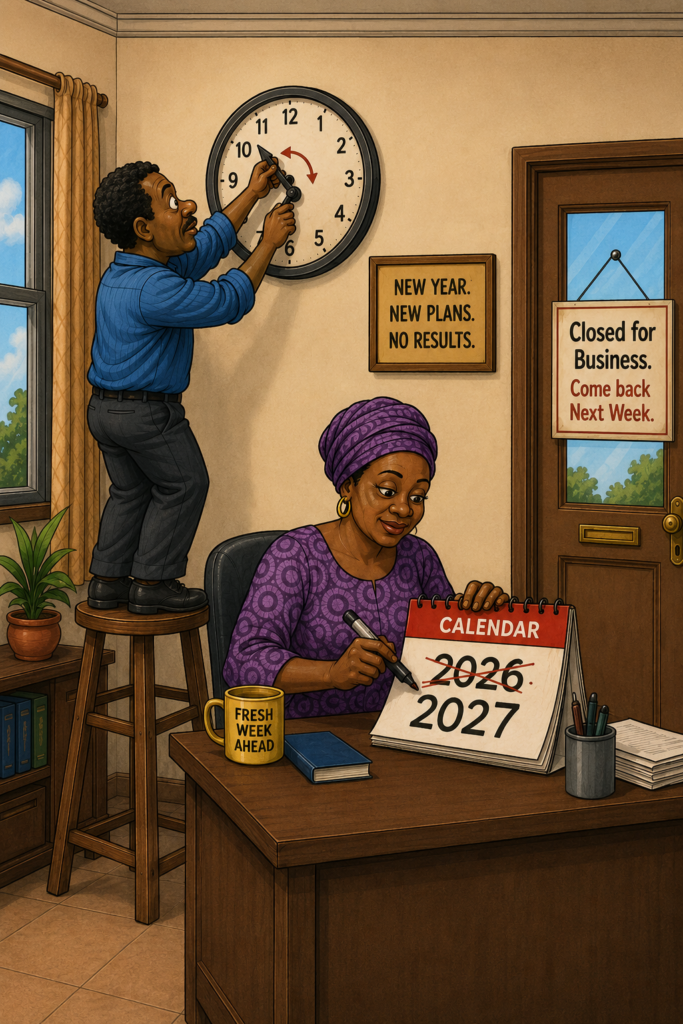
There is a bridge in a town I will not name, because the town does not matter. What matters is the sign. It went up when the bridge project began, a modest board announcing completion within eighteen months, and it is still standing today, faded to the colour of old bone, twenty-three years later.
Three governors have posed beside that sign for photographs. Two contractors have been paid to finish it. A boy was born the year the sign went up, learned to walk beside its rusting posts, crossed the unfinished bridge every morning to reach a school with no roof, grew into a man who now sends his own son across the same broken planks. Some mornings, he stops for a moment and reads the sign as though it might have changed overnight, as though eighteen months were a promise still quietly working itself out somewhere behind the scenes.
It has not changed. It is simply the oldest sign in town that everyone has agreed to stop noticing.
This is not a story about a bridge. It is a story about what a country does to time.
Every nation lies to itself a little. But most nations lie about the past, softening old wounds, flattering old leaders, forgiving old failures with the passage of years. Nigeria has perfected a rarer and more corrosive form of self-deception. It lies about the future. It tells itself, with genuine sincerity, that the unfinished thing is almost finished, that the reform is almost arriving, that the season of suffering is almost over, that the eighteen months are almost up, and it has been telling itself this for so long that an entire generation has been born, educated, married and buried inside the word almost.
I do not think Nigeria is dying. I think Nigeria is waiting, and I think it has now waited long enough that waiting itself has become a kind of citizenship, a shared discipline practised by market women and permanent secretaries alike, by the trader recharging a battery with a generator he never wanted to own and the graduate refreshing a visa portal at two in the morning. We have built, without ever convening a single conference to design it, the most sophisticated culture of patience the modern world has produced. We should be terrified of how good we have become at it.
A country does not require a coup to lose itself. It only requires enough of its people to decide, quietly and separately, that the future is something to be arranged elsewhere.
The bridge, in the end, will probably be finished. Something will finish it: an election, a loan, a scandal that finally becomes too visible to leave standing. But the finished bridge will not return the years it took. It will not return the boy’s flooded school shoes, or the trader’s ruined stock, or the ordinary decades a whole town spent commuting across a promise. Completion, when it eventually arrives in a country built on postponement, rarely feels like victory. It feels like a debt quietly settled, long after everyone had stopped expecting it to be collected, and long after the true cost had already been paid in other, uncounted ways.
That is the country I want to examine here. Not the one in the speeches. The one on the bridge.
There is a particular kind of exhaustion that settles over a country once its citizens have stopped expecting drama. Nigeria does not produce sudden collapse. It produces something far more difficult to narrate: a slow, competent, almost administrative postponement of consequence.
Every crisis arrives on schedule, is managed just enough to avoid catastrophe, and is then quietly filed away for the next generation to inherit in a slightly worse form. This is not failure in the dramatic sense. It is failure organised as routine.
I want to propose a different instrument for reading Nigeria, one that does not ask whether the country is hopeful or hopeless, rising or sinking, blessed or cursed. Those questions have already consumed six decades of national conversation and produced almost nothing except fatigue.
The more useful question is mathematical rather than emotional: what is the country’s relationship with its own consequences, and what happens to a system that has learned, with extraordinary sophistication, to postpone them indefinitely.
Call it the postponement economy. It is the invisible operating system beneath the visible one. Budgets are postponed into supplementary budgets. Reforms are postponed into committees. Committees are postponed into white papers. White papers are postponed into the next administration. Elections resolve nothing because the incentives that produced the last government remain intact for the next one. Subsidies are removed and quietly reintroduced through other channels. Debts are refinanced rather than resolved. Infrastructure is commissioned rather than completed. Even grief is postponed, because outrage over one disaster is displaced by the next before accountability can catch up with either.
A country can run on postponement for a remarkably long time. That is the uncomfortable truth this essay wants to sit with. Postponement is not the same as collapse. It can coexist with growth figures, with new banks, with new airports, with a thriving entertainment industry, with billionaires and unicorns and international recognition.
A postponement economy does not look poor. It looks busy. It looks, from a certain angle, like progress. What it lacks is not activity but resolution. Problems are managed forever. They are rarely closed.
This is where I part company with both the optimists and the pessimists. The optimist looks at the busyness and calls it momentum. The pessimist looks at the unresolved problems and calls it doom. Both are describing the same country accurately and drawing the wrong conclusion, because neither is asking the only question that matters for a system built on deferral: who is paying for the delay, and how long before the bill arrives in a form nobody can postpone any further?
Every deferred consequence accumulates interest. This is the part our national conversation consistently underprices. The road not repaired this year does not remain the same problem next year. It becomes a more expensive problem, carried by a weaker economy, inherited by a more cynical population, financed by a currency worth less than it was, and administered by institutions with less remaining credibility than they had the year before.
Postponement is never free. It is simply invoiced later, and usually to someone who did not sign the original bill. A retired public servant did not create the pension shortfall waiting for the next cohort. A newly graduated engineer did not design the currency regime that will govern the value of his first salary. A teenager sitting an examination today did not build the educational system grading her against a curriculum reformed on paper twenty times and reformed in practice almost never. The invoice always finds someone who never ordered the meal.
I raised, some time ago, the distinction between resilience and adaptation to failure, and I want to sharpen that distinction here rather than repeat it. Resilience, properly understood, is what a system does after a shock: it absorbs the impact and returns to function, ideally a more intelligent function than before. What Nigeria has instead perfected is something closer to permanent accommodation.
The generator is not a response to a blackout. It is a parallel electricity policy, privately financed, publicly unacknowledged, and now so embedded in commercial and domestic life that its removal would be treated as an emergency rather than an improvement. The borehole is not a response to a water crisis. It is the actual water policy. Private security is not a response to a lapse in policing. It is the policing system, stratified by what each household or business can afford. None of these arrangements were designed. They accumulated, household by household, business by business, until an entire shadow state of privately financed public goods came into existence beside the official one, better funded in places, more responsive in others, and completely unaccountable to anyone but the person who pays for it.
This shadow state deserves far more attention than it receives, because it quietly resolves a puzzle that confuses many observers of Nigeria: how a country with such visibly weak public institutions continues to function at all. The answer is that the public institutions were never actually required to function, because millions of citizens, at considerable private cost, built substitutes. The tragedy is not that these substitutes exist. Ingenuity under constraint deserves respect rather than mockery. The tragedy is that the existence of the substitutes has removed the single most powerful source of pressure that normally forces a state to reform itself, which is the unbearable discomfort of its citizens.
A government that faces no organised, sustained, structurally painful consequence for institutional failure has very little internal reason to correct it. This is not a claim about the moral character of any particular administration. It is a claim about incentive design, and incentive design is a far more reliable predictor of behaviour than intention, character, or promise.
Wherever the cost of dysfunction is absorbed privately rather than confronted publicly, dysfunction becomes durable, because the people with the least power to fix a broken system are the ones paying to route around it, while the people with the most power to fix it experience almost none of the discomfort that would otherwise compel them to.
This produces what I will call the exemption gradient. At the top of Nigerian society, near total exemption from the consequences of institutional failure: private jets bypass collapsing airports, foreign hospitals bypass a starved health system, offshore accounts bypass currency volatility, foreign education bypasses a curriculum in permanent crisis, and diplomatic and elite networks bypass a judiciary that ordinary citizens cannot afford to test. At the bottom, near total exposure: no alternative electricity, no alternative healthcare, no alternative currency, no alternative school, no alternative court. The gradient in between determines almost everything about how urgently a Nigerian family experiences the failure of the state.
This is why reform conversations conducted primarily among people positioned near the top of that gradient tend to produce eloquent diagnoses and modest prescriptions. The diagnosis is accurate. The urgency is borrowed rather than lived.
I want to be precise here, because this argument is frequently misread as a claim about corruption, and it is not, or at least it is not only that.
Corruption is one mechanism among several, and an excessive national fixation on corruption as the singular explanation has, paradoxically, protected the more durable structural mechanisms from scrutiny. A country can reduce corruption meaningfully and still retain incentive structures that reward extraction over production, connection over competence, and proximity to power over distance from it and independence within it.
Corruption is a symptom of a deeper condition, which is that too many of the country’s most consequential rewards are distributed through channels that have nothing to do with what is produced, built, taught, cured, grown, or manufactured. Where reward is disconnected from production for long enough, a population eventually redirects its ambition toward reward rather than production, because ambition, like water, moves toward the lowest resistance. This is not a moral failing of Nigerians. It is a rational adjustment to an incentive climate, and it would appear in almost any population subjected to the same conditions for the same duration.
None of this, I should say clearly, is an argument for despair, and readers who arrive at that conclusion have misunderstood the intention of a diagnostic exercise. Diagnosis is not sentencing. A doctor who names a disease accurately has not condemned the patient. What a diagnosis does, properly conducted, is remove the comfortable ambiguity that allows a condition to be mismanaged indefinitely under the cover of hope. Nigeria has had no shortage of hope. What it has lacked is the specific, unglamorous discipline of naming its actual condition without flinching, and then building the treatment around the disease rather than around the mood of the room in which the diagnosis is delivered.
This brings me to the second half of what I believe Nigeria requires, which is a realignment not of policy alone but of the mental models through which policy is imagined, evaluated, and defended. A mental model is simply the set of assumptions a mind uses to decide what is normal, what is possible, and what is worth attempting.
Nigeria’s dominant mental models were formed under conditions that mostly no longer exist, yet they continue to shape decisions as though those conditions were still present.
The assumption that oil revenue can absorb policy error indefinitely was formed in a world without energy transition pressure and without the current scale of population growth against a shrinking base of formal employment. The assumption that migration functions as a pressure valve rather than a structural haemorrhage was formed when the number of departing citizens was a trickle rather than a demographic event with measurable consequences for succession planning inside hospitals, universities, engineering firms, and public institutions. The assumption that informal accommodation is a temporary bridge to eventual formal reform was formed decades ago, and the bridge has now been standing long enough to be mistaken for the destination.
Mental models are more stubborn than policies because they operate beneath conscious deliberation. A country can change a policy in a single legislative session and take a generation to change the assumption that made the old policy seem sensible in the first place. This is why so many Nigerian reforms produce disappointing results despite technically sound design. The policy changes. The underlying model of what is normal, tolerable, and inevitable does not, and the old model quietly reasserts itself through implementation, enforcement, and the countless small discretionary choices made by officials who were never asked to update their assumptions along with the paperwork.
If diagnosis is the first task, realignment is the second, and it must proceed on several fronts simultaneously rather than sequentially, because a country of Nigeria’s scale and complexity does not correct itself one variable at a time while holding the others still.
The exemption gradient must be narrowed, not through appeals to elite conscience, which have a long and largely unsuccessful history, but through the deliberate redesign of consequence so that decision makers experience a meaningfully greater share of the outcomes their decisions produce.
Reward must be reconnected to production across the sectors where it has drifted furthest from it, which requires confronting the networks that currently benefit from the drift, an undertaking that is considerably more difficult than issuing a policy document and considerably more necessary than most policy documents acknowledge.
The shadow state of privately financed public goods must be studied honestly rather than treated as an embarrassing footnote, because it already contains an enormous amount of functioning capacity, discipline, and organisational knowledge that a more deliberate national strategy could integrate rather than compete against. And the mental models themselves, the assumptions about what Nigeria can absorb, postpone, or outsource indefinitely, must be subjected to the same rigorous, undefensive interrogation that any inherited belief deserves once the conditions that produced it have changed.
None of this is comfortable, and comfort was never the purpose of this essay. But I would rather offer Nigeria a difficult and accurate account of its own condition than another reassuring one that leaves the underlying machinery untouched. The country is not approaching a cliff in the way that dramatic language sometimes suggests. It is walking, with remarkable stamina, along a gently descending path so long that each individual step feels level.
Stamina of that kind deserves recognition. It should not be mistaken for direction. A people capable of surviving almost anything should ask, with the same seriousness they bring to surviving, exactly what kind of country their survival is quietly making possible for those who come after them. That question, and not another round of optimism or despair, is where the real work of a different Nigeria must begin.
*Charles Ugwu is a contrarian thinker writing from Lagos
