
It started a long while ago – an innocuous past that gave no hint, no presage, of the far-off present it would one day become.
The patchy, windy surrounds of our post-civil-war compound held no foreboding of the difficulties that lay just ahead. As a hapless five-year-old newly emerged from the thirty-month siege on Biafra – that sad, savage encounter which claimed close to three million lives on both sides – every reflex in the environment around me, well-intentioned or otherwise, touched the very nadir of my being.
I could intuit, from my parents’ countenance and from the adults around them, that the future was forbidden territory, bleak and unspoken. The jubilant backslapping and the cry of “Happy Survival” that rent the air – with which our people greeted one another in those early days – sounded hollow to my young ears. A cruel joke, dressed as celebration.
For my family, it was time to take stock – after the severe bombing and strafing in which Southerners, mostly of Eastern extraction, had been fair game to be hunted and destroyed. No fewer than twenty male adults, drawn from both my paternal and maternal families – members of a cherished and promising consanguineal lineage – had perished in the war. God! By any measure, the casualty visited upon both sides of my family was disproportionate and beyond reckoning.
The most touching loss was that of Dee David – my mother’s brother, who, before the hostilities began, had built a thriving career with the Nigerian Tobacco Company in Zaria. He owed his education to the “Onye aghala nwanne ya” philosophy – a communal ethic of brotherhood that looked out for the welfare of others, prevalent among the Igbo of his era.
When the pogrom began in the North, Dee David fled south to what he believed was safety in Biafra, only to be promptly drafted into Ojukwu’s Win-the-War army. When it later emerged that he had died – not from enemy fire, but from the loathsome conspiracy of a colleague – I watched my dear mother relapse into bouts of emotional depression that left her disconsolate for a long while afterward.
The occupying forces seized our ancestral homes for a time and, as if on cue to extract maximum revenge from a decapitated Biafra, descended upon our village, ravaging every native flora and fauna in sight. Livestock, yam barns, and maize farms were plundered without ceremony. Teenage girls, for fear of violation and abduction, fled deep into the bushes. I recall that at midnight, my older female cousins would hide in the rafters of the family house, which by then brimmed with war returnees and refugees. Such was the despoliation of those times.
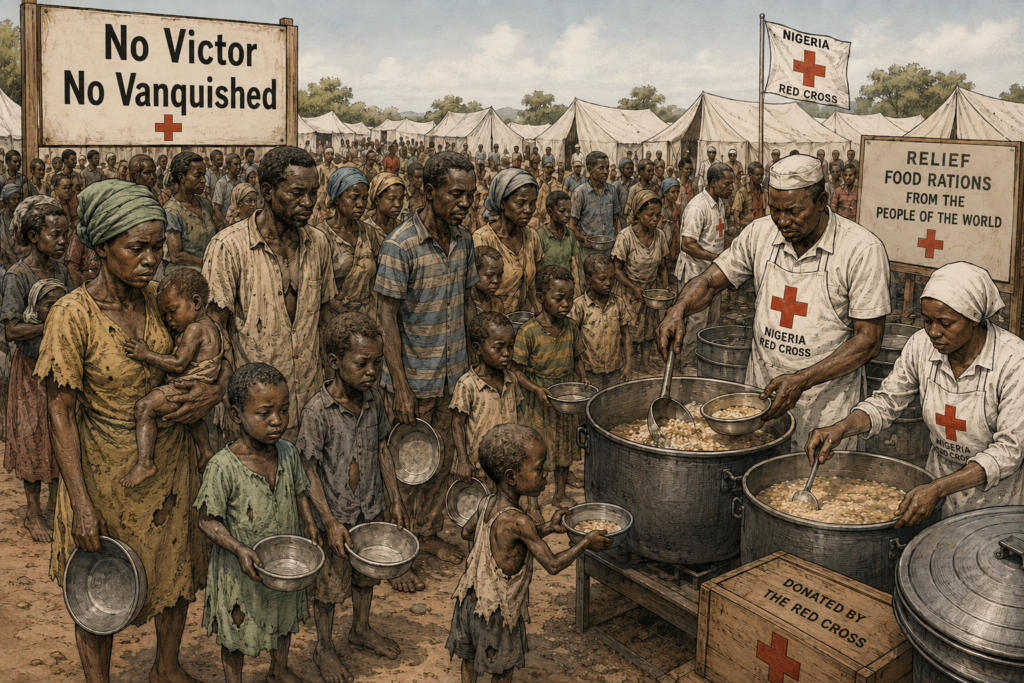
Nkwerre, in my neck of the woods, abutted a makeshift barrack for the victorious Nigerian Army. Red Cross officials and soldiers would periodically distribute relief materials – used clothing and blankets, tinned food, milk, oats, rice and beans, and other sundry items. Ravenous officials must have helped themselves generously from those supplies, and there was never enough to go round. Which meant that brawn and grit decided who ate and who went hungry. Knuckles and elbows flew freely, and, as ever, children and the elderly held the shorter end of the stick.
For the first time – perhaps in conscious memory – I tasted milk. I must have relished it, because to this day I recall, with startling clarity, spoonfuls of powdered milk being shovelled into my young mouth by one of the female Red Cross officials. I stood transfixed, transfigured by the sheer effusiveness of my gratitude. She must have caught the doleful expression on my young face – or perhaps my silent, imprecations to be pushed to the front of the line. She beckoned, and I shyly sidled up to her.
“What’s your name?” she asked.
“Oge,” I stammered.
She smiled – the kind of smile, I would only understand many years later, that relief workers learn to wear as armour against everything they have seen. “Oge,” she repeated, testing the sound of it, as though committing it to memory. She scooped another spoonful and held it out. I do not remember her face today, not with any precision – only the whiteness of her uniform against the ash-grey of that barrack yard, and the astonishing sweetness of that milk, thick and foreign on my tongue, in a world that had, until then, offered me nothing but scarcity.
Many years later, I came to work in a Milk company and had my fill of the commodity.
I did not know, standing there, that I was being fed by the same hand – the same uneasy alliance of foreign charity and victor’s obligation – that had watched, often from a careful distance, while my uncles were being buried in shallow, unmarked graves. I did not know that “relief” and “reckoning” could arrive in the same convoy, wearing the same armband. I only knew that I was hungry, and that for a moment, someone had noticed.
That, I think now, is the strange inheritance of a war child: gratitude and grief learn to live in the same room, on the same afternoon, in the same small body.
I remember the milk more vividly than I remember Dee David’s face – I was too young to have kept that – and there is a particular guilt in admitting this, even now, decades later. But perhaps that is precisely what survival asks of a five-year-old. Not comprehension. Not mourning, not yet. Only the instinct to reach for whatever kindness is offered, and to hold on.
I have carried my hometown with me ever since – its ravaged farms, its hidden cousins, its barrack-yard queues – the way one carries a birthmark: unchosen, permanent, and eventually, almost unnoticed, until someone asks about it and the whole story comes rushing back.
My mother’s disconsolate months. The hollow “Happy Survival” that greeted a village which had, in truth, survived very little intact. The uncles who did not come home, and the one who did – David – only in the telling and retelling of how he was betrayed rather than fallen.
I was five. I did not choose any of it – not the war, not the hunger, not the milk, not even the name I stammered out to a stranger in a Red Cross uniform. And yet all of it chose me, shaped the boy who would carry these fragments into every room he later entered.
This, then, is where my memory truly begins – not with comfort, but with its scarcity, and with the small, undeserved mercy of a spoonful of milk that I have spent a lifetime, in one way or another, trying to taste again.
Today, I drink coffee with milk every single morning. That is my revenge!
**Ken Ihedioha writes from Lagos
