Politics has always been, at its core, a retail business — and like every retail business, it lives or dies on distribution.
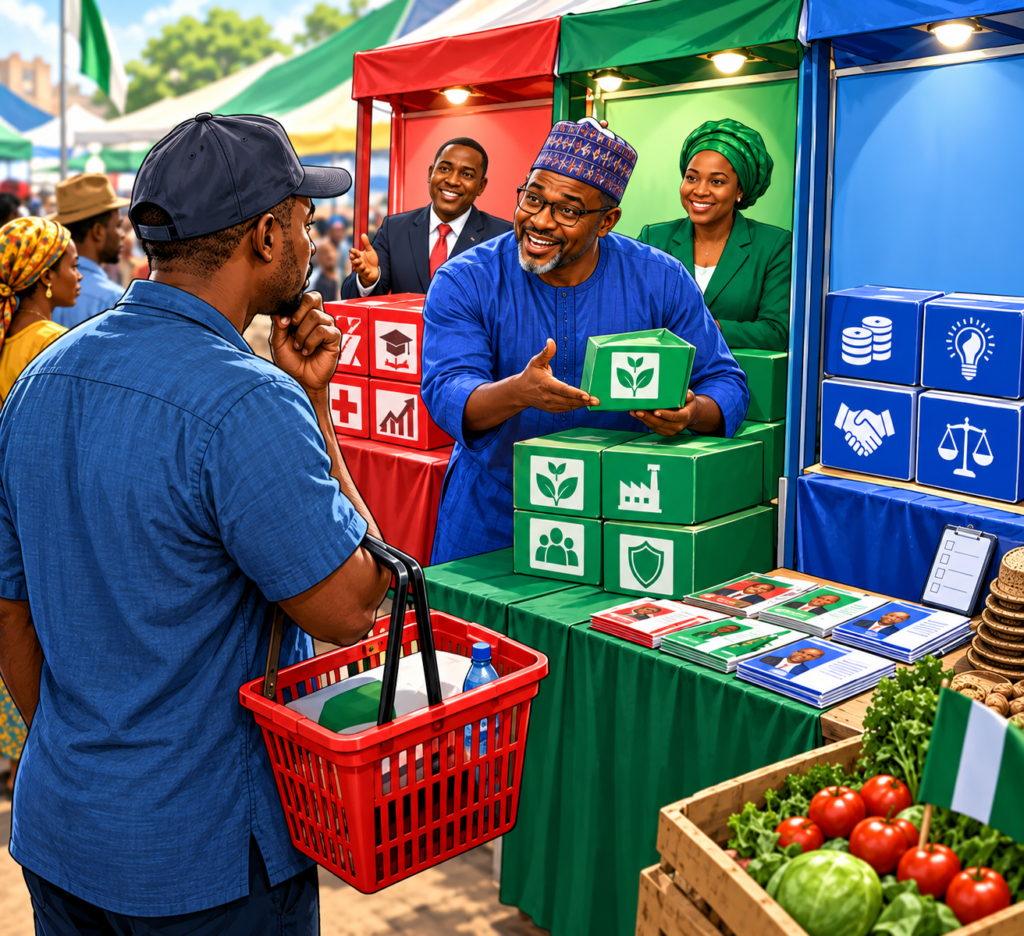
The successful politician traditionally understood the value of showing up: the market, the village square, the town hall, the motor park. Politics was built on proximity — meeting people, listening to them, and letting them feel that the person asking for their vote was one of them. That is, in essence, brand-building
through direct experience.
Technology hasn’t ended that logic. It has simply rewritten the distribution channel. Door-to-door is increasingly becoming phone-to-phone.
The Original Case Study in Owned-to-Earned Media.
Barack Obama’s 2008 campaign remains one of the most instructive marketing case studies nearly two decades later. It proved the internet could be more than paid broadcasting — it could convert an owned audience into an earned-media engine,
turning ordinary supporters into organisers, fundraisers, and advocates.
YouTube bypassed the traditional gatekeepers of television and print, while online networks converted enthusiasm into real mobilisation at a scale no paid
media buy could match.
The lesson was never simply that Obama used YouTube. It was that he used technology to convert an audience into a distribution network. In marketing terms: he stopped renting attention and started building brand advocates.
The Citizen as a Distribution Channel.
Traditional political communication followed the classic paid-media funnel:
politician issues message, press gatekeeps it, voter receives it downstream.
Social media collapsed that funnel entirely. The new model runs through supporters, networks, and communities — each one capable of amplifying, reshaping, or killing the original message.
A smartphone turns an ordinary citizen into a content creator, publisher, and distributor, simultaneously. A thirty-second clip recorded in a Lagos market
can be shared into a hundred WhatsApp groups and debated nationwide before the day ends. A student becomes a broadcaster. A trader becomes a commentator. The campaign no long “owns” every channel its message travels through — the audience has become the channel.
This is, in marketing terms, the earned-media dividend: message velocity you can’t buy, only earn.
Why Advocacy Outperforms Reach.
Retail politics was never really about crowd size. It was about conversion through connection. A politician who spends an honest hour with twenty people may out-convert a television advert seen by two hundred thousand — because those twenty become an unpaid word-of-mouth channel, and word-of-mouth still converts
better than any paid impression.
Digital tools simply multiply that effect at scale. One physical touch point becomes thousands of digital ones; the candidate no longer needs to be everywhere physically for his message to travel everywhere.
That’s the upside of earned distribution. The downside is equally real: the same network that spreads an authentic message spreads misinformation at identical velocity.
Democratized distribution doesn’t reduce the need for verification and brand-safety discipline — it raises the stakes on both.
There’s a sharper marketing lesson buried here too: people don’t share everything they consume. They share what’s interesting, useful, emotionally resonant, or identity-confirming.
The job is no longer simply to produce content — it’s to produce content with built-in shareability, the same discipline consumer brands apply when engineering broadcast ads or word-of-mouth.
A company can spend millions on advertising, but a single customer referral converts on the strength of lived experience no paid placement can replicate.
Political messaging works identically: citizen-to-citizen advocacy outperforms centrally bought reach, every time.
From Hierarchical Funnel to Networked Ecosystem
The old campaign machine mirrored a traditional distribution hierarchy — headquarters to state coordinators to local organisers to voters. The digital campaign behaves more like a modern platform ecosystem: information moves horizontally, supporters become micro-influencers, and local voices translate national messaging into regional dialects of meaning.
A message launched in Abuja gets reinterpreted in Kano, Aba, or Maiduguri, then redistributed through
networks the original campaign never touched or controlled.
The campaign is no longer a pyramid; it’s an ecosystem. And no brand — political or commercial — can assume that owning the official message means owning the conversation. The centre broadcasts. The network interprets, remixes, and redistributes.
The Nigerian Market Opportunity
For Nigeria, this is a genuine market opportunity as much as a political one. Hundreds of millions of mobile connections, paired with a fiercely entrepreneurial population, are the exact ingredients for a decentralised
distribution economy. Nigerian campaigns are moving past rallies and billboards into WhatsApp groups, TikTok feeds, and podcasts — the same channels where consumer brands are already fighting for attention.
The new political entrepreneur isn’t necessarily the one with the biggest campaign office — it’s the one who understands community-building as a growth channel. This doesn’t retire traditional ground organisation; it simply means physical structure and digital distribution now must be run as one integrated channel strategy, not two competing budgets.
The Real Lesson, in Marketing Terms
Obama’s real innovation, translated into brand language, was this: don’t just build an audience — build a community with a stake in your success. That principle now applies well beyond politics.
The customer has become a broadcaster. The employee has become a brand ambassador. The smartphone has become a media house. The marketplace has become one continuous, unmoderated conversation.
The old KPI was simple: how many people attended the rally? The metrics that matter now look far more like a modern marketing dashboard: How many engaged? How many shared? How many created their own version of the message? How many converted that engagement into action?
That’s the shift — from door-to-door to phone-to-phone, from reach to advocacy,
from broadcasting to community-building. The technology changed. The underlying principle of persuasion did not.
Politics, like marketing, remains the art of persuading people. The only real difference now is speed: the person you persuade today can become the person
persuading a thousand others before the week is out.
*Ken Ihedioha, a media and sales veteran, writes from Lagos.
