
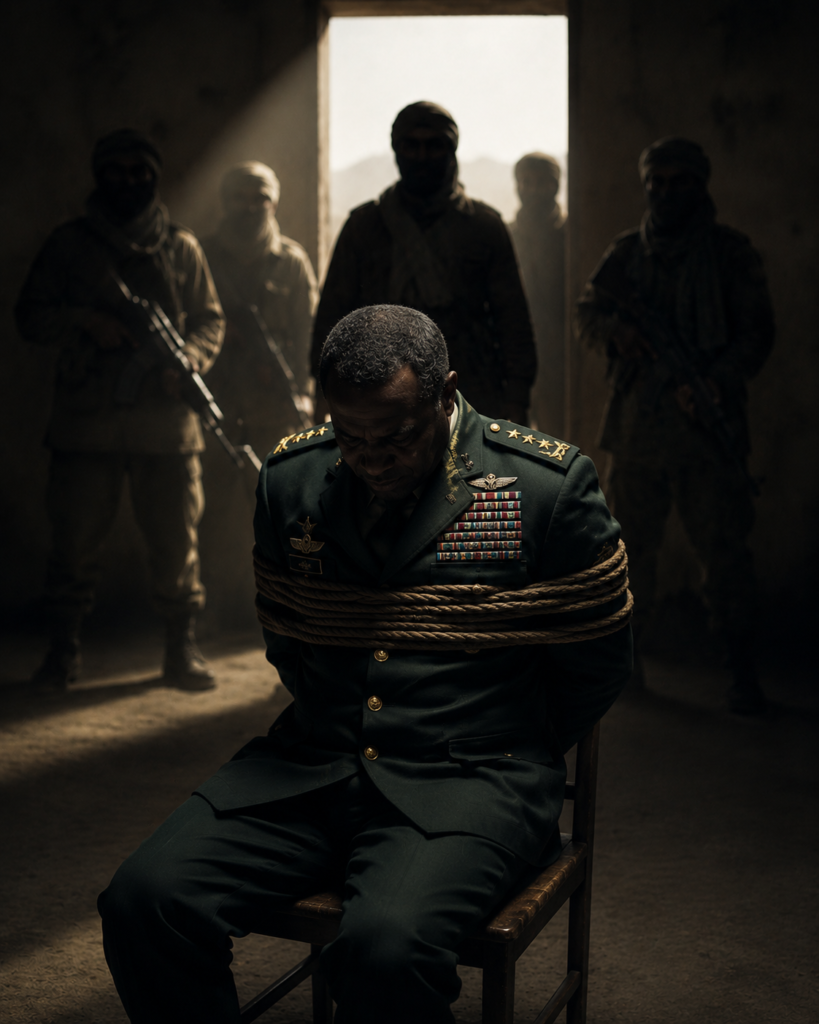
There are tragedies that wound a nation. There are scandals that embarrass a government. And then there are events so symbolic, so devastating in what they reveal, that they transcend the fate of the individuals involved and become mirrors in which an entire country sees its own reflection.
The abduction and death of retired Major General Rabe Abubakar belongs to that last category.
In one of history’s cruelest ironies, the former Director of Defence Information and official spokesman of Nigeria’s Armed Forces between 2015 and 2017 ultimately became a casualty not merely of banditry, but of the very institutional paralysis he once defended and represented. He became its sacrificial lamb.
For three decades, General Rabe wore the uniform. He spoke for the military. He articulated its positions, defended its operations, and projected its authority. Yet when his own moment of mortal peril arrived, the institution whose voice he had amplified appeared to fall silent. No one spoke for him.
Abducted alongside his wife and driver and held for two weeks in the forests of Katsina State, Rabe became the subject of demands that would have sounded absurd had they not been so consequential. His captors allegedly sought the release of three detained associates and the return of livestock seized during security operations. The state refused. The military refused. Negotiation was unacceptable. Concession was impossible.
Both sides stood their grounds.
The hostage died. He expired slowly under the gaze of his own wife.
One is tempted to admire such firmness until one remembers that firmness is only admirable when backed by power. Refusing to negotiate with criminals is a sign of strength only when the state possesses the ability and determination to crush, defeat, punish or annihilate them. Otherwise, it becomes something else entirely: the stubborn indignity of helplessness.
General Rabe died waiting for a rescue that never came.
No dramatic operation materialized. No overwhelming force descended upon the kidnappers. No visible effort reassured Nigerians that the state would move heaven and earth to recover one of its own.
The army he had served did not save him.
The institution for which he had spoken found no words powerful enough to alter his fate.
One can only imagine the thoughts that accompanied those final days of captivity. Here was a man who knew the machinery of Nigerian power from the inside. He understood its structures, its capabilities, its limitations and perhaps its illusions. If disappointment visited him before death, it must have been profound.
Yet the greater tragedy lies not in the death of the retired general, but in what that death symbolized.
It represented a startling inversion of authority.
For generations, the modern state has been defined by one essential characteristic: its monopoly over the legitimate use of force. Citizens surrender certain freedoms because the state promises security in return. Governments collect taxes, enact laws and maintain armies precisely because they claim exclusive authority over violence and coercion.
What happens when armed groups operating from forests begin exercising powers once reserved for governments sitting in fortresses?
What happens when they determine who may travel, who may farm, who may sleep peacefully, who may live and who may die?
What happens when they can abduct a retired major general and hold him for weeks without fear or consequence?
The answers are deeply uncomfortable.
The death of General Rabe suggested that the contest between the Nigerian state and the criminal forces challenging it may have entered a new phase. Not necessarily one in which the state has been defeated, but certainly one in which its supremacy can no longer be assumed.
The symbolism is devastating.
If a retired major general can be kidnapped, then nobody is beyond reach.
If a former military spokesman can disappear into the forests, then no title offers immunity.
If one of the military’s own can perish in captivity, then ordinary citizens are cannon fodder. They are entitled to ask a simple and painful question: what chance do the rest of us have?
Professional militaries around the world understand the psychological dimensions of conflict.
Wars are fought with weapons, but they are won in minds.
This is why armies routinely expend extraordinary resources to recover captured or missing personnel. They understand that abandoning one’s own carries costs far beyond the individual involved. It damages morale. It emboldens adversaries. It weakens institutional prestige. It sends a message that some lives are expendable.
Even history’s most powerful militaries have repeatedly accepted significant risks to rescue isolated personnel because they recognise a timeless truth: every soldier must believe that his nation will not forget him.
The opposite belief is corrosive.
It spreads quietly through barracks and battlefields.
It whispers dangerous questions.
Would they come for me?
Would anyone care?
Would my sacrifice matter?
An army that cannot answer those questions convincingly eventually pays a price.
Yet even more disturbing than General Rabe’s death were the reports surrounding the recovery of his remains.
According to accounts that circulated widely, his body was reportedly deposited near a sawmill and discovered by villagers. Authorities were informed. An ambulance was dispatched.
Then came the details that sounded less like the conduct of a sovereign state and more like scenes from a dark political satire.
The kidnappers allegedly dictated conditions for the evacuation.
Where the ambulance would stop.
Where it would turn.
Who was permitted within the vicinity.
How the process would proceed.
The military complied.
Thereafter, the abductors reportedly arrived on motorcycles carrying the body, completed the handover and returned to their stronghold without interference or consequence.
If accurate, the symbolism could scarcely be more devastating.
The kidnappers were no longer merely criminals.
They called the shots.
They were stage managers.
The military was no longer directing events.
It was receiving instructions.
The handover became less an act of recovery than a public demonstration of authority.
Not legal authority.
Not constitutional authority.
Practical authority.
The kind that matters most in moments of crisis.
The kind measured not by rank insignia or official statements but by who gives orders and who obeys them.
Perhaps this is why the episode resonates so deeply across Nigeria.
Citizens instinctively understand symbols.
They recognise when a balance of power shifts.
They know when an institution appears diminished.
And they know humiliation when they see it.
General Rabe Abubakar found himself at the centre of one of the most painful symbols of Nigeria’s contemporary security crisis. In death, he became an unwilling witness to a spectacle larger than himself; to the humiliation of the institution he served all his adult life.
A retired general held by bandits.
A nation watching helplessly.
An army unable—or unwilling—to alter the script.
And finally, a body returned under conditions reportedly dictated by those who had taken his life.
The humiliation was not his.
It belonged to the institutions that failed him.
And to the country itself.
For the true measure of a state is not how loudly it proclaims its strength, but whether that strength is visible when tested.
In the forests of Katsina, Nigeria was tested.
The result has left many citizens struggling to decide whether what they witnessed was a tragedy, a warning, or an epitaph.
