
There is something deeply mysterious about public love.
It refuses to obey logic.
It ignores certificates.
It does not always bow before money, power, pedigree or propaganda.
And that, perhaps, is why so many powerful people fear it.
For a long time, while observing Nigerian politics, I used to think envy was a uniquely Nigerian epidemic — a stubborn tropical disease spread through microphones, political appointments and WhatsApp broadcasts.
But then it struck me:
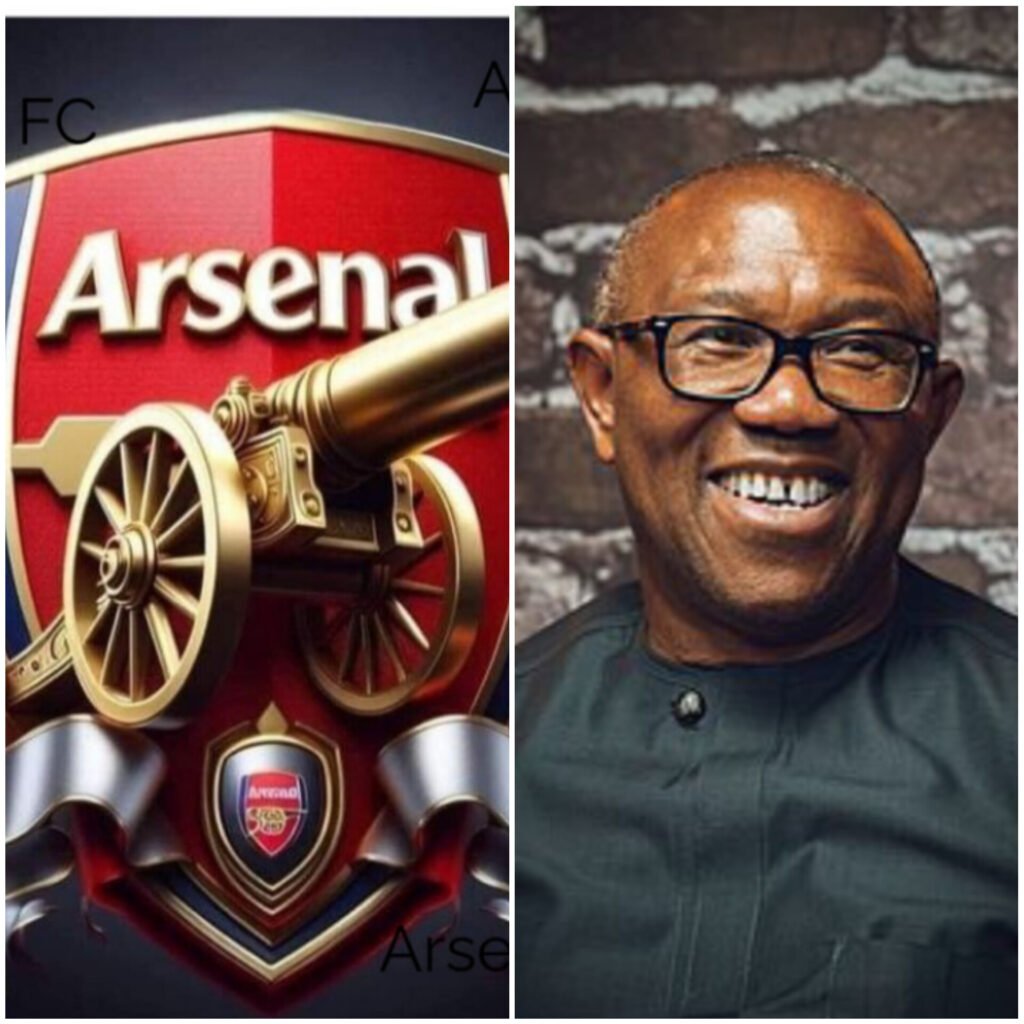
Arsenal F.C. is to the Premier League what Peter Obi is to Nigerian politics.
Pause and think about it.
One has not lifted the league trophy in many years.
The other has never occupied Aso Rock.
Yet both command astonishing affection across cities, continents and demographics.
And this drives their rivals absolutely mad.
You can almost hear the frustration:
“How can people love these fellows this much when they have not ‘won’ anything?”
That is the real irritation.
Not failure.
Not incompetence.
Not lack of achievement.
Love.
Pure, stubborn, irrational public affection.
It is a kind of emotional democracy that elites cannot control.
The old political and football establishments understand trophies, structures, patronage, godfatherism, sponsorship deals, backroom calculations and strategic manipulation. Those are familiar currencies.
But admiration without permission?
Loyalty that survives disappointment?
Hope that refuses to die after repeated setbacks?
That is dangerous.
Very dangerous.
Because once ordinary people discover that they can emotionally invest in an outsider, the monopoly of prestige begins to crack.
And so the establishment reacts the only way it knows how:
By forming an emergency alliance of bitterness. Haters United.
Suddenly, sworn enemies become brothers-in-arms.
Television analysts, online propagandists, rival supporters, political attack dogs, rented intellectuals and professional pessimists gather like village elders confronting a stubborn masquerade.
Their mission is simple:
“Anything but them.”
If Arsenal draws a match, it becomes a national celebration among rival fans.
If Peter Obi sneezes, entire media departments develop pneumonia.
Every misplaced pass becomes proof of eternal failure.
Every supporter becomes a cultist or secessionist.
Every hopeful moment must be mocked before it inspires dangerous optimism.
The hatred becomes almost spiritual.
One begins to suspect that somewhere, in a dimly lit room, there exists an International Association of People Threatened by Popularity.
Their motto:
“We may disagree on everything else, but these people must never win.”
And why?
Because if the “beloved outsiders” eventually triumph, it would amount to a humiliating social verdict on the old order.
It would mean that ordinary citizens and ordinary fans were right to believe.
It would mean that expensive gatekeepers are not invincible.
It would mean that prestige can be defeated by popularity.
It would mean that carefully cultivated empires of influence can collapse before passion and hope.
That possibility terrifies the establishment more than failure itself.
After all, envy is rarely provoked by weakness.
Nobody envies a man they truly consider irrelevant.
Envy is the tax paid on perceived future greatness.
Which brings us to one of the oldest political stories ever told.
Joseph and his brothers.
Bible tells us that Joseph’s brothers did not hate him because he was wicked.
They hated him because they feared his star.
His dreams irritated them.
His favour offended them.
His future threatened their hierarchy.
So they formed an alliance.
Conspiracy became solidarity.
Hatred became policy.
And in their desperation to stop destiny, they accidentally became the transport officers of prophecy.
That is often how history mocks its conspirators.
The very forces assembled to destroy a movement sometimes end up advertising it.
Every attack creates sympathy.
Every smear generates curiosity.
Every coordinated hatred raises a dangerous question in the public mind:
“What exactly are these people so afraid of?”
And perhaps that is the enduring lesson from both football and politics:
Heaven occasionally permits long delays — not because destiny has been denied, but because the drama is still ripening.
The crowd may mock.
The pundits may scoff.
The elite may conspire.
The brothers may sell Joseph.
But heaven, inconveniently, does not always vote with the establishment.
Sometimes it sides with the dreamer.
And that possibility is what keeps the powerful awake at night.
About the author:
Victor Anazonwu is on the Editorial Board of The Renaissance Online Magazine.
