
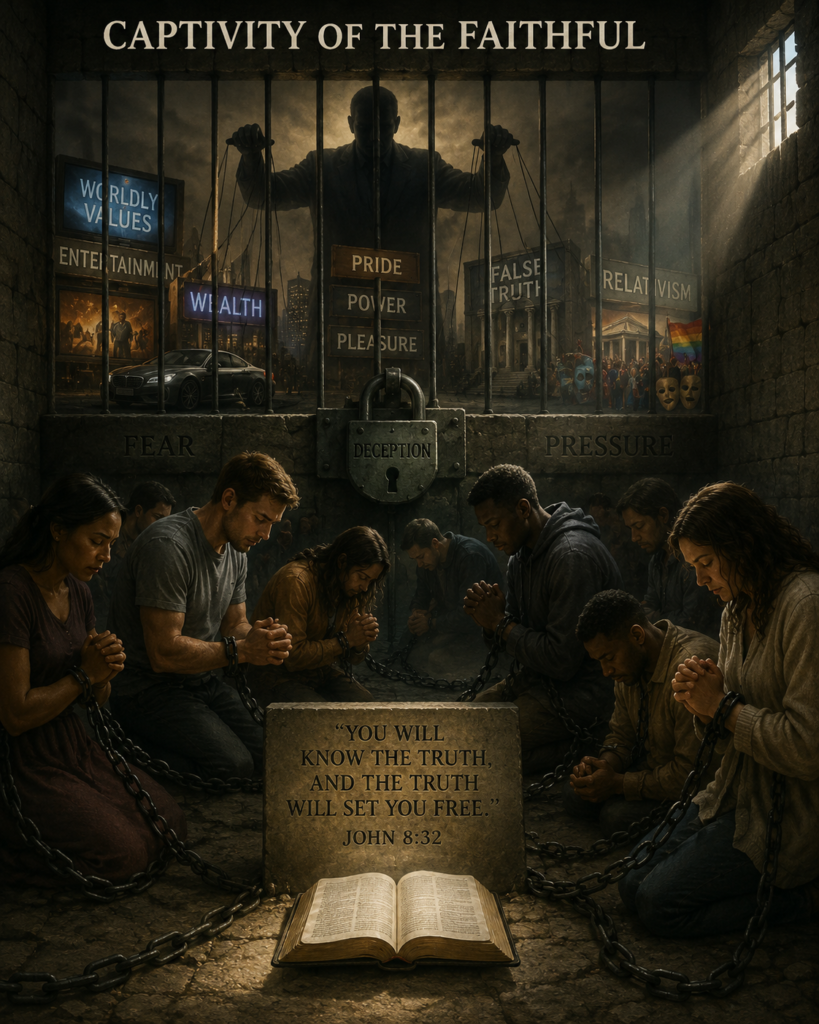
More than half of the world’s roughly forty-five thousand Christian denominations either originated in Africa or operate primarily on the continent. Nigeria alone hosts an uncountable number of them, multiplying weekly out of shop fronts, school halls and converted cinemas. This is not the story of a faith expanding. It is the story of a market clearing.
And the goods on offer in that market should trouble anyone willing to look at them squarely. What presents itself as the most religious continent on earth is, on closer inspection, the most thoroughly captured. The captivity is gentle. It is voluntary. It is sustained by people who would describe themselves, with feeling, as free. That is precisely what makes it durable, and what makes it worth naming.
To understand how we arrived here, one must begin with what was actually transferred when Christianity was brought to Africa, and what was withheld.
The missionaries did not bring a religion in any complete sense. They brought a colonial-era abridgement of European Christianity, stripped of its philosophical scaffolding, its centuries of internal argument, its monastic and mystical traditions, its hard-won negotiations with reason and doubt. They brought catechisms, hymns, the fear of hell and the promise of heaven. They did not bring, because they could not bring, the long European apprenticeship in living with this religion: the universities that interrogated it, the heretics who tested it, the reformations that fractured it, the Enlightenment that humbled it. Africa received the fruit without the tree.
What remained, when the colonial chaperones departed, was a religion without a tradition of internal critique. A faith planted as authority but never as conversation. The mother churches in Rome, Canterbury and Geneva kept their machineries of theology and review. Their African branches retained the certainty without the machinery. From that single asymmetry, much of what now passes for revival has flowed.
Step into ten churches in Lagos on a single Sunday and you will encounter ten substantively different religions wearing the same costume. In one, salvation is a transaction completed at an altar call. In another, it is a continuing struggle requiring weekly deliverance from inherited curses. In a third, it is essentially a financial instrument, deposited as seed and harvested as wealth. In a fourth, it is theatrical performance, a renewal of charisma in which the pastor’s voice cracks at exactly the right moment and the congregation falls, on cue, in tidy rows. The Bible is everywhere present and almost never the same book.
This is not expansion. Expansion is what happens when an organism grows while remaining recognisably itself. What is happening in African Christianity is closer to fission without genetic continuity, a fracturing so rapid and so untethered from any source that the resulting bodies share little beyond a name on a signboard and a book held aloft. The barrier to entry is negligible: a microphone, a generator, a charismatic speaker, and a name combining fire, anointing, glory or breakthrough in some novel permutation.
What unfolds inside many of these spaces is not religion in any meaningful sense. It is a sophisticated system of group capture, and like all such systems it follows a recognisable architecture. The first move is diagnosis. The pastor announces himself as a diagnostician of suffering, listening with the practised ear of his trade to the precise contours of his community’s pain.
The unemployment of a generation educated for jobs that no longer exist. The infertility of couples in a society that punishes barrenness. The political invisibility of a citizenry whose state has abandoned it. He does not invent these wounds. He surveys them.
The second move is reframing. Each wound, he proposes, is not what it appears to be. The unemployment is not the result of an extractive economy and a captured state. It is a spiritual blockage. The infertility is not medical. It is a household demon. The poverty is not structural. It is generational. By this single rhetorical manoeuvre he accomplishes two extraordinary things at once. He removes the political and economic dimensions of suffering from the realm of contestation, and he installs himself as the necessary intermediary for resolving them.
The third move is dependency. The encounter with the divine is no longer a destination but a subscription. There is always another seed to sow, another covering to receive, another anointing to renew. The believer cannot graduate, because graduation would mean independence, and the entire economy depends on the impossibility of independence.
The fourth move is enclosure. The faithful are persuaded that the world outside the church is dangerous, that old friends are agents of the enemy, that family members who do not attend are spiritual liabilities, that secular education and especially psychiatry are conduits of demonic influence. The social world contracts around the church until the church is the social world. Exit becomes not merely difficult but unthinkable, because exit is no longer leaving a religion. It is leaving a life.
The service itself is engineered with a precision that would be admirable if it were not predatory. The lights, the band, the sequencing of fast songs and slow songs, the building of emotional pressure, the long altar calls that exhaust resistance, the deployment of testimony at exactly the moment when the offering basket appears: nothing is accidental. The architecture of contemporary African Pentecostal worship has more in common with the design of a casino floor than with the liturgies it nominally descends from.
Both are environments engineered to suspend critical judgement and extract resources from people who came in believing they were in control.
It would be a familiar mistake to read all of this as evidence of some special African susceptibility. It is nothing of the sort. The conditions that produced this market are structural, and they would produce comparable outcomes anywhere they obtained: a demographic explosion of young people without prospects, states that have ceased to perform the basic functions of states, a historic erosion of indigenous spiritual systems that the missions pathologised and never rebuilt, and a vacuum of intellectual authority within the inherited churches themselves, whose African leaderships have rarely been given, or claimed, the room to develop a serious indigenous theology of their own. Into this vacuum the religious entrepreneur has stepped, with the predictable results of any market in which regulation is absent and demand is desperate.
The hardest question is whether it is appropriate to call the adherents captives. The believers themselves would reject the description with passion. They would describe themselves as free, chosen, delivered, blessed. They would cite testimonies, marriages saved, children born, businesses prospered. They would, in many cases, be telling the truth about their subjective experience. But captivity in its more sophisticated forms has rarely required the captive to recognise the cage. The patriarch who beats his wife into compliance is a crude operator. The patriarch who arranges her universe so completely that she cannot conceive of a life outside it has achieved something more efficient and more permanent. The contemporary religious entrepreneur, at the higher end of the trade, is operating in the second register. He is not coercing anyone. He is curating a totality.
None of this is a verdict on Christianity, or on the deep human longing for meaning that draws people to it. That longing is older than any church and will outlast every one of them. The tragedy of the contemporary African religious market is precisely that it preys on that nobility. It takes the most serious yearning a human being is capable of and converts it into a revenue stream.
A continent that has survived slavery, colonialism, structural adjustment and the long humiliation of being told its problems were always its own fault deserves better than to be told, one more time, by one more authority in borrowed robes, that its suffering is its own fault and that the cure is in the offering basket. The question is not whether Africans should be religious.
The question is whether Africans will permit themselves, in this domain as in every other, the dignity of asking what is true.
Until that question is asked in numbers large enough to matter, the captivity will continue. Gentle, smiling, unrecognised, week after week, in the silence before the pastor takes the pulpit.
About the Author
Charles is a contrarian thinker writing from Lagos
