
Everyone in the surrounding villages knew him—or claimed to know him well.
If something had legs, wheels, or merely the misfortune of being left unattended for a moment, it was safer to assume it already belonged to him. He was a compulsive thief. He stole goats, pots, bicycles, yams, cooking utensils and, on one memorable occasion, the very sandals he had absent-mindedly removed before entering a shrine.
Some even said the name he bore, Akunne—meaning “a mother’s wealth”—was not his. No one knew for certain who his real parents were. It was said that if he ever misplaced his own shadow, he would probably steal another man’s.
His fame spread farther than that of hunters, wrestlers or even great chiefs. Mothers invoked his name to frighten stubborn children into honesty. Storytellers celebrated his nimble fingers with reluctant admiration. In the folklore of the region, he occupied a curious place—not as a hero, but as the undisputed grandmaster of theft.
He wore his notoriety like a medal.
“What matters,” he often declared, “is to be the best at what you do. I am the best at mine. Those who condemn me simply hate excellence.”
The villagers rolled their eyes, but the thief smiled the smile of a man who had mistaken infamy for achievement.
Then came the annual festival.
It was the time each year when the entire community forgot its troubles. The old danced like the young. The young danced as though tomorrow had been cancelled. At the heart of it all stood the great village drum. It was more than wood and stretched hide; it was the heartbeat of the celebration. Its booming rhythm summoned dancers, stirred memories and united the entire village in joy.
The thief watched it with growing fascination.
It was valuable.
It was famous.
It belonged to everyone.
Which, in his peculiar logic, meant it should belong to him.
One moonless night, the impossible happened.
The drum vanished.
Panic spread through the village. Every compound, forest path, shrine and abandoned hut was searched. Hunters tracked imaginary footprints. Diviners consulted the spirits. Elders scratched their grey heads until they almost became bald.
Nothing.
The drum had disappeared as completely as smoke in the wind.
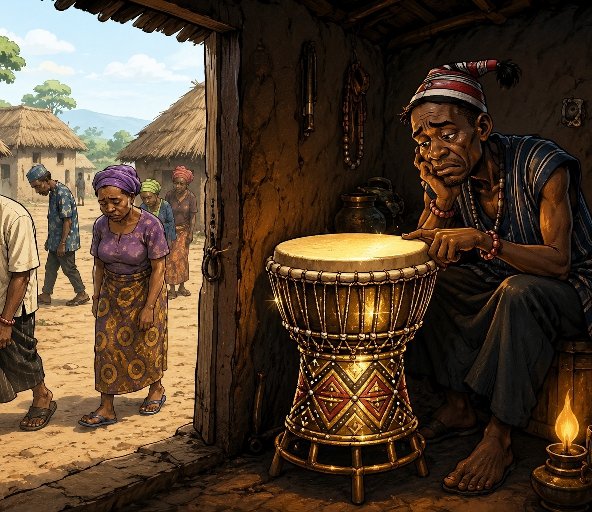
Hidden safely in a secret chamber inside his house, the thief admired his greatest conquest. He congratulated himself for accomplishing what no one had dared attempt.
Then he discovered a small complication.
A drum exists to be beaten.
Every fibre of his being longed to strike it just once—to hear its rich, triumphant voice.
But one beat would bring the neighbours running.
Two beats would bring the entire village.
Three beats would bring armed men from the royal guards.
So he never touched it.
The greatest prize of his criminal career sat silently in a dark corner, gathering dust, while he sat beside it, equally miserable. What had seemed like a trophy slowly became a prisoner—and so did its owner.
When the next festival arrived, the absence of the drum was impossible to ignore.
The dancers shuffled awkwardly.
The singers struggled to find their rhythm.
The masquerades seemed strangely lifeless.
The festival still happened, but without its soul.
People gathered in sorrow.
“What is a festival without our drum?” one old man sighed.
“Whoever stole it has stolen our happiness,” another replied.
They cursed the unknown culprit with remarkable creativity and wholehearted enthusiasm.
The thief stood among them, nodding solemnly.
“A wicked person indeed,” he muttered.
Each curse landed on him like a stone. His face remained calm, but inside, his conscience squirmed.
He wanted to confess.
He wanted to drag the drum back into the village square under cover of darkness.
But years of stealing had trained his instincts too well. A thief does not return stolen goods. Pride would not let him confess, and greed would not let him surrender his prize.
So he lived with both his secret and his silence.
The villagers mourned the missing drum.
The thief mourned the fact that he possessed a drum he could never play.
In stealing the village’s joy, he had unwittingly stolen his own peace.
Moral: Some things are so deeply woven into the happiness of everyone that they lose their value when possessed by only one person. Greed may win the prize, but it often robs the winner of the ability to enjoy it.
Fictional Disclaimer:
All characters and events in this story are fictitious. Any resemblance to real persons, living or dead, is purely coincidental.
*Victor Anazonwu is a public affairs commentator writing from Lagos.
