
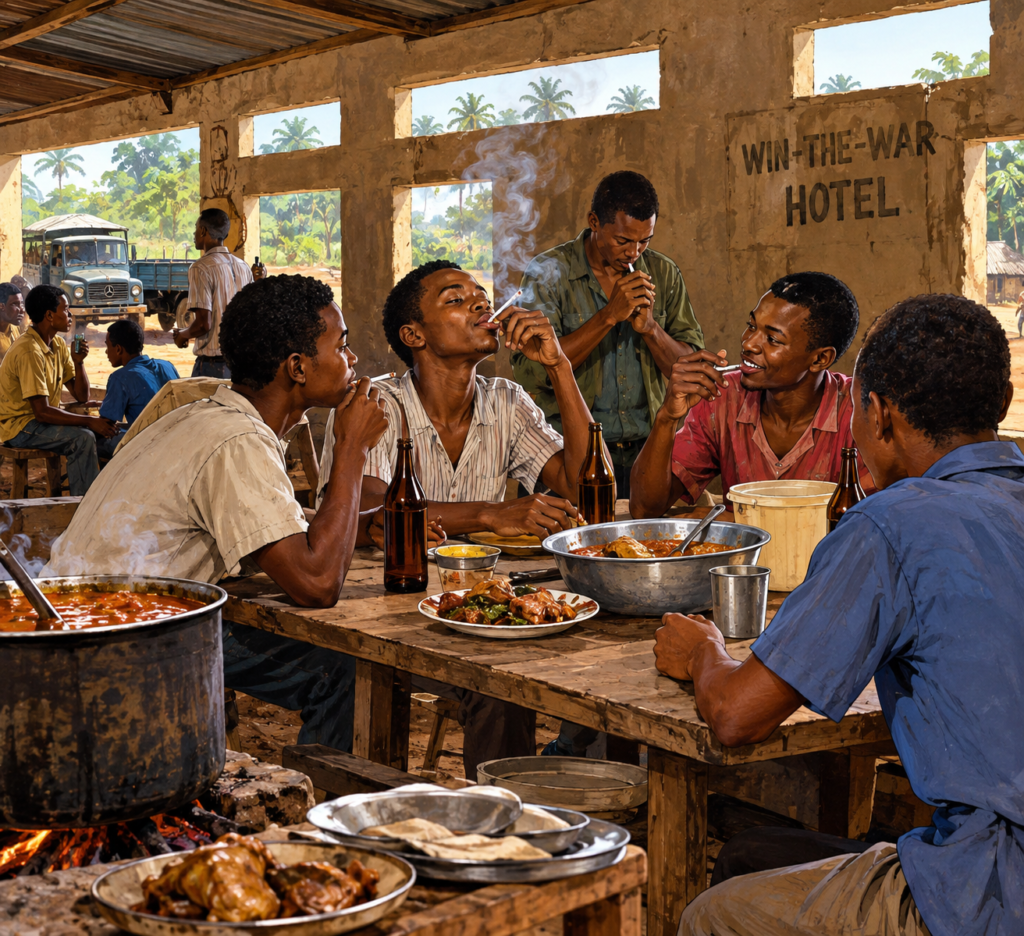
I sauntered into the Eziehulu village square that day literally looking for trouble.
The fairly large open space had a giant ugili tree at its centre. At one edge stood an abandoned nursery school building that had been converted into what we called a “win-the-war hotel.”
The building had doorways at the two smaller ends and two high-level window openings on each of its longer sides. There were no actual doors or windows, so entry and exit were completely unrestricted.
The patrons of this “hotel” were chiefly secondary school students. The youngest among them, by my estimation, were a few years older than I was. But I felt good hanging out with boys who were, in my reckoning, above my league.
There was, however, one little difference.
Most of the teenagers were not idle, like me. They were Afia-attack traders—so called because they operated close to the war fronts.
Afia-attack was a night market that operated on the fringes of enemy territory during breaks in the fighting. The market came alive under the cover of darkness, usually from about 9 p.m. to 2 a.m., with palm-oil lamps providing the illumination.
The timing was deliberate. It reduced the chances of being conscripted by the Biafran side or captured by Nigerian troops.
From Nnobi, the Afia-attack vehicle was a four-ton open Mercedes truck—the famous 911. The vehicle would anchor about two kilometres from the marketplace.
Folklore had it that the truck driver, a man called Kekere, would wait for the young boys on their “attack” trade mission with his diesel engine running continuously for three days. The story was that he kept the engine running because they could not risk the truck refusing to start when it was time to leave.
One of the most sought-after commodities was salt—a commodity that had virtually disappeared from Biafra.
The currency for the transactions was understandably Nigerian money, and Nigeria had regular supplies of salt. Biafra, on the other hand, was blockaded by land, sea and air. The aircraft that managed to beat the blockade had more urgent cargoes to carry, particularly medicine and arms.
Traders from the Biafran side who successfully returned from their expeditions would usually display their “wealth” at the village-square hotel.
The favourite dish was chicken pepper soup, usually accompanied by plenty of palm wine.
Don’t ask where the chickens came from.
Some people stole them specifically to supply the hotel. Others were dead chickens, most likely diseased. The hoteliers conveniently pretended not to know the source of their supplies.
Not surprisingly, seeing a mature fowl roaming around during the day became a rarity during the war.
When all the crooked options failed, the hoteliers had no choice but to buy chickens from the open market, which operated every four days. Ours was the Afor market day.
It was in these circumstances, and at one of these “hotels,” that I learnt to smoke.
After every attempt, I would cough for two days. But I was encouraged to persevere until I overcame the difficulties of starting. After all, as the popular Hebrew proverb supposedly puts it, “All beginnings are difficult.”
Within a week, I had improved considerably.
I could draw the smoke in deeply and, after it had gone down into the depths of my lungs, exhale a thin, almost colourless cloud.
The Biafran cigarettes, made from banana leaves, were guaranteed to knock a neophyte like me over like a bull.
AC cigarettes from France were considered elite stuff. They were expensive, so you could not afford to light one and smoke it normally. Instead, a cigarette would be torn open and its contents divided into several wraps using cheaper smoking material.
One stick of AC could produce at least four wraps.
The paper used for the wraps was traditionally the light-blue ruled sheet commonly used for informal letters—including love letters—in those days.
Even matches were not readily available.
Fire was generated by rubbing two hard “fire stones” together. It took considerable effort to produce a flame, so once a fire was started, it was carefully maintained throughout the day in the kitchen just behind the hotel.
Then came that fateful day in January 1969.
We were feasting at the hotel when I felt the urge to urinate. I went to the next available space. When I returned, Jimmy handed me a wrap through the window and asked me to light it.
I presumed it was the usual cigarette wrap.
I lit it and took a mouthful. Then I inhaled deeply, just as I had been taught.
Immediately, I was transfixed.
I lost consciousness for a while.
When I began to come round, Jimmy was shouting that I should hand over the stuff. The stuff was Indian hemp.
His outstretched hand was barely two feet away, but I could not move my limbs to reach it.
I could feel the heat from the cooking pot barely a foot away. One wrong movement and I could have landed directly in the fire.
Eventually, I regained enough control of my hands to pass the wrap back to Jimmy.
I went straight home.
To this day, I have no memory of that journey. It must have been around 5 p.m. I slept until about 9 p.m.
When I woke up, my mother was curious about why I had gone to bed before the birds went to roost. There was no electricity throughout the war, so she was sitting beside me with a traditional palm-oil lamp.
I reassured her that I was fine.
She asked whether I could eat.
I responded enthusiastically and promptly gulped down my dinner. She was relieved. She had already been contemplating giving me malaria treatment.
I insisted that it was unnecessary, and the treatment was abandoned.
I could not even share the experience with my elder brother, who was four years older than I was.
I returned to our usual joint about two days later and explained my predicament to Jimmy.
He laughed me to stupor.
I wanted to know how to distinguish hemp from ordinary cigarettes. I eventually learnt that there were differences in texture and that hemp took longer to light.
That was my first and last attempt at Indian hemp.
The older boys took their hemp in small quantities. I had mistakenly taken a mouthful and almost paid dearly for my naivety.
That mouthful could have turned me into a psychiatric patient, but for God’s mercy.
I was not yet fourteen.
The Schoolboy Smoker
I continued smoking after the war.
At the end of the war in 1970, we were automatically promoted to Class Two. That year, we were all day students. It was not until 1971 that the government was able to reconstruct the school hostels.
In April 1971, I was smoking with two friends somewhere outside the dormitory blocks when we ran into some senior students.
They were post-secondary-school students preparing for their Advanced Level examinations. They were already grown men—some perhaps in their twenties.
“How could these rats be smoking at such a young age?” they raged.
They concluded that we were the negative offshoots of a new generation.
We were taken to their classroom and made to kneel for an hour on sharp pebbles.
Then came the real threat: we were to report to the Principal’s office the following morning.
Our Principal was an Irish missionary, and a smoking offence could easily have earned us a month’s suspension.
I was scared to death.
My father, a renowned bookseller, had been supplying books to the school for years before I enrolled. My parents had also been proudly talking about my good conduct.
They would have been terribly disappointed.
But luck was on my side.
That trip to the Principal’s office never happened.
The Close Shave
During the Easter/Second Term holidays, another incident occurred.
I was smoking at about 7:30 p.m., some three streets away from our house, when a car rolled past.
It was already dark, so I did not recognise the car until I saw the rear lights.
Lo and behold, it was my father driving home.
He normally arrived between 7 and 7:30 p.m. so that he could have dinner and participate in the family Rosary. The Rosary usually took place between 8 and 8:30 p.m.
I knew I was in serious trouble.
I stayed out until after 9 p.m. before I mustered enough courage to go home.
When I eventually entered the parlour, my father was waiting.
My heart sank.
He asked why I had come home late—beyond his curfew and the mandatory family prayer.
I could not think of a convincing excuse.
But he pardoned me, apparently because I was a first-time offender. He gave me a stern warning about lateness.
He had not seen me with the cigarette.
For me, it was a close shave with “death.”
I sat there speechless, lost in my thoughts.
Then my mother’s voice rescued me.
“You have not eaten your dinner!” she shouted from the dining room. “What is really wrong with you?”
I rushed to the dining room and guzzled my food.
That was the day I made a decision.
10 May 1971.
I quit smoking.
And, as far as I was concerned, I never looked back.
*Charles Okolue, an Engineer, writes from Enugu.
