
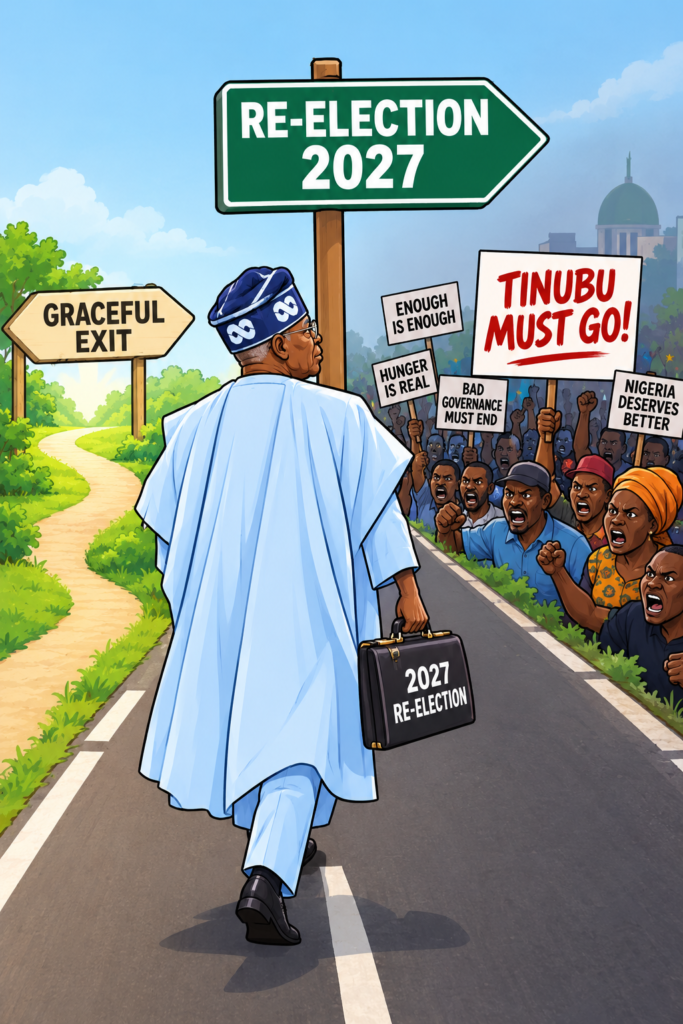
There are many ways for a politician to discount his legacy. Some lose elections. Others lose their moral compass, their political allies, or their grip on reality. A few manage to lose all four simultaneously. President Bola Ahmed Tinubu appears determined to explore another, more spectacular possibility: turning a controversial first term into a case for why he deserves a second.
If there is one monumental disservice Tinubu has done to himself, it may well be his determination to seek re-election in 2027 after four years that have tested the patience, pockets and survival instincts of millions of Nigerians.
Presidential re-election is not a constitutional entitlement. It is an invitation to the electorate to review a candidate’s performance and decide whether the country can afford another four years of the same experience. Unfortunately for Tinubu, the report card from his first term is unlikely to inspire a standing ovation.
Perhaps the President has been listening to the wrong people. In the peculiar acoustics of Nigerian power, the louder the suffering outside the presidential villa, the more enthusiastic the applause inside it. Advisers praise economic reforms, party loyalists celebrate political structures, and ambitious beneficiaries of government patronage insist that everything is working. Meanwhile, ordinary Nigerians are left wondering whether the promised dividends of democracy have been deposited into somebody else’s account.
The tragedy is not merely that Tinubu’s government has disappointed many Nigerians. It is that he appears determined to interpret their disappointment as a communication problem rather than a performance problem.
The Election That Never Quite Settled the Argument
Tinubu’s journey to the presidency in 2023 was contentious from the beginning. His victory was challenged by political opponents, disputed in court and contested in the court of public opinion. Although the legal process affirmed his election, the controversy surrounding the result left sections of the electorate unconvinced that the country’s democratic institutions had delivered an honest mandate.
A president emerging from such circumstances would ordinarily recognise the importance of governing inclusively, earning public trust and demonstrating that he understands the fragility of his political legitimacy.
Tinubu chose a more adventurous route.
Barely had Nigerians settled into the reality of his presidency than he announced the removal of the petrol subsidy in his inaugural address. It was a policy decision with potentially defensible economic arguments, but its abrupt announcement, inadequate preparation and painful consequences became a defining moment of his administration.
The message was unmistakable: the government was prepared to make Nigerians pay immediately for reforms whose promised benefits would arrive at some unspecified date in the future.
Petrol prices surged. Transport costs followed. Food became more expensive. Businesses struggled with rising operating costs, while households discovered that salaries could remain unchanged even as the cost of survival moved into a different economic universe.
The subsequent foreign-exchange reforms and the naira’s dramatic depreciation compounded the distress. Inflation eroded purchasing power, and millions of citizens found themselves working harder to afford less, or borrowing to eat the next meal.
The government insisted that the medicine was necessary, even if bitter. Fair enough. But there is a difference between prescribing bitter medicine and expecting the patient to pay for the prescription, endure the side effects and still applaud the doctor.
Economic reforms are not judged exclusively by their theoretical elegance. They must also be assessed by their timing, implementation, distributional consequences and measurable results.
A government cannot indefinitely demand credit for the sacrifices citizens are making while its key officials live like royalty and questions about the benefits of its policies are treated as evidence of insufficient understanding.
Four years into this experiment, Tinubu should have been preparing to demonstrate why his reforms justify another term. Instead, he faces the more uncomfortable question of whether the suffering has produced sufficient, tangible improvements to justify asking Nigerians to endure more of the same.
The President Who Knows Best
There is another problem: Tinubu’s style of governance.
A president does not have to conduct a referendum before every decision. Leadership requires judgment, courage and, occasionally, the willingness to make unpopular choices. But there is a crucial distinction between making an unpopular decision after listening to the people and governing as though public opinion were an irritating interruption to executive business.
Tinubu’s administration has too often appeared more interested in announcing decisions than building consensus around them, more comfortable defending policies than acknowledging their human consequences, and more eager to celebrate progress than to explain why ordinary citizens are not feeling it.
The result is an expanding gulf between official optimism and popular experience.
When citizens complain about hunger, insecurity, unemployment and declining living standards, they are not necessarily demanding economic miracles. They are asking for evidence that those entrusted with power understand the problems, are genuinely working to solve them, and, in the interim, making their own share of sacrifices.
They want to feel safer in their homes and on their roads. They want their children to have a credible future. They want public institutions that work and public officials who understand that the government exists to serve citizens, not the other way around. They don’t want a leadership which can’t find enough money to fund public services but has surplus funds for political campaigns and new presidential jets.
Many Nigerians increasingly experience the state as an expensive spectator to their misfortunes.
The irony is that Tinubu is a seasoned politician who understands the importance of political calculation. He built a formidable political network and demonstrated considerable skill in the contest for power. Yet the very instincts that reportedly helped him win the presidency may now be working against him.
Political machinery can mobilise supporters, secure endorsements and dominate party structures. It cannot, by itself, persuade a hungry voter that hunger is prosperity in disguise.
Debt, Due Process and the Burden of Trust
Then there is the question of public finance.
Nigeria’s fiscal challenges did not begin with Tinubu, and intellectual honesty requires acknowledging that he inherited structural weaknesses, substantial debt obligations, inadequate revenue generation and years of policy failures.
But inheritance is an explanation, not a permanent exemption from accountability.
A president seeking another term must explain what he has done with the economic and political authority entrusted to him. He must demonstrate that borrowing serves a credible development strategy, that public spending delivers measurable value and that procurement follows transparent procedures.
Debt is not inherently irresponsible. Governments borrow to finance infrastructure, stimulate productive activity and spread the cost of long-term investments. The problem arises when borrowing expands faster than the economy’s capacity to generate revenue, when debt servicing squeezes essential public expenditure, or when citizens cannot clearly connect new liabilities to tangible projects and improvements in their lives.
Nigeria’s mounting fiscal pressures therefore demand more than optimistic speeches and impressive-looking budget figures. They require transparency, credible priorities and verifiable outcomes.
Equally important is the way allegations of corruption and wrongdoing involving public office holders are handled. Between the President’s Chief of Staff (Femi Gbajabiamila), FCT Minister (Nyesom Wike), and Works Minister (Dave Umahi), there have been enough scandals to sink the Titanic. They range from allegations of abuse of office, high-handedness, poor official conduct and corruption to incidents involving violence and even loss of life.
Allegations must not be treated as proof of guilt; they require evidence, investigation and fair adjudication. But neither should they be dismissed merely because the accused occupy powerful positions. So far, the Tinubu Administration has shown an obvious preference for the latter.
The Wisdom of Leaving Before the Applause Stops
Here lies the President’s most consequential political miscalculation.
Tinubu is an ageing political leader whose public appearances and physical condition have periodically generated concern. Such concerns should not be confused with a medical diagnosis, nor should age alone disqualify anyone from public office.
Nevertheless, the presidency is an extraordinarily demanding job. It requires sustained physical stamina, mental alertness, sound judgment and the ability to respond to a country confronting multiple crises simultaneously.
In these circumstances, the President might have considered a different political strategy: completing his first term, defending his record honestly, and supporting a capable, more energetic and younger successor.
Such a decision could have been presented as an act of statesmanship: a recognition that political parties are institutions larger than their leaders and that national leadership is a responsibility to be transferred, not a personal inheritance to be defended indefinitely.
Tinubu could have helped shape the next generation of leadership, strengthened his party’s institutional foundations and earned a measure of goodwill from Nigerians exhausted by political combat.
Instead, the apparent determination to seek another term suggests that personal ambition may be taking precedence over the broader interests of both party and country.
This is where hubris enters the story.
Hubris is not merely excessive pride. It is the conviction that one’s political genius is so exceptional that ordinary rules, public grievances and historical warnings need not apply.
It is the belief that because one has defeated opponents before, one must defeat them again.
History is littered with leaders who made precisely this mistake.
They confused the loyalty of their inner circle with the consent of the population.
Most fatally, they assumed that the electorate’s capacity for suffering was matched by an unlimited willingness to reward the people responsible for it.
The 2027 Gamble
Incumbency confers significant advantages, including visibility, patronage networks, party machinery and influence over the political environment. But winning an election and winning public affection are two different things. So are securing a second term and securing a positive place in history.
A disputed or narrowly secured victory in an atmosphere of widespread dissatisfaction could deepen national divisions and leave the government with an even more difficult task of rebuilding confidence.
Conversely, an electoral defeat could be humiliating for a politician who has invested so much of his identity in the pursuit and consolidation of power.
That is the danger of making re-election a personal test of invincibility. The higher the ambition, the greater the potential humiliation when reality refuses to cooperate.
The phrase “Tinubu will have to kill Nigerians to remain in power” might capture the anger of his critics, but it would be a terrible outcome for everyone if electoral competition were allowed to degenerate into widespread violence. The responsibility to prevent such a catastrophe rests primarily with the government.
If Nigerians decide that Tinubu deserves another term, the result must be respected. If they decide otherwise, he must leave office with dignity and without attempting to frustrate their verdict.
That is what democracy demands, regardless of the size of a politician’s ego or the sophistication of his political machinery.
The Road Less Traveled
Ultimately, the greatest danger of Tinubu’s re-election ambition may not be that he loses. It may be that he has placed himself in a position where even victory could become a Pyrrhic triumph.
A president who leaves office voluntarily, having recognised the limits of his mandate and the need for generational renewal, can sometimes earn greater respect than one who clings to power until the electorate finally ejects him.
Tinubu had an opportunity to shape the terms of his departure. Instead, he appears determined to put his entire political legacy on trial in 2027. The gamble is as extraordinary as it is familiar. It’s too late to cry now.
The president once demonstrated that he possessed the political skill to reach the highest office in Nigeria. The question now is whether he possesses the wisdom to descend from those lofty heights without a painful fall.
*Victor Anazonwu is a member of The Renaissance Online Magazine editorial board
