
Recently, Adesola Adefemi Ojuolape, posted an article in a social media platform, titled “Most Courses in Nigeria’s Universities Have Expired.” He was taken to task by Olawale Adetokunbo Ajayi, Emeritus Professor of Human Capital and Comparative Education. Professor Ajayi agreed that Adesola made valid points in his assessment based on the content, structure and delivery of curriculum materials in Nigerian Universities. According to the Professor, Adesola’s thesis on the subject, indicated that the university coursework still covered the colonial vestiges of being 70 percent theoretical and thirty percent practical. Over the years these courses have ended up producing low to poorly-skilled graduates.
Professor Ajayi and a few others have written additional rejoinders on the subject, raising serious issues of concern; the Nigerian Universities, University Education and Training as well as the overall quality and standard of education in Nigeria seem to have been placed on the spotlight. The leading proposition is that most aspects of University Education have exceeded their shelf life. Just as an expired drug, they should be discarded. Other proponents claim that there is something still relevant and valuable to be derived from keeping the carcass and restocking the shelves for upgrade and a new beginning. Many contributors to this public assembly are correct; their arguments and explanations should not be trivialized.
It is equally important to reset the clock. The legacy institutions left behind by the colonial administrators in Nigeria, Ghana, South Africa, Senegal and all across Africa are still there. They include the class of the University College Ibadan (later the University of Ibadan (UI)), the University of Ghana (Accra & Legon), University of Cape Town, and several others. Among these legacy institutions, is Fourah Bay College (now a college of the University of Sierra Leone} originally established by the Church Missionary Society (CMS) to train local clergy to advance evangelization in Africa; the college was later integrated into the British academic program to offer degrees in liberal arts and science. Obviously, many Nigerian academics have visited these other Universities outside Nigeria; how does the University of Ibadan in 2026 compare with any of these other Universities listed? The show-and-tell answer from honest eyewitness accounts could be reserved for later.
For full disclosure, I have not visited any of these Universities in Ghana, South Africa or Sierra Leone. However, permit me to share my personal experience as a first-year undergraduate student at the University of Ibadan in 1965. I have chosen to discuss this experience in part because the contributors have focused so much on a lot but not any or enough on “Campus Life, Student Welfare, Learning Environment, Quality of Studentship”. The contributors also failed to address the role of government and the wider society towards sustaining the purpose of the University in Teaching, Learning, Research and Innovation.
In 1965, the University of Ibadan remained essentially an Arts and Science Institution, the same that existed right from its founding. The University Teaching Hospital (UCH), though located on another campus was set up as an affiliate of UI, under one governing entity with the Vice Chancellor and a Provost. There were seven Student Hostels identified as Halls of Residence – namely: Mellanby, Tedder, Sultan Bello, Kuti, Queens, Independence and Azikiwe Halls. Each of them was built with a secured courtyard, adjoining cafeteria and utility space for recreation and leisure. Two students were housed in one room; hall warden staff came every week-days to clean students’ rooms. In addition to the regular and routine cafeteria services covering breakfast, lunch and dinner, there were mid-afternoon tea/coffee breaks with shortcakes. Students could relax at the cafeteria lounge fully engaged with their peers on any range of academic interactions and intellectual exchanges.
The Trenchard Hall within an eye-view from Mellanby was a special all-purpose place for university activities of all sorts. The Student Union Building was another attraction for students; there were snack bars and an open-air arcade for games such as table tennis, billiard and checkers. Students were free to hang around, especially those lucky to have girlfriends and significant others. That exuberant flirtatious indulgence was called “driving”; it was a place to relax, chillout to refresh the mind.
There were other campus locations of interest. The University Zoo was one such a place. The zoo was home to many exotic animals, birds, snakes and rare creatures sourced from far and wide. The Botanical Garden served its purpose especially during the weekends; the Department of Botany mounted labels that identified every kind and every specie in the arboreta using both local and indexed taxonomy. It was popularly called lovers’ garden for a reason; a walk-through the entire expanse smelling beautiful roses and eucalyptus in bloom did not disappoint the patrons.
The Departments of Agriculture, Animals Science and Veterinary Medicine served the University in good standing; the cafeteria units received steady supply of eggs, beef and chicken from the University holdings. The Bakery Unit provided assorted kinds of confectionaries including cakes, ice-creams and bread. Faculty staff and students rushed through the bakery plaza as long as the day’s stock lasted.
The campus setting with its luxuriant trees that served as nooks and natural canopies left special aesthetics beyond imagination. It was always a pleasure beholding every part of the UI campus starting from the Tower Court to the last hidden rendezvous at the Oba Dam where the sound of nature’s drainage interfaced with human craft. The streets were identified by familiar names that also reminded visitors and all residents the history that must never be forgotten. UI campus was definitely both on canvass as well as on photogenic images displayed on postcards at the University Bookshop. The library was an architectural edifice that created its own character. It was a contrived zone of quietude where students and patrons in search of knowledge and inquiry received uninterrupted opportunity in time with reading spaces. Physics Department operated a campus Radio Station which also served as research hub for amplitude and frequency modulation.
The lecture theaters and laboratories were equally accommodating and conducive; there was no overcrowding; every student was properly situated and comfortably seated and positioned on location ready for lecturing to begin. The one-hour session was fully engaging in attention and participation. The science laboratories had functioning equipment; the students worked in sizeable groups or as individuals depending on the experiments or specific projects of interest. The social sciences and humanities never had any dull moments; their publications in the campus newspaper provided another enduring outlet for literary scholarship and intellectual debate. The Theater Arts Department presented stage-shows almost every weekend; tickets were sold at the Theater’s Front Desk for particular shows and events of interest. The Department supported the Unibadan Traveling Theater; that troupe formed the early generation of outstanding young men and women in creative visual art, literature and cinematography. Sonny Otti, Ken Saro-Wiwa and Albert Egbe followed the footsteps of Kongi (Wole Soyinka) to advance the stage-drama culture and the shining image of UI across the land. Tunji Oyelana and Yemi Folake (I hope I got the names right) were resident artists then; they had a group of musicians called the Benders. That group entertained campus audiences regularly. Tunji moved on to feature in the Nigerian Television weekend show called “Sura the Tailor”. Albert Egbe went on to become a major television actor and producer; he was a major character in the television comedy “Basi & Company.” He also played the part of a lawyer in “The Village Headmaster”. Sonny Otti later earned a PhD in Theater Arts and joined the University of Jos Faculty where he was until he passed away. Ken Saro-Wiwa served as a commissioner in Rivers State after the war; he was in charge of the controversial “Abandoned Property” saga. He later became an environmental justice activist, serving the interest of his Ogoni kinsmen; that cause got him in collision with the military government and a major international oil company, leading to his execution by hanging in 1995.
In general, the students were ready to learn; they challenged their lecturers and professors to the limits of academic excellence and intellectual inquiry. Extracurricular activities included social clubs and fraternities that enlisted students from various disciplines with shared group and individual interests. Sigma Club was among the most prominent of that era; that club organized an annual carnival that attracted visitors from various parts of Nigeria and other countries in West Africa. Havana Night and its alluring attraction created a special image for the University; it was a night when cultural music and entertainment took center stage within the perimeter box-office of the Tower Court and the Main Bowl of Trenchard Hall. Patrons bought their tickets long in advance to keep a date with the best musicians and musical groups in West Africa. Havana Night was one particular night that the Student Affairs Officer and the Hall Wardens permitted students to harbor visitors in the Halls of Residence. The rules that would normally keep youthful exuberance and rascality on leash were let loose; the students had one night of “Roforofo” as Fela Anikulapo Kuti once described the scene at his performance stage on Havana Night.
The University of Ibadan paraded a cadre of well-trained and experienced faculty members. Many graduated with higher degrees from the best Universities around the world. The University had very robust exchange programs that made it possible to receive visiting professors on short-term sabbaticals and programs supported by various international organizations. In turn, UI made available free accommodation and logistical support for them and their families. The children of such visiting experts were readily admitted at the Staff Primary School and also the International School for those children of secondary school age. In 1965, the University of Ibadan had Standard Bank (today’s First Bank) and Barclays Bank (today’s Union Bank) located on the campus. Kingsway Stores had an outlet near the Senior Staff Club; it was a small building that stocked essential supplies and groceries that served the needs of staff and students, especially the expatriate families.
The University Teaching Hospital (UCH) had its own unique memories during this same reporting period. Alexander Brown Hall (ABH) was the major residential place for both the male and female medical students, separated in different blocks of the same building. The Nursing School also had a separate building for the nursing students, majority of whom were females. The young medical students wore white short-sleeve with tie on top of pants and shoes; the females wore white tops and skirts; everyone had white robes with their statoscope hanging on their necks or tucked in somewhere. The hospital environment was typical, a place where the consultants and their students engaged in serious routine, handling patientcare with professional attention and dedication to their calling.
The nurses were there to make sure doctors’ orders were carried out with the patient’s welfare utmost in their minds. The wards were clean and fully equipped with serving units and components. The laboratories and the pharmacy departments had their staff on shift, making sure services were provided around the clock; both campuses were served by shuttle buses; thus, students were provided the seamless opportunity to benefit from service and healthcare delivery as needed. Above all there was electricity in both campuses with infrequent interruptions.
When and how did the University of Ibadan commence its descent from the top into a declivity? The time-line might not be exact; however, by 1970, the UI and UCH of 1965 had started to lose their color. The civil war was seemingly over but the controlling authorities of Nigeria had switched places from civilians to the military. Obviously, the country of Nigeria and Nigerians had gone through an intense traumatic transformation within a very short period of time. Five years were less than a decade normally used to measure progressive changes of remarkable proportions. The country seemed to have gone through a shock therapy; unfortunately, the greater population that neither experienced nor witnessed the devastating horrors of the civil war were never conscious of the collateral impacts and associated changes brought about by what happened to others. The UI campus was almost a secluded island in this regard. Life moved on as if nothing had happened but not for those who returned to UI nearly five yeas after. The change was as dramatic as it was unbelievably confounding. Student population had started to increase beyond the facilities available; thus, overcrowding created uncontrollable pressure with accommodation; students started what became known as squatting. The cafeteria system broken down; the University was forced to introduce the use of meal-tickets; ablution facilities became so degraded that public health turned into a nightmare especially with halls of residence and lecture departments having to deal with water shortages. Some departments had to rely on portable generators for power supply.
The 1970s marked the beginning of a steady drawdown and the decline of the “Great-UI”. The expatriate staff and a number of foreign students felt it was time to start packing up to leave; and they did. In short order, the faculty of science lost its top-notch professors and lecturers like Goddard, Beetlestone, Redhead, Burke, Whiteman, and others. Between 1970 and early 1980 the University of Ibadan doubled in student population compared to what it was in 1965. That increase did not happen with any corresponding infusion of measurable resources to enable the University cope with its mission and purpose.
On the outside, those companies that used to hire final year students upon their graduation also closed their corporate offices. Companies like Leventis, UTC, A. G. Seward, Lever Brothers, Mandillas, Chellarams, Kellarams, R. T Brisco, SCOA, J. Allen, either folded their network or were taken over by their Nigerian subsidiaries. The rest of the companies franchised by the government did not fair better either. Leyland Motors, Volkswagen, Nigerian Tobacco Company, Anambra Motors, Kaduna Textiles, Savana Sugar, Most of the Beer Producing Companies and a host of others went under. During this same period and beyond, the Nigerian Airways closed shop, the ports facilities in Warri, Calabar, Port-Harcourt were dissembled in favor of facilities around Lagos; the Nigerian Railways ceased to be a regional carrier.
Back to the rejoinder by the Professor Emeritus! The statistics presented and quoted with reference to a number of places outside Nigeria, presupposes that the same Nigeria is like most other countries. The SWOT analysis (Strengths, Weaknesses, Opportunities & Threats) presented does not serve more than an academic exercise. Nigeria has overgrown its weak and faulty foundation. There is nothing actionable about a situation where those who have little or no education to begin with or those whose sources of accreditation are doubtful and uncertain, end up becoming leaders in charge of the highly educated folks.
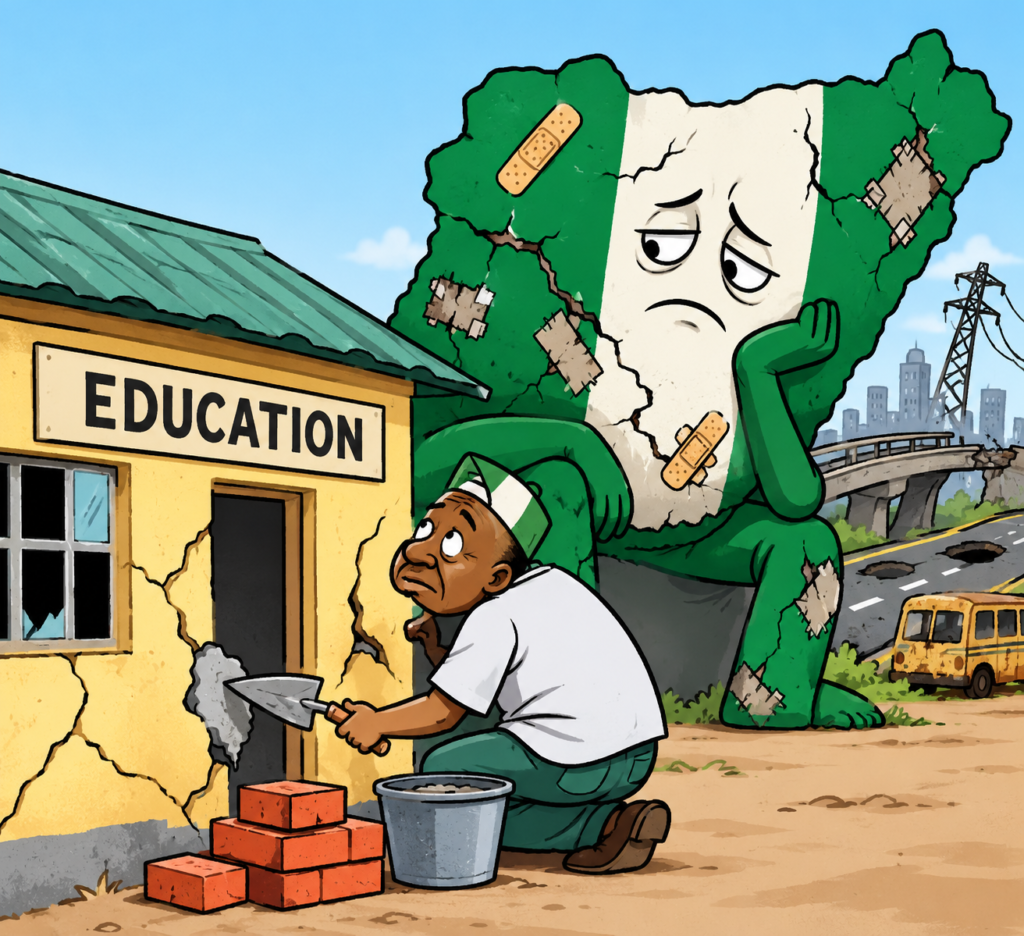
All the models, whether Triple-Helix or Binomial, are just a bunch of theoretical concepts that actually reinforce Adesola’s gripe. The quality of studentship has been degraded to the barest; the public school system both primary and secondary has collapsed. It is from this baseline that the undergraduate category emerges and when qualified becomes the lecturer and professor of tomorrow. The days when a Nigerian University like UI would attract quality professors from foreign countries are over; rather the brain-drain is keeping a unidirectional outflow of talent and expertise from the country. The question being asked and rightly so as reported by Adesola remains valid: “Can this course feed my child?”
It shows the frustration of concerned parents. The answer to such a question should not necessarily come from the University. There is no course of study that becomes or serves as an ultimate platform for skills acquisition. The University offers a preparatory ground or stage in human capital development; the environment of practice creates additional enabling opportunity towards self-improvement. Obviously, there should be modifications and adjustments built into teaching manuals; such instructional resources must be relevant and tailored to the needs of the country and especially the citizens. The advice from Professor Ajayi, cautioning Adesola not to tell “our children that university is scam” should be directed at the people institutionalizing that feeling and belief. Certainly not to Adesola.
Those governors collecting N300 to N400 million monthly allocation meant for the local government authorities and still feel comfortable leaving the children standing knee-deep in flooded classrooms with gaping open-air skylines are actually reinforcing that idea.
Adesola should not be tortured for being the messenger of very bad news. The problem is not the curriculum; it is not the content; it is not the delivery. If it is, the 70% percent theoretical threshold adjudged to be true and candidly accepted, leaves out the 30% component missing from the curriculum or training manual. That shortfall in the overall toolbox for fixing university education cannot be replaced without fixing Nigeria.
How to do so has been addressed in many instances and across many fora. Unfortunately, those people benefitting from the confusion have refused to yield.
**Phyl Amadi is a retired professor of Geological Sciences based in the US
