
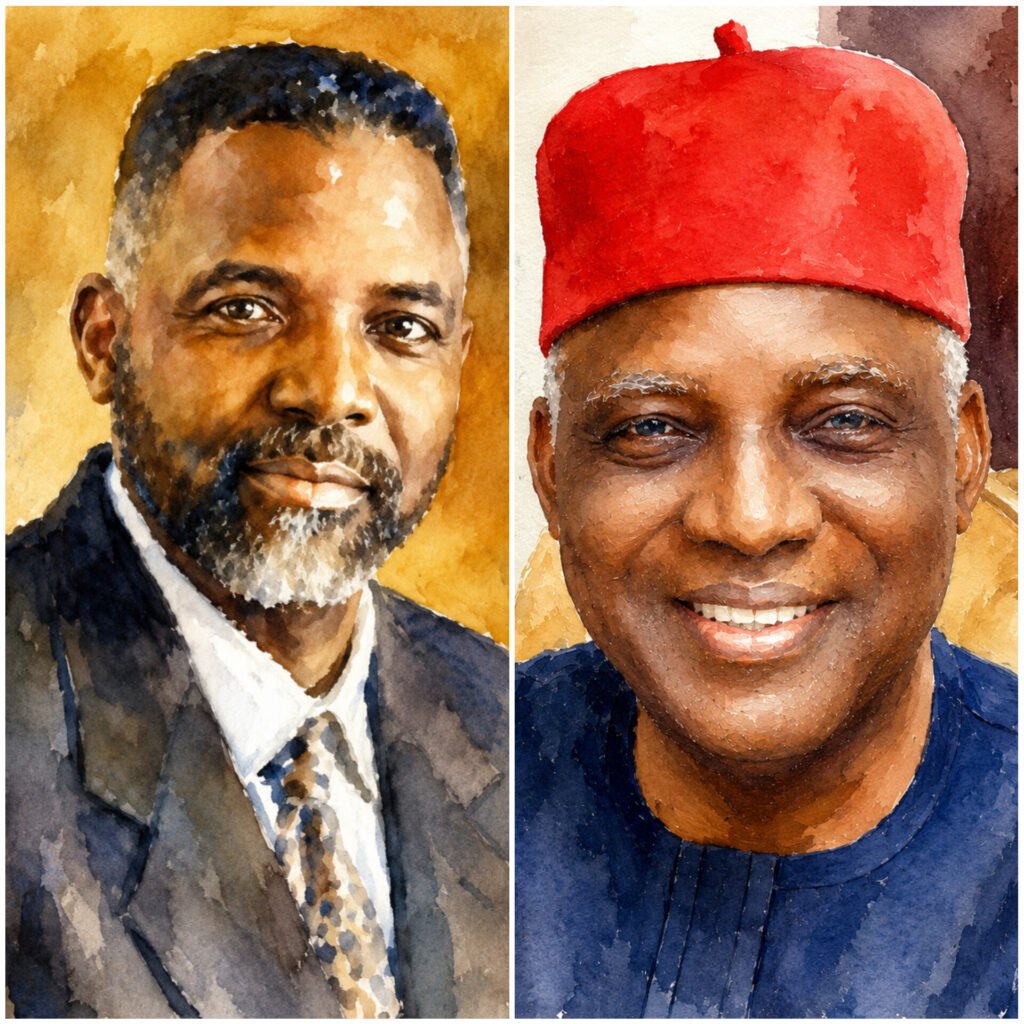
Over the past few days, much has been written about Prof. Bart Nnaji. Every tribute has celebrated his brilliance, his accomplishments, and his extraordinary contributions to engineering, public service and, most recently, his determination to drive darkness out of a large swathe of southeastern Nigeria.
All of it is true. Well, almost.
But there is a problem with writing about Bart. The moment you begin, it starts sounding like hagiography. The man has simply achieved too much. Yet those who know him best understand that what truly distinguishes him is not his towering résumé, but his humanity. Here is a man who is remarkably comfortable with everyone—from presidents to palm wine tappers.
So, permit me to bring the great man down from the pedestal for a moment and introduce you to… just Bart.
Back in the early 1990s, Bart would fly into Nigeria from the United States, where he was already an accomplished engineering professor at a leading research university. After an exhausting intercontinental journey, most people would head straight for bed, exhausted from jet lag.
Not Bart.
We would head to Night Shift in Lagos and dance until the early hours of the morning. Then, while the rest of us struggled to remember our names, he would somehow be the first person at the airport, ready to catch an early flight to Abuja and launch into another punishing workday that often ended close to midnight.
He had mastered something many successful people never do: balancing relentless work with wholehearted enjoyment.
One of those mornings produced a story we still laugh about.
In 1993, Bart insisted on taking the first flight from Lagos to Abuja. I argued that he had just returned from America via Europe and deserved a little more sleep. Against his better judgement—and despite having long concluded that punctuality and I were sworn enemies—he reluctantly agreed to travel on the second flight.
That decision saved us from becoming unwilling tourists to Niamey.
The first flight was hijacked and diverted to Niger Republic. We would almost certainly have been on it had Bart ignored my advice. It remains one of the very few occasions in life when my reluctance to wake up early qualified as sound strategic judgement.
Of course, Bart’s distrust of my relationship with time had started a year earlier.
The day after the celebrated Kenyan scholar Ali Mazrui delivered The Guardian Lecture in Lagos, Bart and I were having lunch with the great man at the Sheraton. I was completely absorbed. Mazrui had been my intellectual hero since my school days, and I wasn’t about to cut short such a conversation merely because of something as mundane as a flight.
Bart repeatedly urged that we leave for the airport.
I confidently assured him that Nigeria Airways would, as usual, depart late.
On this singular occasion, the airline chose to become Swiss.
By the time we arrived, the flight was full and preparing to depart on schedule.
Fortunately, someone recognised Bart and squeezed him into a crew seat beside the aircraft lavatory—a location whose fragrance and traffic hardly reflected the dignity of a distinguished professor. He accepted it cheerfully, delighted that at least one of us would get to Enugu.
I, meanwhile, was left behind on the tarmac to contemplate the wages of overconfidence.
Or so he thought.
By one of those inexplicable Nigerian miracles, I somehow negotiated my way into the cockpit. When the aircraft landed in Enugu, Bart watched in astonishment as I emerged with all the composure of a seasoned captain.
He later admitted that while I had earned his respect for street wisdom, I had permanently forfeited any claim to respect for punctuality.
That verdict still stands.
People often describe Bart as calm, and rightly so. I have seen him remain composed under pressures that would unsettle most people.
But I once witnessed the exception.
On an October evening in 2024, we were chatting upstairs at his Enugu residence when he suddenly jumped to his feet.
“That’s my wife! That’s my wife!” he exclaimed with the excitement of a schoolboy.
A vehicle had just entered the compound. He had instantly recognised it.
When I asked what the excitement was about, he explained that his wife had travelled alone to the village earlier that day to settle family matters.
“She went without security,” he said anxiously. “She takes unnecessary risks. I just pray she returns safely. I don’t think we could manage without her.”
That simple moment revealed more about the man than any official biography ever could.
For all his achievements, Bart remains deeply anchored in family, community and his roots.
Indeed, one of his greatest pleasures is returning to his village near Enugu. There, titles disappear. He is perfectly happy chatting with palm wine tappers, farmers and petty traders. They seem to recharge him in ways that boardrooms and conferences never can.
Perhaps that explains another memorable moment.
When he was sworn in as minister, he declined all the impressive prefixes Nigerians love to accumulate. No “Professor.” No “Chief.” No “Engineer.” No “Dr.”
Simply:
Bart Nnaji.
Officialdom eventually restored the “Professor,” but his preference said everything about him.
Many people spend their lives trying to become important.
Bart seems far more interested in remaining himself.
As he turns seventy, I celebrate not only the globally respected engineer, entrepreneur and nation-builder, but also the friend who could dance all night, rescue a conversation with wit, forgive my chronic lateness only when it accidentally saved his life, and still become positively giddy at the sight of his wife returning home safely.
Happy 70th birthday, my dear friend.
May the years ahead bring you continued health, joy, purpose and many more opportunities to remind the rest of us that true greatness wears humility with remarkable ease.
C. Don Adinuba is a former Anambra State Commissioner for Information and Public Enlightenment.
