
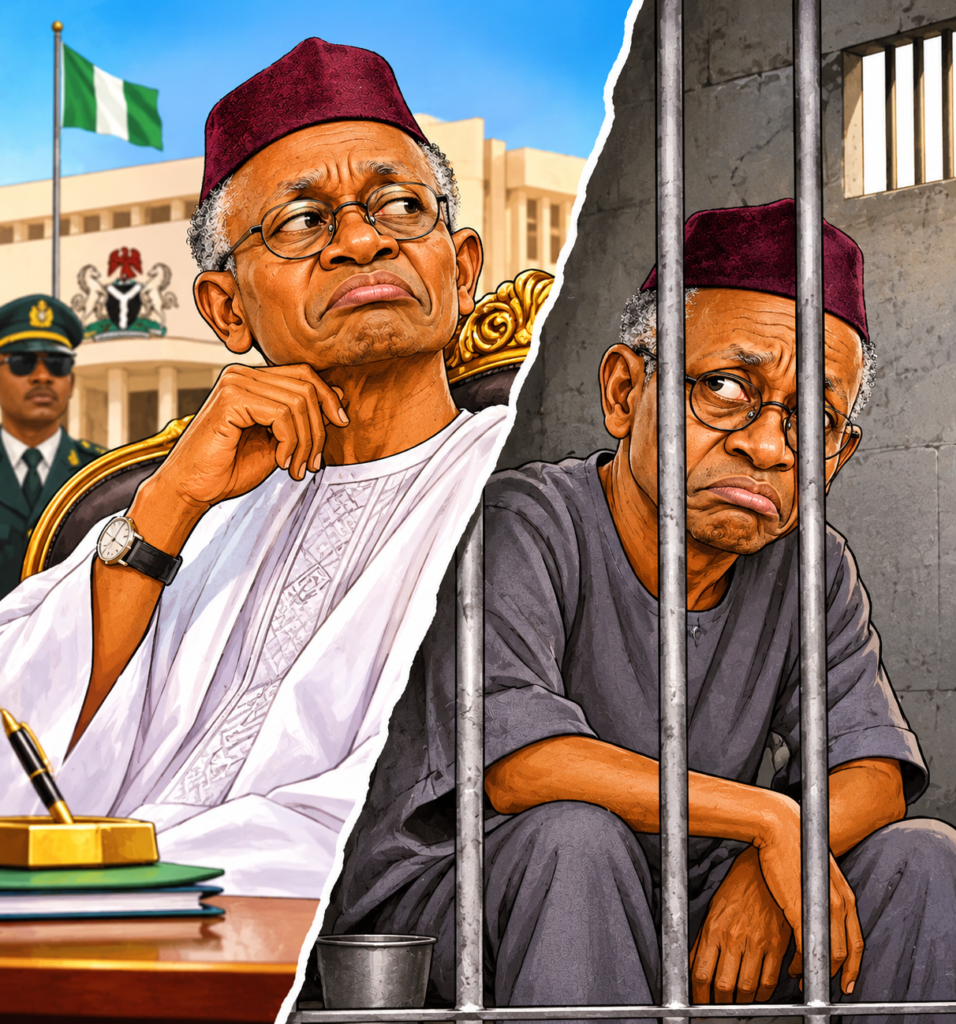
These days, he divides his time between the solitude of a detention cell and occasional appearances in court. He looks forward to the latter with the eagerness of a boarding-school student anticipating an outing day: a rare opportunity to see other people and escape the monotony of confinement. At every court appearance, one of his fervent prayers to the judge is to be granted admission to hospital, where, he hopes, life might be a little more bearable. Such is the present reality of Mallam Nasir El-Rufai, until recently the Governor of Kaduna State.
How dramatically life can change!
As Director-General of the Bureau of Public Enterprises under President Olusegun Obasanjo, he was known as a stickler for rules and regulations. Given Nigerians’ penchant for flouting rules, this was a welcome development in the eyes of most right-thinking members of the public. For this reason, Mallam Nasir was widely admired and subsequently elevated to the position of Minister of the Federal Capital Territory. I was among those cheering from the stands.
It was during his tenure as FCT Minister that the less admirable side of Mallam Nasir began to emerge, much to the dismay of his admirers.
He soon acquired a reputation for ordering the demolition of private homes and commercial properties with the zeal of an avenging spirit on the loose. Time and again, it appeared that his enthusiasm went beyond enforcing compliance with the famous Abuja Master Plan. To many affected property owners, it bordered on vindictiveness. He seemed to derive an unhealthy satisfaction from wielding power in ways that inflicted pain on others.
Years later, as Governor of Kaduna State, a similar pattern appeared to play out, this time with far bloodier consequences. The diminutive governor seemed to have little regard for human feelings, public opinion or some of the basic conventions of public service. He often projected the image of a man who considered himself a law unto himself.
Some of his critics even accused him of suffering from the Napoleon Syndrome – a tendency for short men to overcompensate for their height disadvantage by being overly aggressive, dominant or ambitious. First coined in the early 20th century by British pop psychologists, the term quickly became a propaganda slang referring to the great French General, Napoleon Bonaparte, who was said to be of a small frame.
Whatever the meaning, Kaduna, once regarded as one of the more peaceful and cosmopolitan states in Northern Nigeria, became engulfed in communal violence, ethnic acrimony and religious extremism under El-Rufai. For eight years, blood flowed and tears fell. Conflict, controversy and carnage became recurring features of the state’s troubled narrative.
The suggestion that this deterioration was entirely unrelated to the political leadership of the period would be difficult to sustain. Equally, the relative calm that followed his departure from office in 2023 invites questions about the relationship between leadership and the security climate in Kaduna. Coincidence or consequence? You do the maths.
There is a reason organisations seek references from previous employers and colleagues before hiring prospective employees, especially into sensitive positions. It is because character leaves a trail. Here is what former President Olusegun Obasanjo, the man who recruited El-Rufai from the United States and introduced him to the highest levels of public service, had to say about him years later in his book (“My Watch, Volume 2”, 2014, pages 110 – 112 ):
“Nasir’s penchant for reputation savaging is almost pathological. Why does he do it? Very early in my interaction with him, I appreciated his talent. At the same time, I recognised his weaknesses; the worst being his inability to be loyal to anybody or any issue consistently for long, but only to Nasir El-Rufai.
“He lied brazenly, which he did to me, against his colleagues and so-called friends. My vivid recollection of him is his penchant for lying, for unfair embellishment of stories, and his inability to sustain loyalty for long… He is a pathological purveyor of untruths and half-truths with little or no regard for integrity.”
A reference of this nature, if presented to a reputable organisation, would hardly enhance anyone’s employment prospects. But recruitment into leadership positions in Nigerian politics is hardly governed by the sort of due diligence expected in the corporate world. El-Rufai went on to become Governor of Kaduna State despite the controversies that trailed his tenure in the FCT. The rest, as they say, is now history.
Towards the end of his tenure as Governor, El-Rufai began granting populist interviews and hobnobbing with self-styled progressive elements. Critics began to wonder what was brewing. Clearly, some said, the cat was among the pigeons.
During the run-up to the 2023 general elections, El-Rufai was among the staunchest supporters of Bola Tinubu’s presidential ambition. He toured with the campaign team and accompanied Tinubu to Chatham House. He was also present when Tinubu famously enunciated the principle of “Grab it, snatch it and run with it.” Around the dinner table, he joined others in laughter and applause. He wined, dined and danced with the campaign entourage, seemingly convinced that he was on the winning side.
He subsequently led a group of Northern governors to challenge President Muhammadu Buhari’s naira redesign policy at the Supreme Court, amid suspicions that the policy was intended, among other things, to undermine Tinubu’s campaign financing. All these efforts appeared to be part of a broader investment in the anticipated Tinubu presidency.
Then things went south.
Tinubu nominated El-Rufai for a ministerial appointment, only for the nomination to run into trouble at the National Assembly. The Senate did not proceed with his confirmation, and the political circumstances surrounding the episode fuelled suspicions of a falling-out between the two men. Many believed Tinubu had pulled the rug from under his former ally.
It was like inviting a man to the village square for a dance, only to arrange for the masquerades to strip him naked. The two men have been estranged ever since.
A review of El-Rufai’s public life suggests a number of conclusions.
First, he appears to be a man easily intoxicated by power and position, wielding both with considerable disdain for those he considers beneath him. He often seems more comfortable playing the role of an overlord than that of a leader.
Second, he has demonstrated questionable political judgement in his choice of allies. His enthusiastic support for Tinubu’s presidential ambition, followed by the spectacular breakdown of their political relationship, raises questions about his ability to read people and anticipate the consequences of political alliances. He backed a man he evidently did not understand, only to discover that the relationship could turn decidedly predatory.
Now, he finds himself in the hyena’s belly. Poor Mallam Nasir!
It is often said that to err is human and to forgive is divine. But where does sympathy belong in this moral equation? On the side of humanity or divinity? I honestly do not know. What I do know is that it is difficult to summon much sympathy for someone whose public conduct has left so many aggrieved. Perhaps there is more to come. Perhaps the prayers of those who believe they suffered under his watch have finally found their way to heaven.
El-Rufai may have talked his way into trouble. And this time, he has no one else to blame. Karma, as they say, has a way of finding its address. Perhaps it is finally his turn to experience a taste of the helplessness and oppression that others have accused him of inflicting.
James Hadley Chase’s 1939 crime novel, No Orchids for Miss Blandish, tells the story of the pampered daughter of a wealthy Kansas City businessman who is kidnapped by a ruthless criminal gang and subjected to horrific abuse. The orchid, an expensive and exotic flower, evokes luxury, privilege and refinement. The title itself became an ironic expression of the absence of tenderness, comfort or consideration in the face of human suffering.
It is an expression that seems particularly apt for Mallam Nasir El-Rufai at this hour. And for us all, ultimately, because no condition is permanent.
Take heart, Mallam Nasir.
**Osita Azubuike writes from Bauchi
