
Memories of a boy, a city and a Nigeria finding its feet again
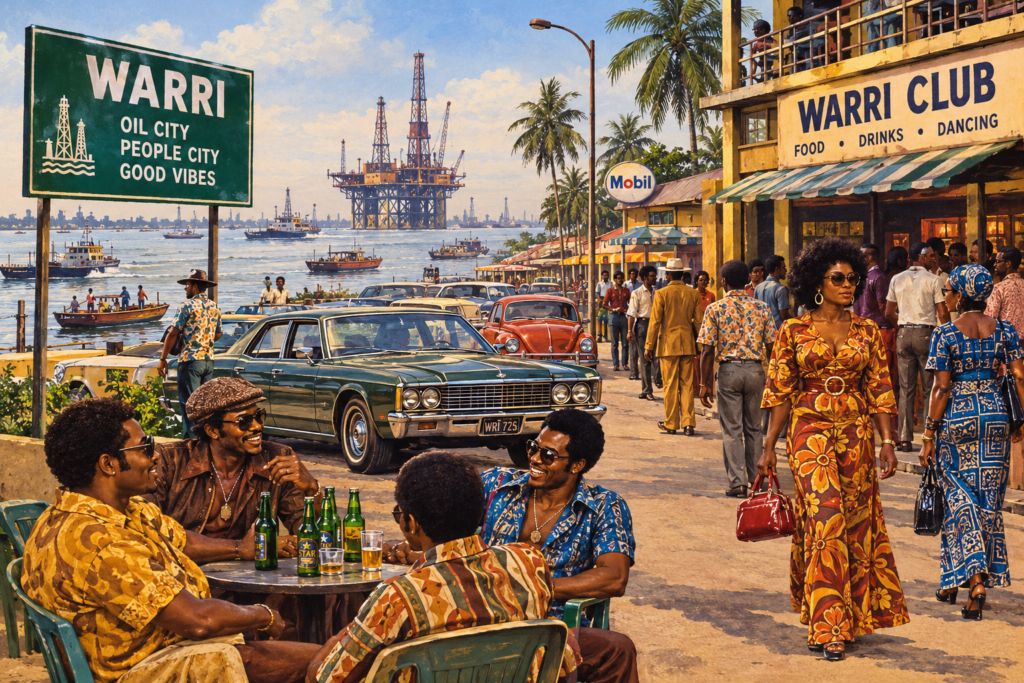
Warri is a city of contrasts. Its personality is feisty, swashbuckling and unmistakably its own. Its brand of Nigerian Pidgin English is a language apart – colourful, sharp-edged and capable of cutting a newcomer, or a jonnie-just-come, down to size in a single sentence. Then there is the city’s celebrated social life: the music, the joints, the women, the banter and all the other ingredients that have long made Warri a pulsating address.
Warri had been all this for a long time before I arrived. By the early 1970s, it was already an important urban centre, playing host to major corporations, entrepreneurs and a lively social culture. It was a city with swagger, and it was about to become the setting for some of my earliest and most enduring memories.
Imagine, then, a rural boy of six, freshly emerged from the rustic tranquillity of my win-the-war hometown of Owerre-Nkwoji, in the Nkwerre precincts of Imo State, suddenly thrust into this world. Warri was a breath of fresh air, a revelation, an invitation to possibilities I could scarcely have imagined in my little corner of the countryside.
My memories of Owerre-Nkwoji were those of an almost Arcadian existence, though the Nigerian Civil War had left its scars. The war had ended, but its consequences lingered. Parents and older siblings were still trying to piece together the fragments of lives disrupted by a brutal and frightening experience. The adults had their anxieties, their losses and their uncertainties about the future. I was six. The future, to me, was simply whatever adventure the next morning promised.
With no school to attend and little by way of organised activity, childhood had become an extended holiday. I followed the older children around, chased masquerades and readily joined whatever mischief was being hatched. One of my guides was Chijioke, an older, distant relation who seemed to possess an inexhaustible supply of questionable ideas.
My assignments were modest but memorable. I would sneak to the boiling pots in our polygamous family compound, steal some yams and deliver them to him. From Chijioke, I also learnt a curious lesson in poultry management: toss a handful of corn seedlings towards an approaching fowl, and the unsuspecting bird would be lured within easier reach – and, as he saw it, greater opportunity.
These were petty childhood offences, committed with all the innocence and impunity of a boy who had not yet learnt to distinguish mischief from misconduct. I had no idea that association could be a school in its own right, or that some of its lessons might prove more consequential than others. Chijioke continued along his chosen path. In later life, his misadventures became considerably more serious, eventually bringing him before the Armed Robbery and Firearms Tribunal under an Imo State military administration. I remember that trajectory with a mixture of sadness and distance. The boy who once recruited me into pilfering boiled yams had travelled much further down a road I was fortunate not to follow.
But that was another story. Mine was about to take a different turn.
Before the hostilities, my father had worked with the Nigerian Ports Authority in Port Harcourt. Following the cessation of hostilities in early 1970, he was recalled to service and posted to Warri. Once the formalities were completed, he arranged for the family to join him. The move was timely: I was to begin formal schooling in January 1971, when Nigeria’s academic calendar still ran from January to December.
Uvwie Preparatory School in Effurun, Warri, came highly recommended. My father took my brother Uche and me there for enrolment. The Civil War had deprived me of a proper foundation in education, and my spoken English was, to put it kindly, still finding its feet. I remember the adults around me using the expression “Happy Survival” in the months after the war. It seemed an apt description of a country emerging from catastrophe, and of families trying to resume ordinary life after extraordinary hardship.
The headmaster, Mr Anaduaka, was reassuring. “No worries, we’ll take care,” he told my father.
In those days, one informal test of a child’s readiness for Primary One was wonderfully simple. You stretched your right arm over your head and attempted to touch the tip of your opposite ear. If you could manage it, you were deemed old enough to begin school. I passed the test and was admitted. How my younger brother Uche fared in his own experiment has, regrettably, escaped my memory.
And so began my immersion into the world of formal education.
School gradually did what school is supposed to do. It gave structure to my days, exposed me to new ideas and, through daily interaction with other pupils, helped improve my spoken English. The teaching was fair enough for a rural boy who had arrived with little formal preparation – a tabula rasa, if you like, waiting to be written upon.
I soon found my feet and made friends with the other boys, including Ovie and Ohifeme. Familiarity replaced strangeness; faces became friends, and the classroom began to feel like a place to which I belonged.
The girls, however, were an entirely different proposition. I was painfully shy around them, never quite sure where to look or what to say. But Gloria somehow caught the roving, wide-eyed gaze of a young boy eager to establish himself as a proper township fellow. I could not have explained what made her stand out. I only knew that, amid the business of settling into a new world, she had somehow become a person worth noticing.
Perhaps that was my first tentative encounter with the mysteries of attraction. At six, one could hardly be expected to know what to do with such a discovery. It was enough that Gloria had caught my eye – and that I was much too shy to do anything about it.
Friendship with the other pupils soon extended beyond the classroom. Our families became acquainted, and invitations to birthday parties and other social occasions began to arrive with pleasing regularity. Nigeria was rediscovering its appetite for celebration, and the early 1970s offered no shortage of reasons to gather.
I still remember the Udoji Awards of 1974, which brought a wave of additional money into the economy and helped fuel a period of conspicuous social activity. Parents seemed unusually willing to throw parties. While the adults exchanged news, discussed politics and caught up with the affairs of the day, we children had our own agenda: dance enthusiastically, eat rice, drink Fanta Orange and wait for the gifts.
For a child, it was an arrangement of near-perfect proportions.
Some of the more prosperous families had swings in their compounds, and those were attractions in their own right. Then there were the Raleigh Chopper bicycles. They were not merely bicycles; they were status symbols on two wheels, instantly distinguishing their fortunate owners from the rest of us. I did not own one, but whenever the opportunity arose, I was more than happy to take a turn. One did not need to own a luxury to appreciate its pleasures.
Even the simple matter of footwear told its own story about class and circumstance. In those days, going barefoot was common among children from less privileged households. The expression “knacking ten toes” captured the practice with the kind of blunt, teasing humour Nigerians do so well. A former president would later make heavy weather of having grown up without shoes, but for many Nigerian children of my generation, bare feet were hardly exceptional. We walked over rough paths and the occasional thorns without much complaint. If there was one injury adults dreaded, it was tetanus.
Looking back, I recognise how privilege often announces itself through ordinary things. A pair of shoes. A bicycle ride. A party invitation. The difference between having to go without and being able to enjoy a little extra. As children, we rarely understood the economic circumstances behind these distinctions. We simply noticed who had what and made the best of what was available to us.
Beyond the parties, the bicycles and the small pleasures of childhood, Nigeria itself seemed to be rediscovering its rhythm. The country was finding new ways to reconnect, rebuild and project a renewed sense of national purpose. The National Youth Service Corps (NYSC), the National Sports Festival, the Challenge Cup and the National Arts and Culture Festival, among other initiatives, injected fresh energy into the national conversation. They created a buzz around the Nigerian brand, giving a country emerging from the trauma of civil war new reasons to celebrate its possibilities.
Education, too, was about to take an unexpected turn in my young life. In 1973, the government decreed a change in the school calendar, moving the academic year from January-December to September-June. The immediate effect was startling: every pupil in every Nigerian school gained a promotion to the higher class after only six months. In practically no time I found myself a senior, and the idea of secondary education within the Midwest State – as it was then called – became a project worth considering.
The Mid-West State of the Brigadier Samuel Ogbemudia era was particularly distinguished in education, sports and social development. Its leading secondary schools enjoyed enviable reputations. Federal Government College, Warri; Government College, Ughelli; Edo College, Benin City; St Patrick’s College, Asaba; and Hussey College, Warri, were among the institutions that commanded attention. To a young boy contemplating the next stage of his education, these were not merely schools. They were gateways to a wider world of achievement, discipline and possibility.
I remember Eva vividly. On some visiting days, he would come to our house dressed in the immaculate white-on-white uniform of Federal Government College, Warri, a reading material tucked under his arm. There was something about his appearance and carriage that caught my attention. I heard stories of his academic brilliance and distinction in sports, and the combination seemed almost magical to a boy of my age. Eva made secondary school look attractive – not merely as the next compulsory step in education, but as a place where one could acquire distinction, confidence and a certain enviable bearing.
His visits left an impression on me. The uniform, the books, the quiet suggestion of achievement: together, they gave secondary education a glamour that no amount of parental persuasion could quite have manufactured. For the first time, I began to imagine myself in that world, among boys who excelled in the classroom and on the sports field, and who seemed to carry themselves with the assurance of young men already preparing for bigger things.
But just as I was about to try the examinations to these schools, a transfer letter came for Dad to relocate to Port Harcourt. The plans I had begun to nurture were abruptly overtaken by the demands of his career. Warri, which had opened my eyes to a world of new possibilities, was about to become a chapter of memory. Life, once again, began in a different direction.
Beyond our school and social lives, Warri offered a more complicated education.
My family lived in Oghenekaro Estate, a small collection of about six three-bedroom bungalows on McDermott Road. It was a modest residential enclave, but it provided its share of memorable episodes. One hot afternoon, a neighbour’s son, Akpos, ran around the estate in a state of apparent delirium. He was perhaps a mid-sized teenager, and rumours soon circulated that he had experimented with Indian hemp. Whatever he had taken appeared to have overwhelmed him.
I was too frightened to approach the scene. The older residents, however, rushed to his assistance, attempting to calm him and arrange medical help. The episode left me with a child’s mixture of fear, curiosity and bewilderment. It was one of my earliest glimpses of how the attractions of city life could sometimes conceal less pleasant consequences.
Across the estate fence lived a group of young women whose noisy visitors and colourful language made them the subject of neighbourhood speculation. It was, by all appearances, a brothel – or something close to it. In the Warri of those years, such establishments formed part of the city’s less respectable, but no less visible, social landscape.
The green and yellow lights were unmistakable. So, too, was the vocabulary that floated across the fence, much to my mother’s dismay. Mum was a teacher and, in her own way, a guardian of our innocence. She tried valiantly to insulate her young children from the occasional verbal assaults emanating from the other side. But children are curious, and language has a way of slipping through barriers. One expression lodged itself in my memory: “I born throway for Chief … I born throway for Prince, you na who you born for?”
At the time, I could repeat the words without fully appreciating their implications. Curiosity occasionally drew me towards the customer list displayed near the entrance. It contained a crude menu of services, with prices denominated in pounds and shillings, since the naira had not yet come into circulation. One entry offered “Full Service” for eighty pence; another listed “Toss Body” for twenty pence. Only years later did I understand the lewd, lecherous distinctions in the services being advertised.
The experience was an early reminder that a city teaches through more than its schools. It educates by proximity, by observation and sometimes by exposing children to things adults would rather they did not see. My mother’s efforts to preserve our innocence were sincere, but the world beyond her reach had lessons of its own. Yet, for all these recollections of Warri’s vibrancy, social contrasts and urban temptations, one of my most instructive childhood lessons came not from the streets, the school or the neighbourhood, but from my own misbehaviour.
Chijioke’s influence had not entirely worn off. Some habits, once acquired, prove remarkably persistent. My favourite sweet was Goodie-Goodie, a delicious candy from the stable of Cadbury Nigeria. The few pennies I saved from gifts given by visiting relations were sometimes enough to buy a few pieces. I liked the sweet, and I always wanted more.
On more than one occasion, childish ingenuity got the better of my conscience. I would approach a neighbourhood grocery, flash a coin as though I were paying, and then use the owner’s momentary distraction to help myself to additional sweets. In my own childish reckoning, it was a clever little operation. I had discovered a way to enjoy more of what I wanted without having to pay for it. The shopkeeper may initially have been amused by my audacity. But at the third or fourth attempt, my luck ran out. He caught me, exposed the little trick and shook the stolen sweets out of my pockets.
He could have made a public spectacle of me. Instead, he spared me the humiliation while giving me a stern dressing-down that I have never quite forgotten. For days, I was sullen and withdrawn, retreating into the protective shell of a chastened child. The shame was real. So was the lesson. It was an epiphany of sorts: the moment I began to understand that cleverness without character was merely dishonesty wearing a clever disguise. The sweets had been small, the offence childish, but the lesson was larger than either.
Looking back, I sometimes wonder whether that shopkeeper realised what he had done. He had recovered a few pieces of candy, but he had also interrupted a habit before it could become something more serious. He chose correction over humiliation, and I was fortunate enough to learn from it.
Warri gave me friendships, memories, exposure to the wider world and the first stirrings of adolescent fascination. It introduced me to the contrasts of privilege and deprivation, respectability and mischief, innocence and temptation. It was a city that entertained, bewildered and educated me in equal measure.
I arrived as a rural boy emerging from the shadow of war. I left with a wider view of the world – and, perhaps, a little more understanding of myself. Some cities leave you with photographs. Others leave you with stories. Warri left me with both, and with memories that have grown richer, funnier and more revealing with the passage of time.
That was Warri through the lens of my childhood: a city full of swagger, a country finding its feet, and a little boy slowly learning that growing up is not just about discovering the world. It is also about discovering the person you might become.
