Every first of October, Nigeria writes the same essay. It opens with the flag lowered at the Lagos Racecourse in 1960, pauses at the civil war, counts the coups, and then divides its remaining pages between two columns. In one column sit the gains we imagine: a unity that holds largely because no one has worked out how to dissolve it, a democracy measured by the number of elections rather than their quality, a “giant of Africa” title the continent quietly stopped using some time ago. In the other column sit the losses everyone already knows: power, roads, insecurity, emigration, the naira. The essay ends with a prayer. It is read, forwarded, and forgotten by the fourth of October.
This year that essay would be worse than useless, because it would miss the one thing that makes 2026 different from the last twenty anniversaries. For the first time in more than a decade, the external world has turned in Nigeria’s favour. Not because Abuja planned it, but because a war in the Gulf disrupted a strait, lifted the oil price, and made a Lagos refinery strategically important to half a continent. The country arrives at sixty-six holding something it has not held since 2014: room to move.
The question worth asking on this anniversary is therefore not “what have we achieved?” It is narrower and harder. Nigeria has been handed an accidental fortune. Will it become a position, or will it become the fourth wasted boom?
The Settlement
The Igbo apprenticeship system offers a better lens for this moment than any borrowed model of development economics. In igba boi, a young man serves a master for years: opening the shop before dawn, learning the suppliers, absorbing the discipline of margins and credit. At the end, if he has served faithfully, the master settles him. He is given capital to open a shop of his own.
The settlement is the most dangerous moment in the apprentice’s life. Everything before it was instruction. Everything after it is judgement. Some apprentices convert the settlement into a trading house that outlives them. Others spend it on the wedding, the car, the display that announces arrival, and are back in someone else’s shop within three years. What separates the two is not the size of the settlement. It is whether the apprentice understood, before the money came, what the money was for.
Nigeria in 2026 has received a settlement. The difference is that this one was not earned through faithful service. It came from the misfortune of others: a war, a disrupted shipping lane, a scramble for barrels and refined products that Nigeria happened to be positioned to supply. An unearned settlement is more dangerous than an earned one, because the recipient has not been disciplined by the effort of earning it. And the master in this case is no benefactor. It is the global market, which never returns to ask how its capital was used. It simply withdraws. This essay asks what the settlement is for.
Anatomy of a Borrowed Boom
Begin with the numbers, because the anniversary rhetoric will avoid them.
On the eve of independence day, global oil prices have surged past 106 dollars a barrel on Middle East tension, and the Central Bank’s reference price for Bonny Light stood at 119.38 dollars on 23 September. Nigeria’s 2026 budget was built on 64.85 dollars. The distance between those two figures is the settlement.
The reserves show it. External reserves stood at 55.25 billion dollars in mid-September, the highest in eighteen years. The naira, which in 2023 was a byword for dysfunction, now trades near 1,328 to the dollar in the official window, with the parallel rate only modestly weaker. Foreign capital has returned: 10.37 billion dollars flowed in during the first quarter, against 5.64 billion a year earlier. On 21 September, FTSE Russell restored Nigeria to its Frontier index after the downgrade of 2023.
Now the other half of the ledger, the half the celebrations will skip. Nigeria cannot collect the full settlement, because it cannot produce the barrels. Crude-only output in August was 1,500,190 barrels a day. The budget assumed 1.84 million. The country met its OPEC quota for a fourth consecutive month, which sounds like discipline until one notices that the quota is roughly what the fields can deliver anyway. Output remains about 31 percent below its 2015 average. June’s figure of 1.735 million barrels a day, crude and condensate combined, was the strongest month in more than six years, and it did not hold.
So the fortune is partial. Nigeria is a price-taker enjoying a price it did nothing to create, on volumes it has spent a decade failing to restore. That is not strength. It is exposure that happens, for now, to point upward.
And Nigeria has been here before. The boom of 1973 to 1980 built a new capital and an import habit, and ended in the austerity of the mid-1980s. The boom of 2003 to 2008 produced the Excess Crude Account, a genuine attempt at discipline that was steadily drawn down by claimants who regarded it as unspent money rather than saved money. The boom of 2011 to 2014 ended in the recession of 2016. Three settlements; three weddings. An anniversary speech that does not name this pattern has not earned the right to promise anything.
One Plant, One Nation
If the oil price is the settlement, the Dangote refinery is the one part of it that resembles earned capital. It deserves honest praise, and it deserves an honest warning.
The praise first. In August 2026 the refinery supplied roughly 71 percent of Nigeria’s petrol while running above its nameplate capacity of 650,000 barrels a day. Diesel imports fell by 84 percent. Seaborne shipments of petroleum products from Nigeria averaged 561,000 barrels a day in the second quarter, against 79,000 in 2023. For half a century Nigeria was the continent’s great paradox, the largest crude producer importing its own fuel. That paradox has been broken, and it was broken by a private investor, not by the state.
That last clause is the warning. In the same month, no state-owned refinery recorded any production at all. The country’s fuel security now runs through a single private complex in the Lekki Free Trade Zone. When that complex falters, the nation feels it: reports in May described a catalyst leak that shut the residue cracking unit and cut overall output by about a third. Its crude supply is not secure either. In March, the national oil company supplied only five cargoes, under 40 percent of the refinery’s intake, and one account puts local crude received between October 2025 and March 2026 at barely a quarter of requirement.
Consider what this means in geopolitical terms. A country whose petrol, diesel and aviation fuel depend on the uptime of one cracking unit in one private plant is not energy-sovereign. Its sovereignty has been privatised into a single point of failure. This is not a criticism of Aliko Dangote, who has done what the state could not. It is a criticism of a state that has allowed the most important strategic asset in West Africa to be discussed as a business story. Nigerians are now invited to buy shares in it through a public offering that closes on 13 October. That is good for ownership. It does nothing for redundancy.
The prescription has three parts. First, a binding domestic crude-supply regime, so that the country’s own refinery is never again short of the country’s own oil. Second, deliberate policy to bring second and third refining nodes into operation, whether private, modular, or rehabilitated state plants under credible management; the goal is redundancy, not ownership. Third, and most audacious, a doctrine of fuel diplomacy. Nigeria now supplies refined products across West Africa, including to Sahelian states that have turned their backs on ECOWAS. Refined fuel is the most practical instrument of influence Nigeria has held since the 1970s. It should be managed as foreign policy, not merely booked as export revenue.
Courted and Coerced
Nigeria’s foreign ministry speaks of strategic autonomy. The phrase describes an aspiration. The reality of 2026 is a country being courted and coerced at the same time, often by the same capital.
Consider Washington. On 24 July 2026 the United States imposed a 12.5 percent tariff on Nigerian goods over alleged failures to enforce restrictions on forced-labour imports, a higher rate than the 10 percent applied to India, Indonesia, Malaysia, Mexico and the United Kingdom. Oil and gas, more than 80 percent of Nigeria’s exports to America, were exempted. The African Growth and Opportunity Act, reauthorised in February only to the end of this year, expires in three months. Yet in the same season American military officials described Nigeria as a willing and capable partner, and joint counter-terrorism operations deepened after the airstrikes of December 2025. Nigeria is at once a tariff target, a religious-freedom talking point in American domestic politics, and an indispensable security partner.
Consider Beijing. China is Nigeria’s largest source of imports, with the United States second. Nigeria is a market for both and, beyond hydrocarbons, a meaningful supplier to neither.
The frank reading is that the world values Nigeria for three things: its oil, its cooperation on Sahel security, and the size of its consumer market. It does not value Nigerian sovereignty for its own sake, and it will not until that sovereignty carries a price. Autonomy is not declared in communiqués. It is earned by becoming hard to replace in something others need.
In 2026, for the first time in a long while, Nigeria has two such things: refined products in a supply-constrained world, and a frontline position against Sahelian jihadism. The anniversary question is whether Abuja will bargain with them deliberately, trading security cooperation for market access and product reliability for regional cooperation, or whether it will continue to answer each pressure as it arrives. A country that only reacts is not autonomous. It is merely busy.
The April 2026 decision to cut import adjustment taxes on agricultural goods, including removing the extra duty on American wheat, shows that Nigeria can make trade concessions. The harder question is what it received in return. Concessions that are not priced are gifts.
The Northern Frontier
Nigerian foreign-policy commentary still faces west and south: toward Accra, toward the Atlantic, toward the diaspora. The strategic fault line of this decade runs north.
Mali, Burkina Faso and Niger have left ECOWAS and built a confederation of their own, whose parliament held its inaugural session in Niamey in late August 2026. Nigeria’s longest land border is now shared with a bloc that regards Abuja with suspicion, partly because of the threatened intervention in Niger in 2023 and partly because of Nigeria’s deepening security partnership with the United States. Meanwhile the armed groups the juntas promised to defeat have not been defeated. Analysts have warned that JNIM is positioned to push toward Sokoto, and Nigeria’s own North-West has become a borderland where bandits, insurgents and the state contest the same forests.
Nigeria typically provides three quarters of the personnel for ECOWAS missions and much of the funding. It is the regional hegemon on paper. But hegemony that cannot secure its own northwestern local governments is theatre. Nigeria cannot credibly lead West Africa’s response to Sahelian instability while it remains a partial theatre of that instability.
The audacious position for the sixty-sixth year is a pragmatic reset with the Sahelian confederation. Not a return to sanctions and democratic conditionality, which failed, and not capitulation to juntas, but a transactional framework built on three shared interests: fuel, trade corridors, and intelligence on armed groups that cross all four borders. Nigeria holds the refined products the Sahel needs and the ports it uses. It should use them to buy cooperation on the frontier. The legalism of 2023 cost Nigeria its northern neighbours. This moment requires the instincts of a trading house, not a courtroom.
Stability Is Not Take-Off
It would be dishonest to write this essay without acknowledging that the macroeconomy is in better shape than at any time in years. Real GDP grew 4.43 percent in the second quarter, above the 4.23 percent of a year earlier. Agriculture recovered to 4.39 percent. The EBRD projects 4.2 percent for the year. The currency has converged. On 22 September the Central Bank cut its policy rate by 350 basis points, to 23 percent, the largest single cut since 2006. The stock exchange is up roughly 62 percent for the year. The painful reforms of 2023, the removal of the petrol subsidy and the float of the naira, have produced the stability their defenders promised.
Stability, however, is the floor and not the ceiling. Three facts should temper the celebration.
The first is arithmetic. With population growing at roughly two and a half percent a year, headline growth of 4.4 percent becomes less than two percent per person. At that pace the average Nigerian’s income takes around four decades to double. That is not transformation. It is recovery at walking pace.
The second is structural. Industry, the sector that manufactures, builds and mines, grew only 3.96 percent in the second quarter, down from 7.46 percent a year earlier. The constraints cited are the same ones cited in 1996 and 2006: electricity, finance, logistics. Growth is concentrated in services, which already account for more than 56 percent of real output. An economy that expands mainly by trading and servicing, while its factories stall, is widening its shop front without enlarging its workshop.
The third is distributional. The stock market has had a spectacular year while borrowers wait. Six days after the rate cut, banks had not reduced lending rates, and one tier-one bank official said there were no plans to reprice loans. Nigeria is producing a boom in financial assets beside a stall in productive credit. Those who hold paper are gaining. Those who make things are not.
The government should also retire, publicly, the ambition of a trillion-dollar economy by 2030. It would require sustained double-digit growth, which Nigeria has never achieved. Unreachable targets are not harmless inspiration. They teach citizens and investors that official numbers are aspirational rather than operational, and at a moment when credibility has begun to return, credibility is the scarcest asset the state holds.
The Election Clock
One more fact makes this settlement uniquely dangerous: its timing. The windfall arrives on the eve of the 2027 general elections.
In Nigerian political economy, election seasons are when rents are converted into loyalty. Excess revenue does not sit idle; it is claimed by federal, state and local actors, each with a story about urgent need. The Excess Crude Account did not fail because no one saved. It failed because saving was treated as a temporary condition awaiting the right political justification for spending. The same pressures are gathering now, and they will intensify with every month that oil trades above 100 dollars.
The audacious proposal is a ring-fenced windfall rule, announced before the campaign makes it impossible. Every naira earned above the budget benchmark would flow into three channels only: electricity transmission and distribution, security of crude supply to domestic refineries, and a stabilisation reserve. Inflows and outflows would be published monthly, audited independently, and reported to the National Assembly every quarter. It would not be popular with governors. That is the point. A rule that pleases the claimants is not a rule.
If the windfall is spent in the campaign, 2028 will begin with the same grid, the same output shortfall, and a lower oil price. Nigeria will have held its fourth wedding.
Objections Considered
A serious reader will raise at least four objections, and each deserves an answer.
The first is that the windfall may not last: the Gulf conflict could end, prices could fall, and this analysis would rest on sand. That is correct, and it strengthens the argument. A temporary windfall is precisely the kind that must be ring-fenced, because there is no second chance to spend it well.
The second is that the concentration risk around Dangote is overstated, since a private plant has stronger incentives to stay online than any state refinery ever had. That is also correct, as far as it goes. But incentives do not prevent catalyst leaks, and a single plant has no redundancy however well it is run. The argument is for more nodes, not for fewer private ones.
The third is that engaging the Sahelian juntas lends legitimacy to military rule. To a degree it does. But isolation has been tried for three years and has produced neither elections nor security. Nigeria’s first obligation is to Nigerians in Sokoto and Kebbi, not to the doctrinal consistency of a regional protocol the Sahel has already left.
The fourth is that this essay is too severe on a government that has, in fact, delivered stabilisation. It is not. It gives stabilisation full credit. It simply refuses to confuse the end of a crisis with the beginning of development. They are different achievements, and conflating them is how the last three booms were lost.
The Sixty-Seventh Scorecard
If the anniversary is to mean anything, it should end with numbers that can be checked on the first of October 2027. Not prayers, not pledges, but measures a citizen, a journalist or a foreign investor can verify. Six will do.
▪ Power: megawatts actually delivered to consumers per head of population, published monthly.
▪ Oil: crude output against the budget benchmark, with a public explanation for every month that falls short.
▪ Refining: the number of independent refining units operating at scale, and the share of their crude supplied from Nigerian fields.
▪ Exports: non-oil exports as a share of total exports, the only honest test of diversification.
▪ Industry: manufacturing as a share of GDP, reported without the theatre of rebasing.
▪ Frontier: the number of northwestern and north-central local governments in which state authority operates without armed contest.
A government that publishes these numbers and moves them will have turned the settlement into a shop. A government that does not will have hosted another wedding.
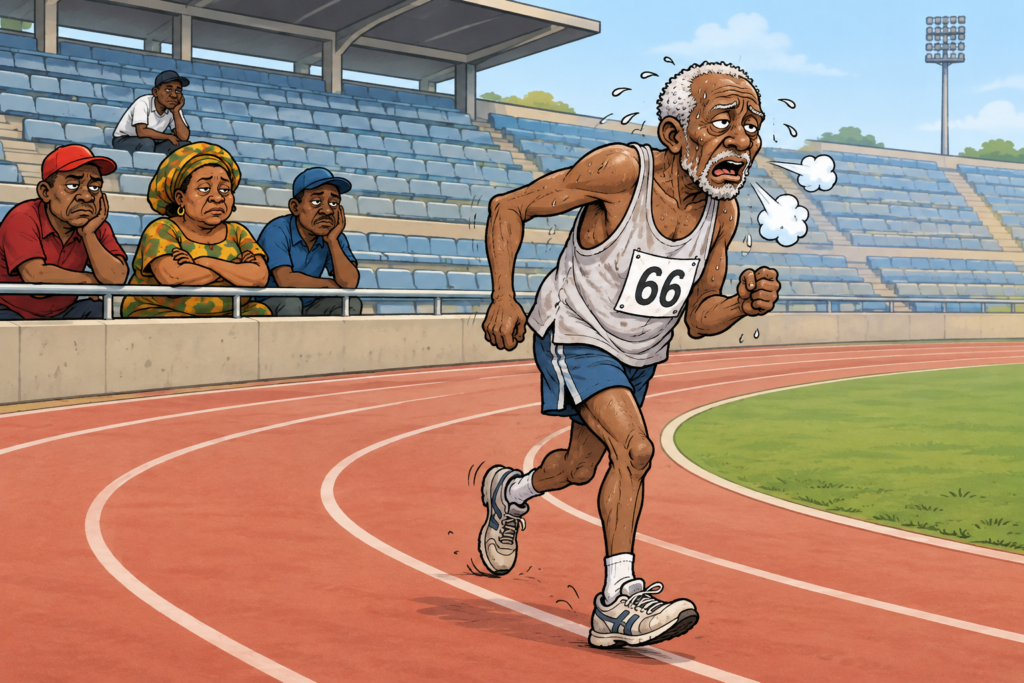
At sixty-six, Nigeria is too old to be forgiven for promise and not yet old enough to be excused for decline. It stands in the middle of life, the age at which a person either consolidates what they were given or begins, quietly, to dissipate it. The world has, by accident, placed capital in Nigeria’s hands. The apprentice has been settled. What happens next will not be decided by the size of the fortune, but by whether the country knew, before it arrived, what it was for.
That is the conversation Nigeria should be having on the first of October. Everything else is the essay we have already written sixty-five times.
**Charles is a contrarian thinker writing from Lagos
