
The Nigeria-Biafra War had been raging for less than a year, but it had already rearranged our lives. I had been born and raised in Enugu and was a student at the College of Immaculate Conception (CIC) when the war broke out. Like thousands of other families, we fled when Nigerian troops took the city. My family retreated to the safety of our ancestral village in Nnobi.
The village was a different world.
No electricity. No running water. The conveniences of city life had disappeared almost overnight.
It became one of my daily chores to fetch water from a stream several kilometres away. I made several trips each day, usually in the company of other boys my age. The playful company and endless banter made the long trips surprisingly enjoyable.
For all the hardship, there was one thing I had in abundance: time.
School had stopped. My father could no longer afford to send me to secondary school in wartime Biafra. He suggested that I return to Primary Six until circumstances improved.
I refused.
I had already spent enough time helping younger children with their arithmetic. Returning to the same classroom as those I tutored seemed, to my twelve-year-old mind, an unacceptable demotion.
But my father was unconvinced. He tested me with problems from our arithmetic textbook.
I solved them all.
So I stayed out of school. Much to my relief.
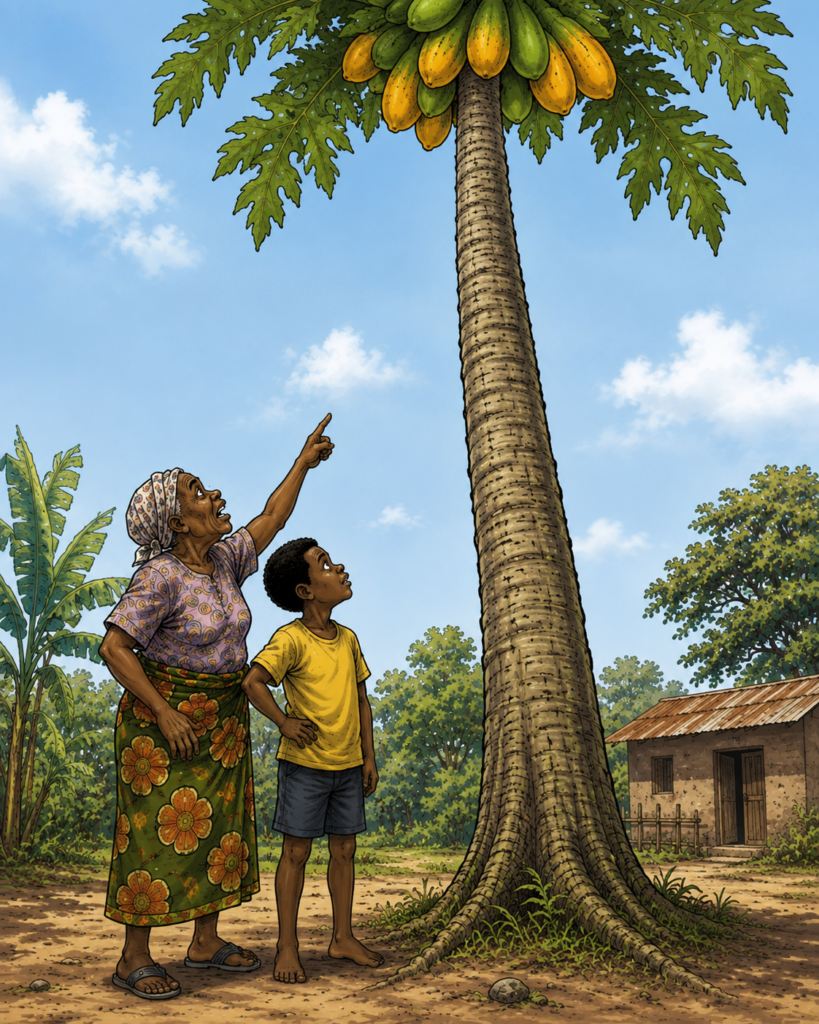
And that was how a boy with too much time on his hands came to be standing beneath a pawpaw tree on a warm March morning in 1968. It was precisely March 13 and just before noon. How could I forget?
The tree belonged to an elderly woman in our neighbourhood, Ngbafor Onye Okwu—Ngbafor the Talkative. She was childless, and on that day she apparently decided that I was the nearest thing to a son she had around.
She asked me to climb up and pluck some of her pawpaws.
I looked at the tree.
It was a tall tree—at least thirty feet high, or so it seemed to me.” Its trunk narrowed dramatically as it rose. But I saw only the fruit.
I was a city boy.
I knew how to climb things.
Or so I thought.
More importantly perhaps, though I wouldn’t admit it then, I wanted to prove a point.
I began climbing.
At first, everything went smoothly. I went up steadily, hand over hand, my eyes fixed on the prize above me. Looking down on the earth below felt good, almost triumphant.
So, up I went.
About halfway up, the tree began to sway gently.
I stopped. Frozen by fear.
What if the trunk broke and I went down with it? What would my father say? Who would console my mother? These thoughts sent a chill down my spine.
As if the tree heard my thoughts, it stopped swaying.
Encouraged, I continued climbing.
It swayed again.
I froze once more.
Was there a conspiracy between the tree and the wind to lure me into a fall?
By then, my hands and thighs were badly bruised. Some of the skin had broken and was bleeding. The rough trunk scraped against the wounds every time I moved.
I should have stopped.
I should have climbed down.
But I had already come too far.
Besides, climbing down felt just as painful as climbing up.
So I continued.
Higher.
The tree grew thinner.
The swaying became more pronounced.
Each time I shifted my weight, the trunk responded with a gentle but unmistakable swing. I would freeze until it steadied, then move another few inches.
From the ground, Ngbafor was still talking.
At some point, I could no longer hear her.
There was only the wind, the creaking of the tree and my own breathing.
Then a ripe pawpaw dropped from above and struck me on the head.
Twaaaahh!
Another followed.
They made a mess of my head and shoulders.
The falling pawpaw fruits added insult to my injuries.
At this point, fear gave way to indignation. I had come this far, I was not going back empty-handed.
From nowhere, I felt a surge of determination. My pain eased.
Looking back now, I realize a twelve-year-old does not understand the difference between courage, ignorance and empty pride.
I kept climbing.
At last, I reached the cluster of fruit and plucked the ones Ngbafor and I had our eyes on. I felt the thrill of victory and rested a few moments to enjoy the feeling.
Then I began the journey back down.
That was when the pain came back, this time unbearable.
The wounds on my hands and thighs were now bleeding freely. Every movement rubbed them against the rough trunk. I had to descend slowly, gripping the tree and placing my feet carefully.
Below me was the ground.
Above me was the tree canopy and a vast blue sky.
There was nothing between me and the ground but my grip on that slender trunk.
And the tree itself was hardly the sort of structure on which anyone should have trusted his life.
One broken trunk.
One failed grip.
One wrong movement.
That was all it would have taken.
I don’t know how long it took me to get down.
I only remember the moment my feet finally touched the ground.
I had survived.
I ran home straight from Ngbafor’s backyard without waiting for my share of the pawpaw. Somehow, I cleaned myself up and went to bed.
I must have slept for over three hours.
When I woke up, I was cold. Not the ordinary cold of a March afternoon, but a strange chill that seemed to have settled somewhere inside me.
Lying there, I began to relive how close I had come to disaster.
If the tree had broken, I would probably have died.
If my grip had failed, I could have died.
If one of those many moments when the tree swung had gone slightly differently, I could have died.
And nobody standing below could have done much about it.
I did not tell my parents.
Not that day.
I was less than three months away from my thirteenth birthday.
That morning, I had climbed a tree in search of pawpaws.
By afternoon, I had acquired something I would carry for the rest of my life: the knowledge that death can stand very close even to a child without announcing itself.
Looking back, I realise that the pawpaw tree was not really the danger.
The greater danger was my ignorance.
I was a city boy displaced by war, out of school and suddenly living in a world whose dangers I did not fully understand. I had mistaken not knowing the danger for being brave.
I was lucky.
Very lucky.
Lucky to come down with my life. And some sense.
And that, all these years later, remains the harvest I remember most.
*Charles Okolue is an engineer and writes from Enugu.
