If Nigeria were a business, it would be a corporate behemoth: vast, complex, layered with authority, and spread across multiple verticals. With a GDP of approximately $387 billion (which, for the sake of argument, I use as a proxy for turnover, contrary to what economists would expect), it would sit in the elite league of Apple (turnover: $416bn), Alphabet ($403bn), Berkshire Hathaway ($371bn), McKesson ($359bn) and PetroChina ($349bn). Its CEO would be a global business icon, speaking with a voice that reverberates with authority. She or he would be highly revered and, most likely, entrepreneurial: not an all-knowing superhuman, but versatile enough to engage intelligently across functions and verticals. For perspective, even the combined turnovers of Africa’s 10 largest firms would still fall short of $387 billion!
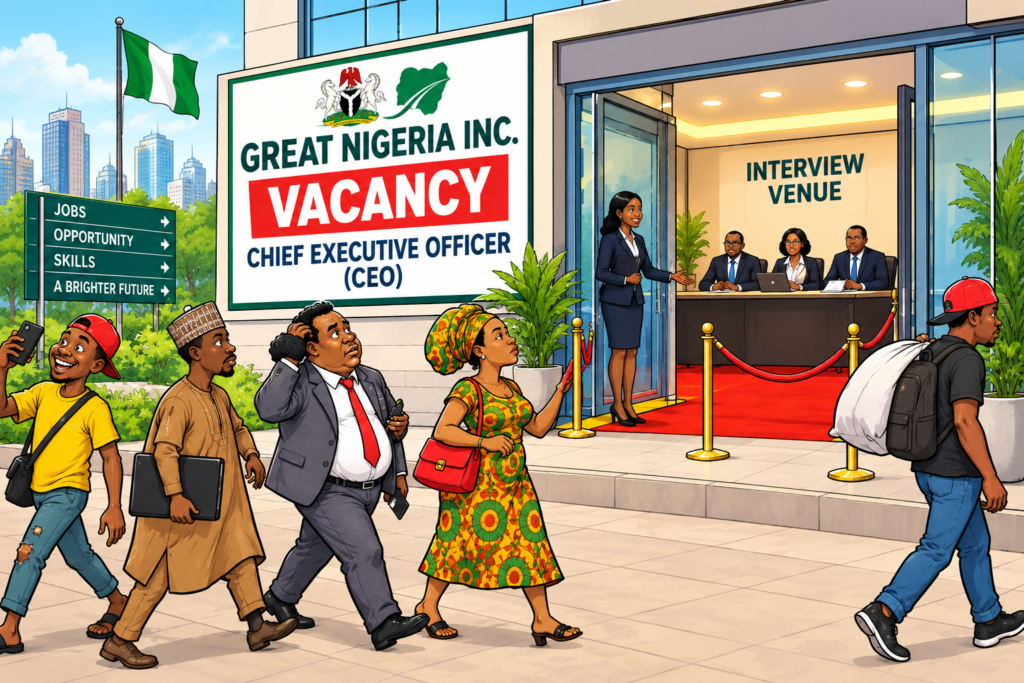
Now imagine a vacancy at Nigeria Incorporated, our hypothetical business. Who would dare apply to lead such a corporate colossus? What gilt-edged CVs would they bring to the table? And how gruelling would the recruitment gauntlet be before one supremely gifted, brilliant candidate rose to the top and secured the job? The point is simple: competing for such a role would be no walk in the park—and certainly no all-comers affair.
But Nigeria is not a business. It is far greater than several big businesses combined—a meta-business, if you like, with vastly more at stake than any of the companies mentioned earlier. Its CEO, then, should perhaps be a super-CEO, if you catch my drift. Yet because Nigeria is just a country, and not necessarily a business, almost every citizen of voting age can aspire to lead it. That has always left me wondering: how many big businesses would consider some of those who want to be president of Nigeria—or governors or legislators—hireable as CEOs or other C-level officers? Would their CVs even survive the first screening? Would they make it to an interview? I have no answers; you, the reader, probably do. But the larger question is unavoidable: if someone is not good enough to lead a mere business organisation, would you entrust them with the leviathan called Nigeria?
Growth complicates a business; time transforms a nation. And time has so altered Nigeria’s complexion that the country of 2026 looks strikingly different from that of 2015, 2019 or even 2023. The economy has taken a pounding from the vagaries of the oil market, inflation, exchange rates and more. Poverty appears to have settled comfortably among us, while inflation has practically earned Nigerian citizenship. The grim human-development statistics are familiar. So is biting unemployment. We export scarce resources, then import what we ought to have in abundance. Meanwhile, the security situation produces fresh conundrums by the day, even as centrifugal forces gain ground. Make no mistake: being president at a time like this is a punishing assignment. Anyone who craves the office must have the stomach for work that turns hair grey. Still, people will want the job. And, ultimately, someone will get it.
Against this backdrop of complexity and crisis, one question demands an answer: what kind of CEO does Nigeria need now? What follows is my rough sketch of the country’s next chief executive. Others will differ, of course. But party leaders, kingmakers and voters must look beyond populist sentiment and think hard about the presidency Nigeria’s present moment demands. We should draw up a set of debatable but useful portraits of that leader—then test every aspirant against them.
Let me be clear: this is neither an indictment of current leaders nor a post-mortem on their predecessors. It is my portrait of the CEO Nigeria needs for the formidable task ahead. Few would dispute that Nigeria is extravagantly endowed with human and material resources; I know of no other country so richly blessed. Yet much of that abundance remains unharnessed and unproductive. If we accept that leadership has been part of the problem, then we must confront the question of what kind of leadership can become part of the solution—starting at the very top.
Throughout this piece, I deliberately cast Nigeria’s president as its CEO. I am not proposing a change of official title; rather, “CEO” captures with particular force the scale and weight of leading a country. The metaphor is not far-fetched: the Nigerian Constitution (Section 130:2) recognises the president as the “Chief Executive of the Federation”—a point former president Olusegun Obasanjo underscores in the second volume of his trilogy, My Watch (pages 67–68).
So, what kind of CEO does Nigeria need now? In my view, one who is both angry and impatient. Angry that, after so many years of nationhood, we are still speaking of Nigeria’s “potential” for greatness. Angry that life has become cheap—and that bandits have made it cheaper still. Angry that the average Nigerian is not expected to live to 60; that literacy remains stuck at just 70%; and that one in every three Nigerians willing to work cannot find employment. Angry that manufacturers surrender 50% of their production costs to energy. Angry that at least 80 million compatriots remain beyond the electricity grid, while many who are connected cannot count on even 12 hours of supply a day, whatever their tariff band. Angry that more than 18 million leaders of tomorrow are out of school. Angry that a four-year degree in a public university can stretch to six because of incessant disputes between government and university employees. Angry that SMEs—especially those owned or run by women—struggle to secure loans and, when they succeed, may face interest rates of 50%. Angry that inflation remains stubbornly in double digits. Angry that Nigeria is still heavily dependent on oil and gas even as climate change becomes a life-and-death global concern. Angry that the average worker may spend an entire career without saving enough to build a home—and without a solid mortgage system to fall back on. Angry, too, at the negative perception of Nigeria and Nigerians, particularly on corruption.
The list goes on. There is more than enough to sustain a deep, enduring anger. But anger alone is useless. Nigeria’s next CEO must turn it into a disciplined resolve to fix these failures—not with seductive quick fixes that collapse over time, but with durable solutions. And that leader must be impatient: impatient enough to assemble the finest Nigerian minds available and drive the sweeping changes the country requires.
Nigeria now needs a CEO who puts the country first—and self last. A leader whose heart is in the right place; who understands, in principle and in practice, the difference between leadership and rulership; and who recognises that sovereignty belongs to the people, not to the person temporarily entrusted with exercising it on their behalf. The office is not about the occupant. It is about the people.
That conviction should inspire a humility rarely seen in our politics: the humility to leave ego at the door and do what is right for Nigeria, even when pride takes a bruising. This CEO must also rise above the narrow pull of ethnicity and the corrosive clannishness that so often bedevil our politics. Above all, the leader must be anchored in ethics, equity and justice.
Nigeria needs a CEO who sees the country’s vast human resources as its greatest asset—more valuable than oil and gas—and proves it through investment in education, health infrastructure, housing, employment, science and technology. With over 18 million Nigerian children out of school, the country is sitting on a time bomb primed by mass illiteracy and ignorance. For those fortunate enough to be in school, the quality of education they receive will determine whether Nigeria develops the human capital it needs to power its growth. At a time when digital literacy has become the currency of technological development, education demands massive investment. So does opportunity. A CEO who truly believes in creating pathways for young people will understand that opportunity is one of the surest ways to wean many from what we call “yahoo-yahoo” business.
Housing must also command urgent attention. An African proverb says a man is not a man until he has a house of his own. The same is true of a woman. That many compatriots still struggle for space under flyovers in this century is surely a stark form of existential dehumanisation.
Then there is healthcare. Nigeria needs a CEO determined to reverse the outflow of foreign exchange that sustains medical tourism. What does it really take to invest in the health sector—or to encourage private investors to do so? What do the countries we flock to know that we do not? The cruel irony is that Nigerian doctors in the diaspora have become linchpins of other nations’ health systems.
Speaking of private investors, Nigeria needs a CEO who understands business—even without having run one. Better still, the country would benefit from a leader with a record of building a successful enterprise. What matters most, however, is a clear grasp of the value of private investment and the resolve to create policies that protect investors and their capital. Such a CEO would reject policy somersaults, multiple taxation and official high-handedness in corporate affairs. The leader must also think beyond the next political cycle and end the country’s ruinous dependence on generators to power industry. Until the power sector works, Nigeria will remain at the back of the industrialisation race; real economic development cannot take off in the dark.
The CEO must understand basic economics, weigh the consequences of every policy choice and treat waste as an enemy—cutting the cost of governance with urgency and resolve.
At a time like this, Nigeria needs a CEO who treats every Nigerian life as precious—and will go to extraordinary lengths to protect it and convince citizens that their lives truly matter. When people know that they matter, patriotism begins to shape their everyday choices. Nothing could be more horrifying than a country in which 100 Nigerian lives appear to be worth less than a thousand naira.
I shudder when official accounts of terrorist attacks or other tragedies, often seeking to correct allegedly exaggerated casualty figures, report that “only 30 died”—as though the loss of 30 lives were not itself a colossal waste. Nigeria needs a CEO who feels the loss of a Nigerian life anywhere in the world. That same commitment must extend to security. The country needs a leader who can overhaul its security architecture and make it effective, proactive and efficient; inspire personnel across the security services to discharge their duties with utmost commitment; and recognise that such commitment also requires taking proper care of the men and women who protect the nation.
Nigeria’s next CEO must be digitally fluent—comfortable using technology to transform governance and strip away inefficiency. But technological confidence must be matched by disciplined execution: a bias for action, certainly, but only after careful thought. Such a leader should also have the humility to admit when plans go wrong and apologise promptly. What Nigeria cannot afford is an “I’m sorry” CEO who repeats the same mistakes and learns nothing from experience.
The CEO Nigeria needs must rise above ethnic sentiment and recognise a truth more fundamental than tribe: whether Nupe, Kanuri, Bwari, Yoruba, Itsekiri, Hausa, Igbo or a member of any of Nigeria’s more than 250 ethnic groups, every Nigerian is first a human being. For such a leader, primordial loyalties and parochial divisions must never determine who gets what—or how anyone is treated. Nigeria needs a unifier with a genuinely pan-Nigerian outlook, one who believes in the oneness of its people and can translate that conviction into national purpose. The vision must do more than make life better for Nigerians today; it must also secure a sustainable future for generations yet unborn.
Nigeria also needs a CEO with the courage to make bold, non-populist decisions whose value may become clear only with time. That leader must scour the world for Nigeria’s finest minds and put them in charge of the ministries where their expertise matters most. The government should be technocratic, with every appointee clear about their responsibilities and bound by an agreed performance charter with measurable targets.
Above all, the CEO must never feel diminished by the ideas or brilliance of ministers and advisers. Only a leader who is intellectually secure can confidently surround themselves with exceptional people.
Nigeria also needs a CEO who can hold his or her own among world leaders—and whose words and actions make Nigerians stand taller. That leader must be versatile, articulate, cerebral and strategic; secure in themselves, impeccable in character and beyond purchase or compromise. As an astute negotiator with strong self-esteem, the CEO should be able to secure reciprocal advantages from other countries without ever making Nigeria look like a supplicant.
Nigeria also needs a CEO who will confront gender bias in all its forms—and prove that commitment through action, not ritual statements issued on International Women’s Day. For generations, women and girls have borne the weight of inherited cultural practices that subjugate them and deny them their full human rights. The time to dismantle those barriers is now.
My use of pronouns such as “s/he” and “they” is deliberate: Nigeria’s (next?) CEO need not be a man, even as men are the major contenders. The country has many formidable women who fit the bill and, given the opportunity, could transform its fortunes. Nigerian politics has been patriarchal for far too long. It is time to change that.
Finally, this portrait may make the CEO Nigeria needs appear almost celestial. It should not be so. Nigerians who fit this profile exist; they have simply been crowded out by a vociferous few who bestride the political space as though no one else mattered. The task now is to find them—especially the many competent Nigerians whose diffidence has kept them at the margins of politics. Can the parties do that work? Can they rise above their internal cake-sharing culture and help Nigeria headhunt a capable CEO? Can 2027 still provide the answer? Of course, no single leader, however gifted, will be a panacea for all our challenges. But the right CEO can reset the tone and standard of national leadership. By action or inaction, the next CEO will either shove the country over the edge or pull it back to safety. So, whom does the cap fit?
Note: This article was first written in 2023. At the time, Nigeria’s GDP (equivalent to business turnover) placed it in the same league as Amazon, Walmart, PetroChina, Apple and Sinopec. That comparison no longer holds: some of the companies have grown much larger and now sit far ahead of Nigeria.
*Dr Nwankwo writes from Lagos.
