
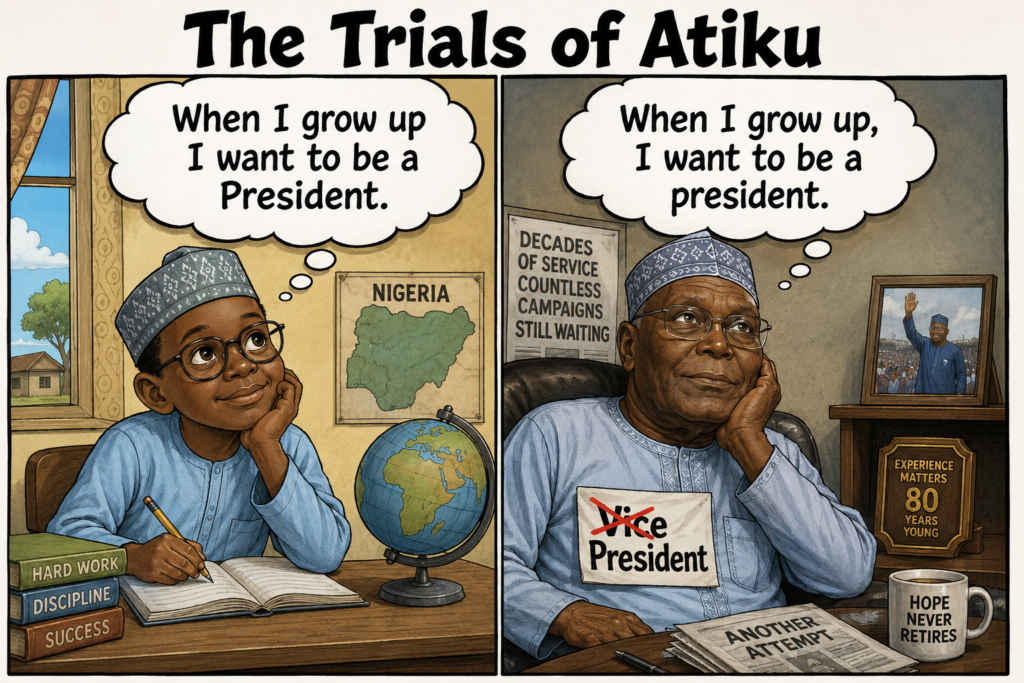
Former Vice President Atiku Abubakar presents one of the most fascinating puzzles in Nigerian politics: a man whose public life has become almost inseparable from his quest for the presidency. Once, as VP, he was a touching distance from the ultimate diadem. Now, some say, it looks like a fading dream.
At an age when many politicians retire into the comfort of elder statesmanship, Atiku remains firmly in the arena. Nearly every election cycle since 2003 has featured his familiar declaration of intent. Parties have come and gone. Alliances have risen and collapsed. Rivals have appeared and faded. Yet one constant remains: Atiku wants to be President and Commander-in-Chief of the Federal Republic of Nigeria.
There is nothing inherently wrong with ambition. In politics as in life, ambition is often the fuel of achievement. The problem arises when ambition ceases to be a means to an end and becomes the end itself.
After more than two decades of presidential contests, Nigerians are entitled to ask a simple question: beyond occupying the office, what exactly does Atiku want to do with it?
Put differently: What is Atiku’s Big Idea? And what does Nigeria gain from it?
This is where the mystery begins.
Most politicians are associated with a defining idea. Some are remembered for economic reforms. Others for social programmes, constitutional restructuring, anti-corruption campaigns, or national integration projects. Yet despite his longevity in public life, Atiku’s political identity remains tied more to his desire for the presidency than to any singular transformative vision.
No one I know can point to his ideological backbone. Some say it doesn’t exist.
His supporters argue that his private-sector experience, advocacy for economic liberalisation, and long record in public service demonstrate a coherent philosophy. His critics respond that these positions have never crystallised into a compelling national project capable of inspiring broad public enthusiasm.
The result is that Atiku often appears less like a man pursuing a mission and more like a man pursuing a destination.
His years as Vice President under President Olusegun Obasanjo only deepen the debate. On one hand, that administration oversaw significant economic reforms and debt-relief negotiations that many observers regard as important achievements. On the other hand, the relationship between President and Vice President eventually deteriorated into one of the most bitter political feuds in modern Nigerian history.
The mutual accusations that followed have become part of political folklore. Obasanjo’s subsequent writings offered a harsh assessment of his former deputy, while Atiku’s supporters have long dismissed those criticisms as the grievances of a former ally turned adversary.
Reasonable Nigerians may disagree on who was right.
What is harder to dispute is the impression that Atiku’s personal political advancement has consistently taken precedence over national vision and the search for public good.
This is particularly evident whenever the question of power rotation emerges. Since the return to democracy in 1999, Nigeria has largely operated on an informal understanding that the presidency should rotate between North and South. The arrangement is not enshrined in the Constitution, but many regard it as an important mechanism for national stability.
Atiku disagrees. He shows up each time, whether it is the turn of the North or not. He says it is his constitutional right.
Atiku’s detractors argue that showing up at nearly 80, even when it is the turn of the South, is proof that he is not a team player and prioritizes personal ambition over national cohesion. They say this is a chronic case of “Emi Lokan” (It is my turn), a phrase made infamous by President Bola Tinubu. His defenders counter that democratic competition should not be sacrificed on the altar of unwritten agreements.
Both arguments have merit.
Yet politics is not merely about what is permissible. It is also about what is prudent.
This is perhaps why Atiku’s repeated candidacies generate such strong reactions. To his supporters, they demonstrate perseverance. To his critics, they suggest an inability to recognise when personal ambition should yield to broader political considerations.
The irony is that Atiku may have spent so long pursuing the presidency that the pursuit itself has become his political brand.
Every four years, Nigerians hear the familiar speeches, watch the familiar negotiations, and witness the familiar coalition-building efforts. The country changes. The economy changes. Political parties change. Even voter demographics change. But Atiku remains remarkably consistent in his determination to make one final attempt.
And then another final attempt.
And perhaps another.
At this stage, the question is no longer whether Atiku wants to be President. That much is obvious.
The real question is whether Nigerians can clearly see what Atiku wants for Nigeria that cannot be achieved without him becoming President.
Until that question is answered convincingly, many voters will continue to view his candidacy less as a national project and more as a personal quest—a long political journey whose destination has remained unchanged even as the country around it has transformed.
There is a thin line between ambition and obsession. There is a thin line between perseverance and poor judgement. The highly respected Turakin Adamawa appears to be walking those lines now. He must decide quickly for legacy’s sake.
There is something admirable about persistence. There is also something cautionary about it.
The difference often lies in knowing when persistence serves a cause—and when the cause begins to serve the persistence.
So, once again, I ask: What does Atiku want for Nigeria, and what does Nigeria gain from Atiku? What is his big idea?
The veteran politician himself and those who speak for him need to speak up on this simple but crucial question because most Nigerians do not know. The time has passed when Nigerians voted on party, regional, ethnic or religious lines. Today they want to vote for people who have smart, sensible solutions to their existential challenges. And practical pathways to their global aspirations.
About the author:
Victor Anazonwu, a member of The Renaissance Online Magazine editorial board, is also a lecturer at the International Center for Regional Integration and Trade Research (ICRITR), Nnamdi Azikiwe University, Awka.
