If history were a Nollywood script, Nigerians would reject it for being too predictable. Yet here we are—watching a rerun of a political drama whose original ending was so catastrophic that it should have been permanently banned from syndication.
The parallels between the First Republic and today’s Fourth Republic are no longer subtle. They are brazen, theatrical, even ominous. Like all good satire, they are also funny—until you remember how the last act ended.
In the early 1960s, Abubakar Tafawa Balewa (hereinafter referred to as ATB) presided over a country already creaking under the weight of ambition and intrigue. By 1963, the federal center had developed a curious hobby: meddling in the internal affairs of the opposition, particularly the Action Group in the Western Region.
The method was simple. Find a disgruntled insider—in this case, Samuel Ladoke Akintola—and quietly encourage him to “redefine loyalty.” The target? Obafemi Awolowo and the cohesive political machine he had built. The objective? Fragment the opposition, capture the region’s votes, and—most importantly—avoid the embarrassment of governing without genuine popular legitimacy, as had happened after the 1959 elections.
By the time the dust settled, the West was politically on fire, elections had become theatrical exercises in pre-determined outcomes, and the country was sprinting—eyes wide open—towards the abyss of 1966.
Fast-forward sixty years.
Enter Bola Ahmed Tinubu (BAT), presiding over a democracy that often behaves like a reality show with a faulty voting system. And, just as in 1963, the ruling establishment has rediscovered its fondness for opposition engineering.
Its first major victim was Rivers State under the opposition PDP Governor, Similalaye Fubara. Its agent? Nyesom Wike, immediate past governor of the state. Appointed FCT Minister, he was armed with federal muscle. The objective? Rivers must remain his, even from Abuja.
As in 1963 Western Nigeria, a democratically elected government was set aside in Rivers State, replaced under emergency rule by a Sole Administrator. And after reconfiguring the electoral software to guarantee a favorable outcome in the next elections, a tamed Governor was reinstalled who swore his allegiance to the Renewed Hope mandate.
Alongside the Rivers heist, the Labour Party was also commandeered.
The script was eerily familiar. Identify someone willing to swim in the mud. Amplify and finance them. That was how a certain Lamidi Apampa emerged—less as a leader, more as a device. The aim? Not ideological victory but structural sabotage. A divided opposition is not an opponent; it is a prop.
And just like in the 1960s, the stakes are electoral. A floundering PDP and fragmented Labour Party weakens the political force that energized millions of young Nigerians—including the so-called Obidient movement—in 2023. It conveniently clears the path for the ruling All Progressives Congress to retain power in 2027, even with a report card that embarrasses its most ardent supporters.
When only one real party remains, elections stop being contests. They become ceremonies.
Of course, 2023 already provided a dress rehearsal. The now-infamous “glitch” in the Independent National Electoral Commission’s result transmission system turned what should have been a transparent electoral process into a national guessing game. Results that were promised in real time arrived fashionably late—or not at all—like politicians at anti-corruption summits.
Nigerians were told, with straight faces, that technology had simply “failed.” Today, APC strategists do not want to rely on the same old trick. They want to do better. They want to control the entire process from design.
But the real poetry of this historical echo lies in its symbolism.
Abubakar Tafawa Balewa: ATB
Bola Ahmed Tinubu: BAT
The same letters. Rearranged. Recycled. Reissued—like a bad currency system that refuses to demonetize.
1963 marked the beginning of the First Republic’s unravelling. 2023 is beginning to look like the Fourth Republic’s biggest crack.
Sixty years apart. Close enough to be coincidence. Far enough to be prophecy.
What is most striking is not just the similarity in tactics, but the similarity in temperament. Then, as now, the architects of political malevolence wore the mask of innocence, yet acted with brazen impunity. Silence became strategy. Distance became deniability. The house burned, and the arsonists stood outside, shaking their heads in theatrical disbelief.
“We didn’t start the fire,” they seemed to say, while still holding the matchbox.
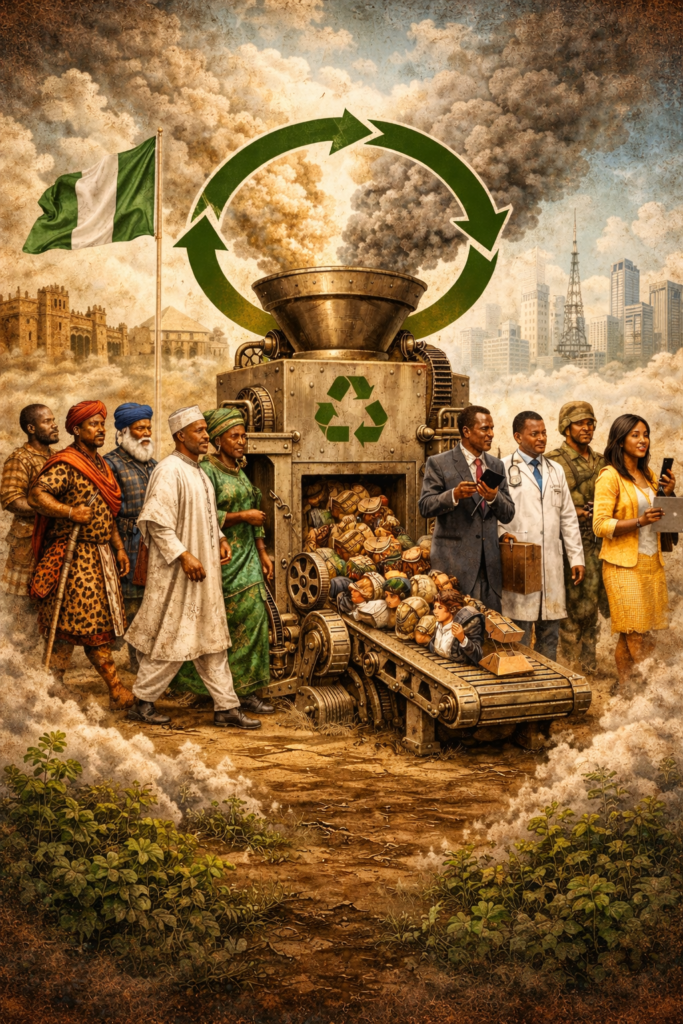
The tragedy, of course, is that Nigerians have seen this film before. They know how it ends. Political manipulation gives way to electoral illegitimacy. Illegitimacy breeds unrest. Unrest invites intervention. And intervention—once invited—rarely leaves politely.
It is at this point that one is tempted to revisit Jean-Baptiste Alphonse Karr, the French writer who famously observed that “the more things change, the more they stay the same.” In Nigeria, this is not philosophy. It is policy and prophecy.
Because what we are witnessing is not just repetition. It is refinement. The methods are more complex and insidious. The language is more polished. The justifications are wrapped in legislative and judicial finery rather than brute force. But the underlying impulse remains unchanged: control the process, manufacture the outcome, and manage the narrative. Ignore all calls for due process.
Democracy, in this context, is not a system of government. It is a stage play—with predetermined winners and an audience that is expected to applaud on cue.
The uncomfortable question, then, is this: are these merely coincidences, or are they warning signs?
Because if 2026 begins to look anything like 1966—God forbid—it will be difficult to claim ignorance. The signs are not hidden. They are blinking, flashing, and, in some cases, trending.
History is speaking. Loudly.
The big question is whether anyone in power is listening—or whether, like their predecessors, they are too busy rewriting the script to notice that the ending has already been written.
When the final act arrives, as it surely will, may we not gather once again to ask the tragic question:
How did we not see this coming?
Victor Anazonwu writes from Lagos.
