
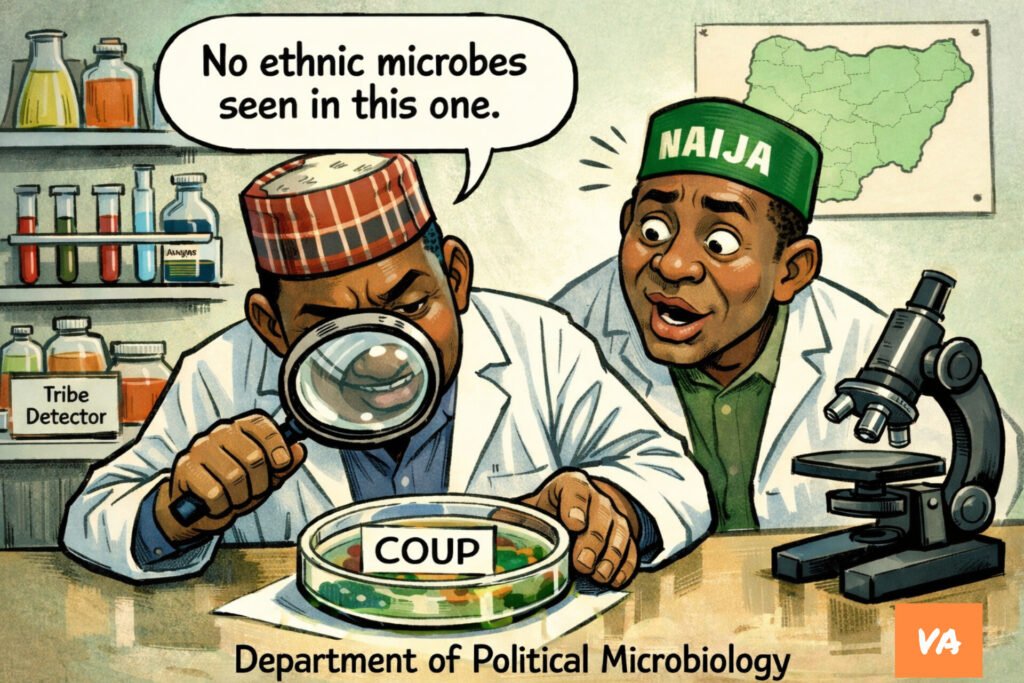
Nigeria has achieved something remarkable. After months of official denial, patriotic throat-clearing, and the usual “nothing to see here” routine, authorities have finally unveiled the list of military officers allegedly plotting to overthrow the Tinubu government. Sixteen officers, we are told, are in detention and preparing for trial. Most reportedly come from Northern states. Their alleged civilian financier, thoughtfully balanced from the South-South, is currently enjoying Nigeria’s well-established tradition of being “on the run.”
Curiously — and perhaps reassuringly — no one has described this development as a “Northern coup.” No emergency ethnic summits have been convened. No regional spokespersons have emerged to issue wounded press statements. No ancestral grievance committees have been activated. Nigeria has displayed impressive restraint. The suspects are being treated as individuals who allegedly committed crimes, rather than as cultural ambassadors sent by their villages.
Progress is a beautiful thing.
Unfortunately, Nigerian history suffers from a stubborn refusal to forget itself.
Let us rewind to January 15, 1966 — Nigeria’s debut appearance in the global coup marketplace. On that morning, five young army majors toppled the notoriously corrupt and deeply unpopular First Republic government led by Prime Minister Tafawa Balewa. Across the country, citizens reportedly celebrated with enthusiasm. Independence had arrived only six years earlier, but the political elite had already perfected the art of converting national hope into private estate development.
Newspapers of the time captured widespread public relief. The government had fallen, and the people were not exactly lighting mourning candles.
Then, in one of Nigeria’s earliest and most successful exercises in narrative engineering, the story underwent a miraculous transformation. Within days, the coup ceased to be a military intervention. It became an “Igbo coup.”
The reasoning was elegant in its simplicity. Four of the five principal officers involved were Igbo. Therefore, the coup was Igbo. Case closed. History adjourned. Logic excused.
The revised version conveniently overlooked certain stubborn facts. For instance, the fifth officer declined to cooperate with the ethnic casting. More inconveniently, the coup plotters reportedly planned to install Chief Obafemi Awolowo — a Yoruba political leader — as head of government. This claim has been corroborated by multiple sources close to the coup plotters, including Yoruba officers. At the time, Awolowo was in prison in Calabar, widely believed by supporters to have been politically framed by the same establishment the coup sought to dismantle.
In short, Nigeria successfully labeled a coup allegedly designed to hand power to a Yoruba leader as an Igbo conspiracy. It was a masterclass in historical creativity.
The consequences were catastrophic. The ethnic branding of the 1966 coup deepened suspicion, hardened regional divisions, and helped fertilize the poisonous political climate that eventually exploded into civil war. Millions of lives were consumed by a story that was less about evidence and more about convenience.
Since 1966, Nigeria has hosted a respectable parade of coups, attempted coups, and rumours of coups — enough to justify a national loyalty card for military interventions. Yet, remarkably, none of these later adventures in unconstitutional enthusiasm have been widely framed in ethnic terms.
When officers from other regions seized power, analysts discussed institutional decay. Commentators blamed military ambition. Scholars wrote papers about governance failure. Nobody summoned tribal census charts to explain constitutional collapse. Coups were treated as professional misconduct, not cultural festivals. Rightly so, until a certain ethnic group is involved.
Nigeria, it seems, practices a highly sophisticated doctrine of selective objectivity. Ethnicity is deployed only when it aligns conveniently with pre-existing suspicions. When it does not, the nation suddenly discovers the virtues of individual accountability.
Which brings us back to the present moment. Sixteen officers, mostly from one region, allegedly conspiring to overthrow a government headed by a president from another region — and Nigeria is behaving with admirable composure. Television panels discuss constitutional order. Security analysts debate civil-military relations. Commentators call for due process. Entire regions are not being invited to apologise on behalf of their ancestors.
One is tempted to applaud. Or at least to blink in cautious astonishment.
But Nigeria has long mastered the delicate art of appearing to learn lessons while secretly rehearsing their repetition. The country does not forget history. It simply rearranges it, like living room furniture, until it matches current political décor.
The deeper problem with ethnic labeling of national crises is not merely that it distorts the past. It manufactures future conflicts. Once a political event is branded with ethnic ownership, it ceases to be a governance failure and becomes a communal accusation. And communal accusations, unlike political disagreements, do not retire. They linger, mature, and occasionally explode.
Ironically, military coups are rarely organised along ethnic lines in their planning stages. They are typically driven by ambition, rivalry, access to state resources, and the enduring belief among soldiers that politicians are irresponsible babysitters of national power. Yet once coups fail or succeed, civilians — who were not invited to the conspiracy meetings — often rush to assign tribal uniforms to events that were primarily about control of the national treasury and its accompanying privileges.
Perhaps ethnicity provides emotional comfort. It is easier to blame tribes than to confront systemic corruption, elite impunity, and chronic institutional failure. Ethnicity simplifies national problems into digestible folklore. Governance failure, by contrast, demands uncomfortable self-examination.
The current alleged coup plot offers Nigeria a rare opportunity to demonstrate genuine political maturity. If the accused officers are guilty, they should be punished as individuals who violated constitutional order. If they are innocent, they should be released without the lingering perfume of regional suspicion. The constitution recognises citizens, not cartographic stereotypes.
Still, history advises caution. Nigeria has a talent for equal justice in the present and unequal storytelling in the archive.
As the country watches this unfolding drama, Nigerians might quietly reflect on the nation’s most successful unwritten principle: All citizens are equal, but some are more equal than others.
In Nigeria, treason may be a crime. But sometimes, depending on who is telling the story, it can also be a matter of ethnicity and geography.
Victor Anazonwu, a journalist, historian and author, is on the Editorial Board of The Renaissance Online Magazine.
