
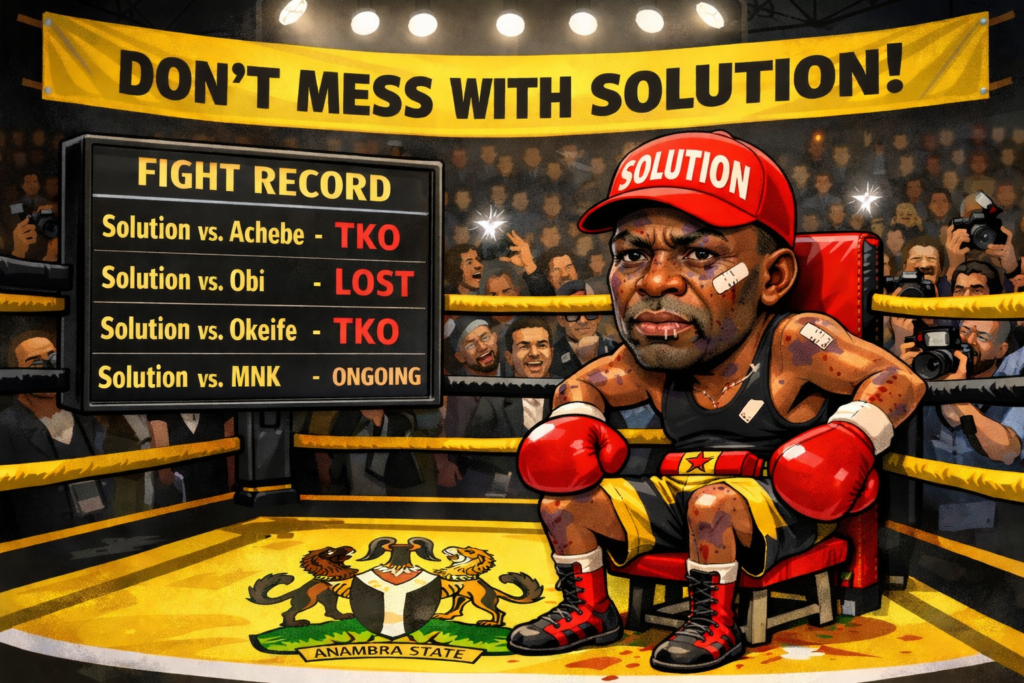
For almost as long as he has been helmsman at Government House, Awka, Professor Chukwuma Charles Soludo—once a high priest of macroeconomics, now an energetic acolyte of retail politics—has displayed a rare and puzzling appetite for controversy. Not the accidental kind. The deliberate, voluntary, “hold-my-beer” variety.
His latest performance came in Onitsha Main Market, that roaring cathedral of Igbo commerce, where the governor arrived with a convoy, a retinue, and a megaphone, as if history itself needed amplification. Mounting a makeshift rostrum by the roadside, Soludo delivered what may yet be remembered as the Sermon by the River.
“The rest of the world will not adjust to our calendar,” he intoned. “Monday is the most important trading day… If you are not ready to open your shop, go elsewhere. We will revoke your shop and give it to people who are willing to work.”
On the surface, this was courage. A governor finally confronting a six-year-old economic absurdity: the weekly paralysis imposed on the Southeast by a sit-at-home order pronounced by an outlawed non-state actor. Instituted in 2021 by IPOB to protest the arrest and detention of its leader, Nnamdi Kanu, the action was initially enforced with fear—random attacks, burning markets, unanswered screams. The state blinked. The people adapted. Mondays quietly died.
Kanu is now serving a long sentence after a winding judicial pilgrimage. The sit-at-home, however, remains stubbornly alive. Soludo has chosen not to end the fight quietly or by consultations, but to stride into the ring, chest bare, demanding a knockout.
And this is where courage begins to look suspiciously like compulsion.
Because this fits into a pattern of behavior.
In 2022, with presidential elections looming, he lunged—uninvited—into another fire. Declaring that Peter Obi, his predecessor and then presidential candidate, had left no meaningful investments in Anambra, Soludo attempted to puncture the balloon of Obi’s national myth. It was an astonishing move: academically bold, politically suicidal. Obi’s record was well documented; his following, fervent. Soludo emerged not as truth-teller but as the jealous uncle at a wedding, muttering about the groom’s shoes.
Then came the palace intrigue. When Soludo crossed swords with HRM Nnaemeka Achebe, the Obi of Onitsha—a man whose authority in Igboland is more metaphysical than constitutional—it was no longer politics but psycho-drama. Achebe, as chairman of the State Council of Traditional Rulers, attempted quiet diplomacy after the governor queried the council over alleged misconduct by one of its members. Soludo responded by firing Achebe. The council was dissolved, reconstituted, and reordered. In the Southeast’s delicate royal ecosystem, this was the equivalent of flipping the ancestral table.
More recently, when Nicholas Ukachukwu and Uche Ekwunife dared to contest for his prized position (as Governorship and Deputy Governorship candidate respectively) in the November 2025 off-cycle election, Soludo literally threw the kitchen sink at them. He called Ukachukwu a near illiterate and said Ekwunife procured a PhD to boost her poor academic credentials. Hell was let loose. Unprintable words were said. Spouses and families were dragged into the fray.
A pattern emerges.
Not Peter Obi.
Not the Obi of Onitsha.
Not Ukachukwu and Ekwunife.
Not IPOB or Nnamdi Kanu.
Soludo, it seems, does not share the spotlight well.
The psycho-political reading is hard to avoid. Soludo is a technocrat who conquered ideas before he conquered crowds and public perception. In the classroom and the central bank, authority was earned by brilliance or appointment. In politics, authority must be performed. And so Soludo performs—dramatically, repeatedly, compulsively—by choosing the most emotionally charged symbol in the room and challenging it to a duel.
The sit-at-home order is not just an economic issue; it is trauma. Peter Obi is not just a former governor; he is an emotional project for a large chunk of Nigeria’s demographic, especially the youth. Ukachukwu and Ekwunife are not just challengers, they represent the ruling APC. The Obi of Onitsha is not just a traditional ruler; he is history wearing a crown. By confronting each, Soludo is not merely governing—he is asserting primacy. He is wrestling for the spotlight.
This is not the confidence of power at ease. It is the restlessness of power that must be seen winning. Always.
Hence the megaphone. Hence the threats. Hence the boiling water.
Which brings us to the now famous claim that sit-at-home Mondays cost Anambra State N8 billion every week. It sounds devastating. It may also be deeply misleading.
What has happened is not economic collapse but economic rearrangement. Igbo traders did not stop trading; they simply moved their Mondays to Saturdays. The markets now roar louder on weekends. The money flows differently, not less. Mondays, in turn, have become a new rest day—arguably the healthiest innovation in a commercial culture famous for grinding itself without mercy.
If Igbo traders were truly hemorrhaging ₦8 billion weekly, no governor would need a megaphone to rouse them. Hunger and their famed appetite for money are far more effective mobilizers than any speech. The fact that coercion is required tells its own story: the economy adapted faster than the state’s economic statistician.
The irony, of course, is that Soludo is often right—technically. Mondays do matter. Fear cannot be policy. Economies cannot heal by ritual paralysis. But politics is not a spreadsheet, boardroom presentation or classroom lecture. You do not debug trauma with ultimatums, nor exorcise fear by shouting at it.
You fish out the bad guys attacking innocent people in the name of IPOB. You provide visible security guarantees for lives and property. You engage market leaders and critical stakeholders. You consult other governors across the Southeast states similarly affected for a coordinated effort—after all, sit-at-home Mondays also happen in Enugu, Owerri, Umuahia, Abakaliki and even Awka. You negotiate a win-win strategy. And Monday markets will most probably resume. But that doesn’t seem to be the Soludo way. It is a choice to which every leader is entitled.
Which brings us back to the question.
Is this Dutch courage—the liquid bravery of a man intoxicated by his own certainty? Or is it political harakiri—the slow, ceremonial disembowelment of goodwill by ego?
History will decide. For now, one thing is certain: Governor Soludo keeps dipping his fingers in boiling water, not because he does not know it is hot, but because he believes—deep down—that pain is proof of courage. Fresh from securing a second four-year tenure, this instinct toward theatrical confrontation may even intensify.
But boiling water is a poor long-term political strategy. It rarely destroys the flame. It merely accumulates scars.
And so the real question may not be whether Soludo wins these public duels. It is what remains of his political capital when the curtain finally falls in November 2029.
Time, as always, will deliver the final verdict.
