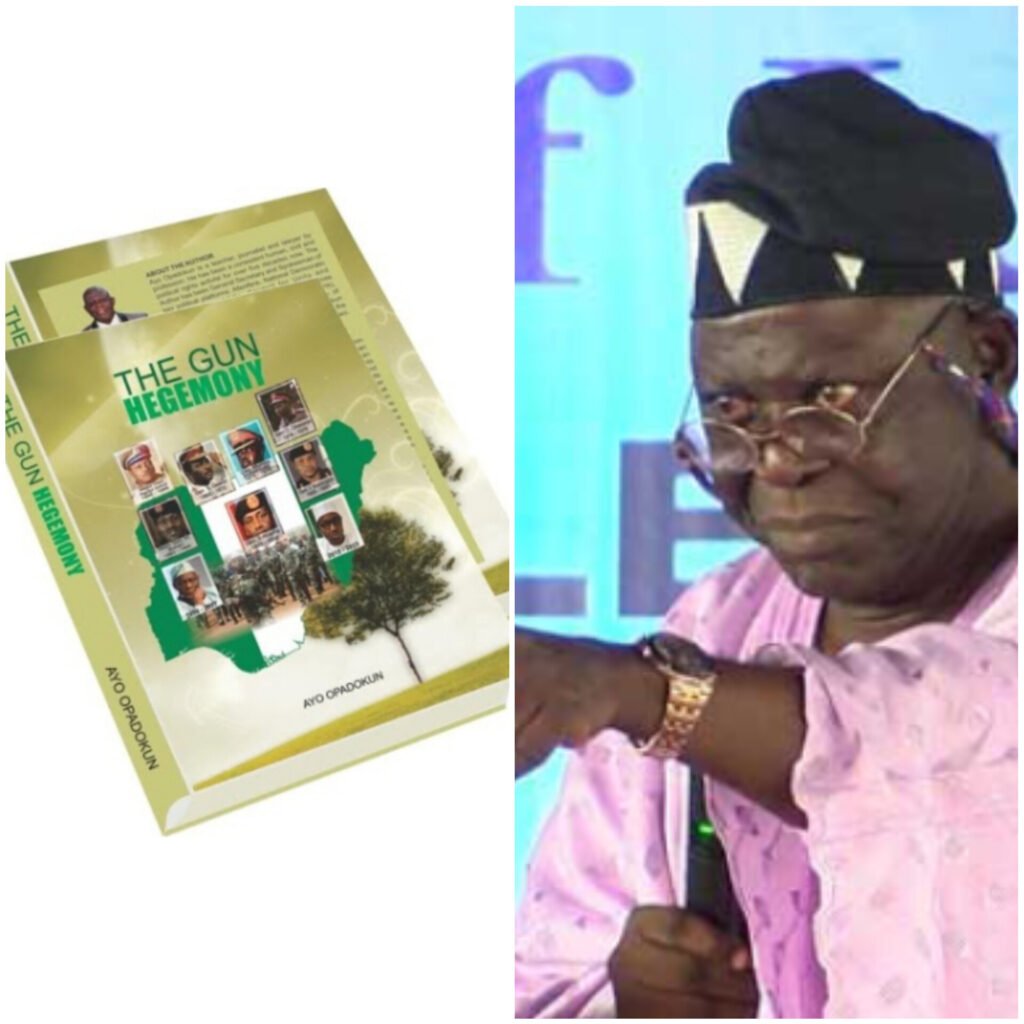
Ayo Opadokun’s book, Gun Hegemony, represents the author’s perennial preoccupation with military rule in Nigeria. His revisionist rendition of that chapter in Nigerian history, is to the critics of his book, an indication that the author has not yet moved on almost 30 years after the nation had transited from military dictatorship into its current democratic space.
Many have also questioned the rationale of presenting the book on the day designated as remembrance day for our fallen heroes. In that regard, it feels like a sickening and insensitive smack on our national sensibilities.
Like the communists/socialists of the early 60s, who were frozen in their dialectical naivety, unable to relate to the global ideological and political evolution, Opadokun has remained within the comfort of his NADECO Hegemony, a period where the whole essence of the Nigerian nation was challenged and berated in the pretext of fighting military rule.
In retrospect, there was no gun hegemony during military rule in Nigeria. Key institutional and democratic traditions persevered. Courts existed and lawyers went to court daily to argue their cases. Today’s courts, even by the testimonies of key stakeholders, offer justice to the highest bidder. So, on what moral pedestal would Opadokun stand to suggest that military era jurisprudence was under the gun?
The Nigerian military didn’t rule entirely by itself. The direction, strategy and policy agenda of the period were designed, coordinated and implemented with the active participation of the politicians and political elites of the time Those who were actively engaged are well-known. But many political leaders of the time offered their services in the dark cover of the night Many in the vocal Southwest and in the ranks of NADECO secretly worked for the various military regimes that governed Nigeria from General Ibrahim Babangida to General Abddulsalami Abubakar.
It was indeed NADECO that lobbied General Abacha to topple Chief Earnest Shonekan, leader of the Intetim National Government, and install Moshood Abiola.
While scholars and commentators on military rule in Nigeria continue to shed more light on the period, it must be stated that contrary to Opadokun’s assertions, the legacy of military rule is not responsible for our current state of hopelessness and underdevelopment.
And his fixation that Military rule was patently dysfunctional and evil is also wrong. Truth be told, that period represents the most consequential developmental epoch of our national history to date – sadly.
Thus, if there’s anything resembling Gun Hegemony in Nigeria’s political evolution, we are living in it at the moment – right under the aegis of a “democratically elected government.”
Today, as most commentators have observed, nearly every notable institution of the Nigerian state, including the legislature, judiciary, sub national governments, trade unions, even opposition parties and the electoral umpire, would appear to have been captured by the ruling party and the presidency. Yet, Ayo Opadokun is not on record to have raised an alarm.
Perhaps the former NADECO chieftain has slipped into intellectual hibernation. In that case, he should wake up and smell the coffee!
Abdullahi Yelwa, a veteran journalist and public affairs commentator, is the Chairman of the Arewa Broadcast Media Owners and Practitioners Forum
