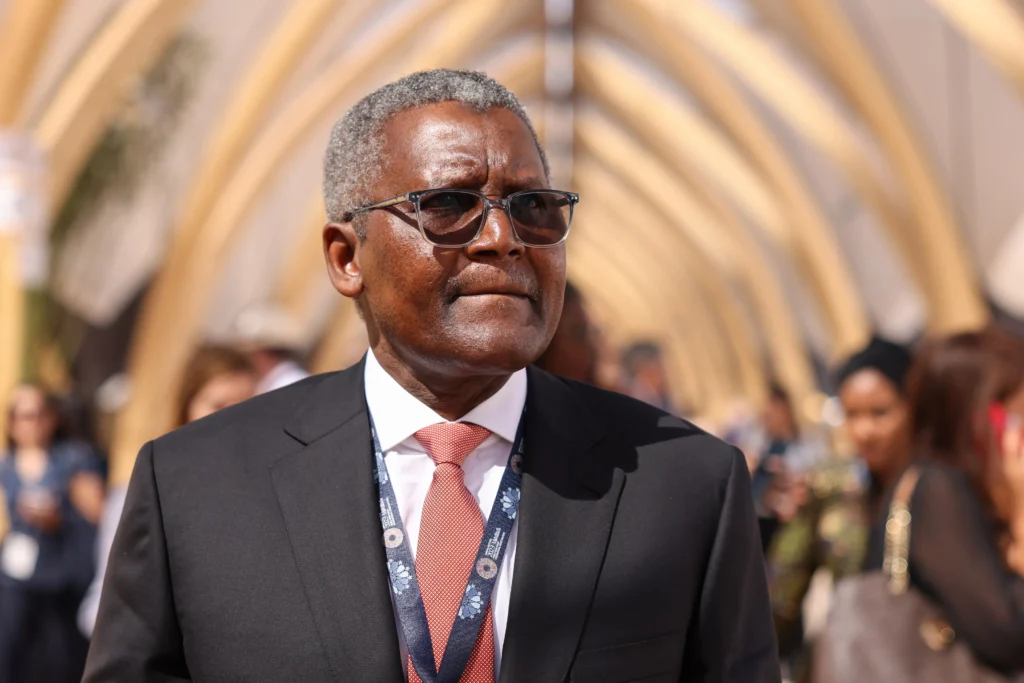
Twice in the past two years, Aliko Dangote—Africa’s most prominent industrialist—has stepped out of the shadows of boardrooms and balance sheets to personally confront what he describes as existential distortions in Nigeria’s oil and gas industry. The first confrontation came over the refusal of the Nigerian National Petroleum Company Limited (NNPCL) to supply Nigerian crude to his newly completed, multi-billion-dollar refinery in Lagos. The second, more explosive episode centers on the continued licensing and importation of refined fuel by the Nigerian Midstream and Downstream Petroleum Regulatory Authority (NMDPRA), even as the Dangote Refinery remains significantly underutilized.
On both occasions, Dangote did not outsource the message to corporate spokesmen or industry lobbyists. He spoke for himself—directly, publicly, and combatively. That choice alone signals the gravity of the stakes involved. When Nigeria’s most powerful private investor abandons diplomatic restraint and takes his case to the court of public opinion, something fundamental has gone wrong.
Each intervention sent tremors through the sector, briefly shifting policy narratives and power alignments. Yet, despite the noise and temporary recalibrations, the underlying contradictions remain unresolved. Dangote, by all indications, is not merely frustrated; he is alarmed. Nigeria is finally happening to Nigeria’s favorite son.
As an African proverb warns, “a frog does not run in broad daylight for no reason—either it is fleeing danger or chasing survival.” Dangote’s agitation is neither theatrical nor altruistic. It is existential. The Dangote Refinery represents the single most consequential private investment in Nigeria’s economic history since amalgamation in 1914. Should it fail, its promoter will almost certainly go down with it. Fortunes of that magnitude are not built on timidity—and they are not defended with silence.
At the core of this controversy lies a principle so basic that its violation should shock any serious policymaker: a regulator has no business trading in the same market it regulates. Dangote is entirely right to expose the mischief inherent in allowing the NMDPRA—Nigeria’s downstream regulator—to simultaneously license fuel imports while actively participating in that same importation ecosystem. Once a regulator becomes a trader, neutrality collapses. Incentives become warped. The rulebook becomes negotiable. Competition ceases to be fair, and the market begins to rot from the inside.
No industry can function properly when the referee is also on the pitch, wearing a jersey, and aiming for goal. In such a system, delays are no longer innocent, approvals are no longer technical, and pricing decisions are no longer neutral. They become weapons.
Yet this is not a morality play with a single villain and a spotless hero. Dangote’s critics are correct to note that the Dangote Group itself rose, in several sectors, under the warm umbrella of state protection. That umbrella, they say, was firmly held up by conniving bureaucrats and compromised politicians to protect Dangote. Cement, sugar, flour, and salt all benefited—at different times—from tariffs, quotas, waivers, and policy barriers that limited competition.
During those years, many other investors suffered. Some were crowded out; others never entered the market at all. Nigeria’s industrial landscape was shaped not by efficiency and scale, but by proximity to power. And Dangote was a prime beneficiary.
History, however, has an unforgiving sense of symmetry. Dangote now finds himself endangered by the same instrument that once insulated him: government protection—this time extended to a public agency that has strayed beyond regulation into commerce. The difference is crucial. Protecting a private monopoly distorts markets; protecting a regulator-turned-trader destroys them. One is bad economics. The other is institutional vandalism.
Still, amid the crossfire, one truth must be stated clearly and without equivocation: an investment of the scale, ambition, and national consequence of the Dangote Refinery deserves to be treated as a strategic national asset. Not because it belongs to Aliko Dangote, but because it belongs—functionally and structurally—to Nigeria’s economic future.
A $20-billion refinery capable of meeting domestic fuel demand, conserving foreign exchange, stabilizing energy supply, and catalyzing industrial ecosystems is not just another private venture. It is infrastructure in everything but name. Serious countries protect such assets jealously. They regulate them firmly, tax them fairly, and challenge them when necessary—but they do not sabotage them through policy incoherence, bureaucratic rivalry, or institutional jealousy.
Ford, General Motors, General Electric, Boeing, Apple, Microsoft, Lockheed Martin, Samsung, Daewoo, Honda, Toyota, Sony, Huawei, Sinopec, Alibaba, Tencent… These are just a few examples of key private enterprises protected as national assets across the globe. For good reasons.
To continue importing fuel at enormous fiscal and foreign-exchange cost while a domestic refinery sits underutilized is not pragmatism. It is economic self-harm and strategic blindness.
Beneath the Dangote–NMDPRA dispute lies a deeper and more corrosive Nigerian reality: for decades, civil servants, politicians, and political appointees with little or no productive investment in the real economy have wielded disproportionate power over it. With no factories to lose, no balance sheets to defend, and no capital at risk, many have treated regulatory offices as toll gates—extracting rents, protecting opaque interests, and converting public institutions into private cash machines.
When their policies fail, they lose nothing. When investments collapse, they walk away untouched. But the nation bleeds—through higher prices, lost jobs, capital flight, macroeconomic disease, and a growing reputation for policy unpredictability.
This is why the Dangote saga must not be trivialized as a billionaire’s tantrum or a clash of oversized egos. It is a stress test of Nigeria’s understanding of regulation, competition, and strategic national interest. Regulators must regulate. Investors must invest. And the state must decide whether it wants to be an umpire or a player—because it cannot be both.
If Nigeria fails to resolve this contradiction, it will not matter who wins this particular dispute. The country will remain trapped in a cycle where institutions cannibalize productivity, policy undermines investment, and strategic assets are treated as bargaining chips rather than national priorities.
That, more than any single controversy, is the real oil spill—slow, toxic, and steadily poisoning Nigeria’s economic future.
About the author
Victor Anazonwu is a journalist, lecturer, author and communication strategist based in Lagos. He can be reached via email on: victor.elipses@gmail.com
