
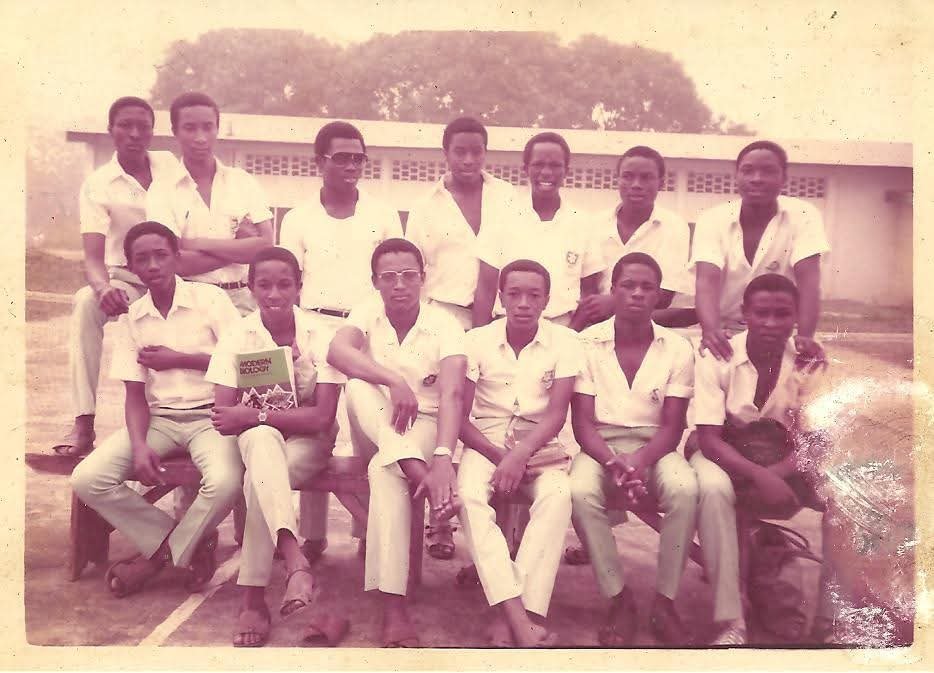
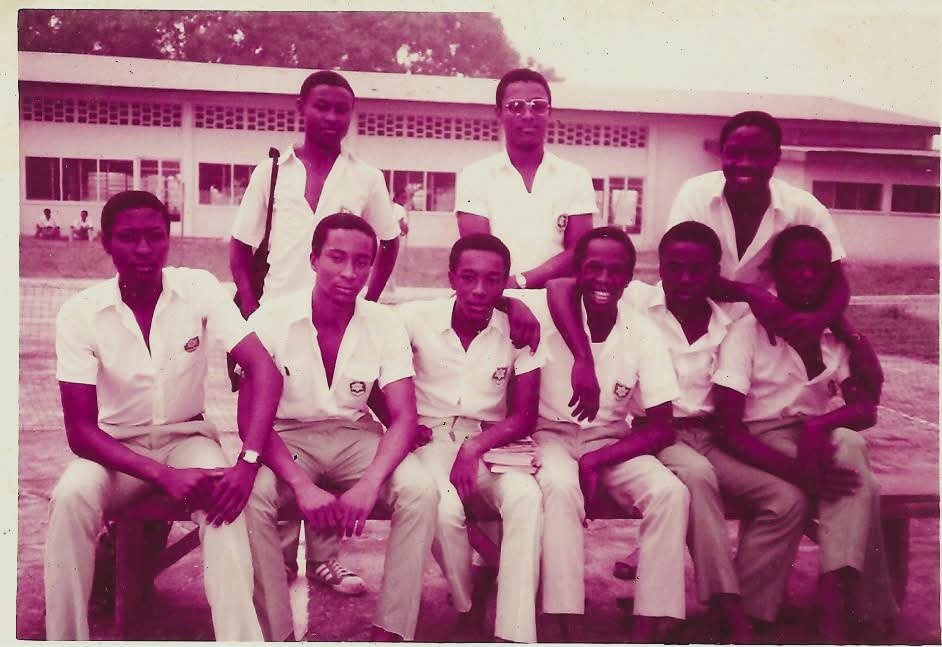
We were Form 5 students of Government Secondary School, Owerri, a school that recently turned 90, having been founded in 1935. Owerri, then 9 years old as the capital of the old Imo State of Nigeria, was the cleanest capital city in the country, a reputation it maintained year after year for quite a while.
This group photo was shot in February 1985, while we savoured the salubrious but elusive Harmattan season, which made everyone sleep soundly for as long as it lasted, before the hellish and sultry dry weather and its skin-scorching humidity of our tropical world returned with vengeance.
We had only 3 months until the commencement of the much-dreaded West African School Certificate exams (WASC). The exams were future-deciding mental exercises which scared the living daylights out of even the most confident and brilliant students, including swots.
In both pictures, I am at extreme right and in physical contact with my mate.
I had arranged for these photo sessions by inviting a young light-skinned, slow-talking mobile commercial photographer, who regularly came into the school compound from the city in those days.
Two of my mates here are now deceased. May God grant their souls eternal rest. Amen.
We stood and sat for the photo sessions on our school’s two tennis courts that were in disuse for most of the time. Back then, tennis balls were white. Wooden racquets, mainly products of Dunlop and Slazenger, were the norm. The next year, 1986, yellow balls, first approved by the International Tennis Federation (ITF) in 1972, but were ignored by Wimbledon in particular, were formally introduced. Yellow is the most visible colour on the planet. And so to enhance the visibility of the ball during games, both for arena-spectators and those viewing at home on their TV sets, the idea behind yellow balls replacing the old white balls soon made sense to pundits and aficionados of tennis worldwide. Boris Becker, Martina Navratilova, Ivan Lendl, and the truculent John McEnroe were the tennis players whose names traversed the length and breadth of the globe. Rafael Nadal had not been born by then.
Oh, it was a different world back then! Upper Volta had changed its name to Burkina Faso in the previous year. Today’s Myanmar was then known as Burma. The African Union was then known as OAU (Organization of African Unity). The UN was known as UNO. The EU was then called EEC.
Film actor and two-term governor of California Ronald Reagan, interestingly lively and personable, was the President of the United States. The richest person in the world in that year was Yoshiaki Tsutsumi of Japan. The richest man in Nigeria was NOT Dangote. The late Alhaji Mai Daribe was.
We paid 20 Naira as school fees, 60 Naira as boarding fees. The commonest car in Nigeria then was Peugeot 504. Mercedes Benz was the car associated with high-society. Lada from Russia, Italy’s Fiat and France’s Renault 12 and Renault 16 were almost gone from the Nigerian roads —as were Toyota Crown of the 1970s, Volkswagen Rio and Volkswagen Igala from Western Germany. There were Benley, Honda CD 185, Vesper scooter, Kawasaki, Suzuki and Yamaha motorcycles imported from Japan. The commonest bicycle in Nigeria was Raleigh, from Britain. The wings of the nation’s carrier, Nigerian Airways, had not been clipped. The most favoured beer in the southern part of the country was Bergedorf, originally a German beer brewed under licence in Nigeria. Lagos was the capital of Nigeria, a country with a 19-state structure. Today’s Adamawa State was then known as Gongola. Edo State we know today was by then called Bendel. The only 2 Igbo states were Imo and Anambra. In the music and entertainment industry, Dizzy K Falola, Jide Obi, Felix Lebarty, Willie Onyeabor, Chris Okotie, Onyeka Onwenu and Sade Adu were among the most famous musicians and singers of the time.
Chief MKO Abiola’s Concord Newspapers filled the newsstands and sold out fast at the hands of newspaper vendors every morning —almost as fast as LAGOS WEEKEND, the controversial weekend newspaper with strong sexual themes which teenagers and children were forbidden to see and touch, let alone read. These were the days when PUNCH Newspapers of Nigeria featured its famous Page 3 Girl —a salacious black and white photo featuring mostly female Caucasians baring their breasts. Most people who bought PUNCH did so MAINLY because of the Page 3 Girl photo. And page 3 was always the first page they flicked open, hurriedly, on obtaining the newspaper. That was the time Binatone electricity supply stabilizer, permanently plugged to the television, sold like hot cake in Nigeria. In block form, like a box, it came with coffee-brown Formica wood adorning its sides, and sold for 44 Naira for quite a long time.
Nelson Mandela was in prison. What only Nostradamus or Baba Vanga would have foreseen was that he would be released exactly 5 years from the moment this photo was shot. The apartheid regime in South Africa reigned on with utter horror. Nigeria was under military rule, for the second time since its independence from Britain in 1960. The military junta was headed by the duo of Buhari and Idiagbon, two stern-faced unrepentant dictators, who ruled with iron fists, and who further intimidated the pusillanimous masses by launching tenets after tenets of their programme designed for the maintenance of law and order, known as WAR AGAINST INDISCIPLINE (WAI). The second in command of the junta, a bald-headed, young man, whose face was never for once publicly photographed smiling, was dreaded more than his boss. Anyone among Nigerians, be they lords of the land or mere pipsqueaks, who raised their voice in opposition was quickly hounded into jail, and without trial. And the masses, including us students, who daily faced three vicious and haughty soldiers posted to our school to ensure brutal discipline, lived in perpetual fear, misery and intimidation.
I still remember the three soldiers’ names. Ntaji, Dalhatu and Zira. My academic set thus became the only one in the history of the school which did not savour the joy and hauteur of senior-boys status. It’s one of the periods in my life I hate to recall. It was a time Nigeria, under the above-mentioned 2 military monsters, severed diplomatic ties with Britain because of one man who had suffered the humiliation of having been crated like a piece of cargo for onward delivery to Lagos, and from Stansted Airport, London. Nigerians know him and can never forget him. And by this time, Nigerians travelled to Britain without visas. That privilege was withdrawn by the Britons just one year after this photo was shot. The ironic sidelight to it all is that the head of the military junta in the period under review was to return to government as a civilian president years after his retirement from the army. A tall, lissome, gap-toothed man from the north, a Fulani, he was the second retired soldier to walk through the avenue of civilian high power in the chequered history of the nation. The next irony clothing the whole scenario around him is that he died this year —40 years after his short-lived military government was toppled by another soldier.
While this picture was being taken, what we did not know, and what only a clairvoyant would have known, was that Michael Jackson and Lionel Richie were putting their heads together in severe privacy, at Michael’s mansion, to write a most important song with a strong message, which would be released just one month later. The song, a rapid response to the frightening hunger and famine in Ethiopia, and sung and recorded by an ad hoc group of genuinely concerned musicians made up of whites and blacks, men and women, all nationals of the United States of America, became instantly and hugely successful. Played on vinyl and cassette tapes as at then, video versions of it were watched mainly on VHS and Betamax video cassettes. Round the clock, everyone in the world was singing, humming or whistling to its ear-and soul-pleasing tune. Today, 40 years after, WE ARE THE WORLD has become a global anthem.
CNN, the first television channel to provide 24-hour news coverage, had launched only 5 years before. One could count the number of houses in Owerri that owned and mounted satellite dishes (status symbols then) with which to receive signals from the celebrated cable news channel in faraway America. Before the advent of CNN, news from foreign lands, and from mainly the BBC and VOA, were received on radio sets. Farmers in the villages too keen on foreign news received clearer signals in the open plains of their farmlands from the BBC, and right on their small transistor radios powered by BEREC and FLASH dry cell batteries, the two most common in the Nigerian electronics market back in the day.
Then, the world had just the next year, 1986, to recognise the supreme talents and prowess in sports of two young athletes —one in the field of soccer and the other in boxing. The soccer god, a squat, aggressive and highly emotional individual from Argentina, would be scoring two unforgettable goals in one match, and in the FIFA World Cup tournament. One of the goals, the very first, was scored with his hand. The boxer, an African American, was just 20 years old when he became the king of the ring. And he reigned with an iron fist, fought in anger and knocked out many of his opponents in the first round.
As we worked hard and observed the most inflexible lucubration for our soon-to-come future-deciding exams, music also rented spaces in our brains to cushion the effects. Lionel Richie’s All Night Long and Stuck on You, released in 1983, were time after time whistled in low tones by those studying privately. So were the tunes from songs of Bruce Springsteen’s ground-breaking album BORN IN THE USA, especially DANCING IN THE DARK, released in 1984. Tina Turner’s What’s Love Got to Do with It, released in 1984, was still lodged firmly in our psyches. Need I mention Purple Rain by the multi-instrumentalist Prince?! The song shook us up positively. I wonder who did not like it —or who doesn’t like it to this day. Earlier in January, Commodores, this time without their old frontman, Lionel Richie, had given the world a beautiful and soul-arresting song titled Nightshift. Dedicated to the memories of Jackie Wilson and Marvin Gaye, who both died in 1984, we students and the rest of the music world were instantly captivated by the great song. We couldn’t wait to dust the rigours of examinations off our system in the month of June before frantically hitting the dancing halls of hotels all over Owerri to get the best from Nightshift.
The Thriller album, released on 30 November 1982, by Michael Jackson, continued to haunt us happily with its songs which never faded from our memories. It was still the most talked-about piece of music in the world in 1985. Many of us found private venues to practise the Thriller unison dance, as performed by Michael and the ‘ghouls’ on that tenebrous night at the cemetery. I dance to it to this day. You can hardly forget what you taught yourself!
We old students who had just graduated in June were home when the wreck of RMS Titanic was discovered by ocean explorer Robert Ballard on 1 September. CNN relayed the event. Until then, the ghostly wreck of the luxury ship had been under the waves, several thousand feet on the bed of the Atlantic Ocean, and undiscovered for 73 years.
Earlier in August, and at home watching the TV, we had been happy witnesses to the surprising victory of the Nigerian Golden Eaglets, captained by Nduka Ugbade, who won the maiden FIFA Under-17 World Cup tournament in China by beating West Germany two goals to nothing.
And we watched and listened with keen interest as the 1980s rolled slowly away, like a magnetic tape on a rotating spool, with its life and times, good and bad.
What we could not have known or imagined or believed if we had been told by then was that, in the future (that future is NOW) science and technology would advance so incredibly and speedily to the extent that some of us in these two pictures who have not met with each other physically in years, in decades, would be communicating through what the world would in the coming years know and refer to as the Internet —a true and puzzling phenomenon. Who would have thought of the Internet, the superhighway of information, by 1985? Communications all over the world via the internet came first through the quiet and somnolent channels of electronic mail, alias email. What happened next in the mould of social media, an integral part of the Internet, so abuzz and agog with social interactions worldwide, news, and life in general, and with its attendant risks and negativities, is interestingly chaotic, and scrambles the brains.
And the world is still evolving, remarkably unrecognisable from the world we knew back in 1985.
With the very best wishes to all who appear in these pictures, and with the sincerest wishes for the good repose, in the bosom of our Dear Lord, of the departed,
This article was first published in and culled from Facebook
