
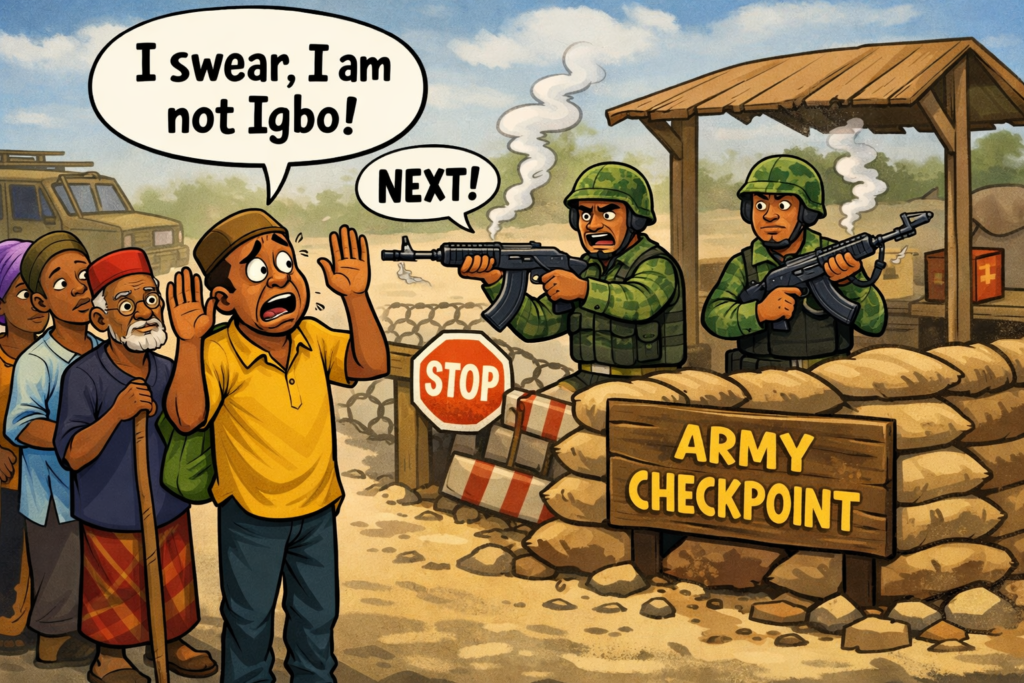
Until July 1966, being Igbo in Nigeria was, in some respects, a badge of honor. The Igbo were among the most geographically dispersed, professionally advanced, commercially enterprising, and socially mobile ethnic groups in the country. They were visible across politics, the civil service, the military, business, and academia. So strong was the Igbo persona that some ethnic non-Igbos, especially from the Eastern Region, did not mind being mistaken as Igbo. Their prominence was such that Ahmadu Bello, then Premier of Northern Nigeria, publicly acknowledged the fear of what he described as “Igbo domination” in his region and made its containment an explicit political goal.
Fast forward to the 2020s. Between November 2020 and Jan 2025, Nyesom Wike, former Governor of Rivers State, now FCT Minister, repeatedly declared that he is “Ikwerre and not Igbo.” The statement triggered a wider public debate. It resurfaced long-suppressed questions about identity among several communities that speak Igbo dialects yet insist they are not Igbo.
This contrast—between Igbo identity as once socially advantageous and now politically dangerous—raises an important question: what changed?
The answer lies not in culture or linguistics alone, but in history—specifically in the violent rupture Nigeria experienced between 1966 and 1970, and in the aftershocks that followed.
That rupture culminated in the Nigerian Civil War of 1967–1970, fought between the Federal Government of Nigeria and the secessionist state of Biafra in the country’s Eastern Region. The conflict, triggered by the 1966 coups and widespread massacre of Eastern Nigerians in the North, became one of the deadliest wars in post-colonial Africa and left deep psychological and political scars that still shape Nigerian public life.
When Identity Became a Matter of Life and Death
The January 15, 1966 military coup marked a turning point. Its leading actors included Majors Chukwuma “Kaduna” Nzeogwu, Emmanuel Ifeajuna, Don Okafor, Chris Anuforo, and Adewale Ademoyega. Although the coup targeted a widely perceived corrupt and unpopular political elite, the absence of prominent Igbo politicians among the casualties allowed a powerful narrative to take hold: that this was an “Igbo coup” intended to impose ethnic hegemony—an accusation that resonated with earlier political anxieties following the federal elections of 1959 and 1964.
The counter-coup of July 1966 transformed this narrative into mass violence. Across parts of Northern and Western Nigeria, people identified—or merely suspected—as Igbo were hunted down, attacked, and killed, often with the indifference or tacit approval of authorities.
Crucially, “Igbo” became a catch-all label, applied loosely to anyone suspected to be from Eastern Nigeria. Or anyone who did not clearly belong to the other major ethnic groups of the North or West.
This indiscriminate violence claimed many Igbo and non-Igbo lives. For example, Major Ekanem, the Army’s Provost Marshal, was executed on a Lagos street after being mistaken as Igbo. He was Efik-Ibibio. Lieutenant A. L. Orok, of Efik origin, was similarly killed in error.
In this climate, Igbo identity became a death sentence. Ethnic profiling precision collapsed, replaced by mob-driven generalization. For many, survival demanded a single, stark choice: deny the identity that made you a target—or die.
From Survival Strategy to Political Instrument
As violence escalated into civil war, identity denial took on additional layers. The Federal Military Government under Yakubu Gowon pursued strategies that weakened Eastern Nigeria’s cohesion, isolated Biafra, and discouraged enlistment in the separatist army. Encouraging or rewarding ethnic fragmentation became a tool of war against the peoples of the then Eastern Region.
At the same time, atrocities against unarmed civilians—including mass killings of “Igbo” populations in places such as Benin and Asaba—reinforced the deadly cost of being publicly identified as Igbo.
The most notorious of these operations were carried out by Nigerian Army units under Lt. Col. Murtala Mohammed who commanded the 2nd Infantry Division. There were several others.
Within Biafra itself, the pressures of war produced reactionary politics. As identity denial and desertion increased outside the enclave, an uncompromising narrative emerged inside: if you are not with us, you are against us. Figures such as Ukpabi Asika—who accepted appointment from the Federal Government as Administrator of Eastern Nigeria—were branded saboteurs. Entire communities, including Onitsha, were stigmatized not for collective actions, but for the political choices of individuals who came from those communities.
Ika, Anioma or “Western Igbos” were among those most affected by the horrors of victimization. Federal troops saw them as “Nzeogwu’s people” because, though born and raised in Kaduna, the ancestral home of Major Chukwuma Nzeogwu, the leader of the Jan 1966 coup, was Okpanam, near Asaba. Under the barrel of the gun, many denied their Igboness, waved green leaves, chanted “One Nigeria” and carried placards welcoming the advancing Federal army in order to have a chance to live.
When news of the mass “betrayal” got to their brothers on the eastern banks of the Niger, emotions ran deep. To many in the Biafran heartland, such denials felt like a family member disowning the household at the moment of danger.
The danger turned out to be real. On October 5 1967, an estimated 700 to 1000 men and boys were rounded up in an open field at Asaba and summarily executed on the orders of Lt. Col. Murtala Ramat Mohammed. Their offence was being Igbo. Official records of the war remain silent on this event.
By the war’s end in 1970, denial of Igbo identity had become not only a wartime survival tactic, but a postwar socioeconomic strategy. Some survivors continued to suppress or obscure their identity to secure jobs, contracts, school admissions, promotions or protection in a Nigeria shaped by victors’ justice. Names were altered. Origins were blurred. Denial became desirable. Silence became inheritance.
A Global Pattern: When Denial Equals Survival
This phenomenon is not uniquely Igbo or Nigerian. History offers many examples where ethnic or religious identity became so dangerous that denial was a rational act of survival.
In the Hebrew Bible, Moses conceals his Jewish origins to grow up safely within the Egyptian royal household. In 20th-century Europe, Jewish identity became a death sentence under Nazi Germany, forcing countless Jews to adopt false names, forged documents, and alternate identities to survive the Holocaust.
During the 1994 Rwandan genocide, many Tutsi survived only by passing as Hutu. In Myanmar, Rohingya Muslims have been compelled to deny both ethnic and religious identity to avoid persecution. Among Armenians during the late Ottoman period, children were absorbed into non-Armenian households, their identities erased to save their lives.
Across contexts, the pattern is consistent: when the state or society weaponizes identity, denial becomes an act of self-preservation.
The Lingering Injury of Defeat
In parts of Nigeria, the children born during and after the civil war often grew up watching their parents suppress who they were. What began as a survival tactic hardened into a psychological inheritance—a quiet, unresolved injury of defeat. Over time, this manifested not merely as fear, but as ambivalence, dissonance, distancing, or even rejection of Igbo identity itself.
Figures who publicly distance themselves from Igbo identity may therefore be better understood as products of Nigeria’s unresolved historical trauma rather than simply as actors in contemporary political theatre.
Understanding this history does not require assigning individual or collective guilt. Rather, it calls for empathy and intellectual honesty. Identity denial in such contexts is not cowardice, nor betrayal. It is what humans do when belonging becomes lethal.
The question Nigeria now faces is not who is “really” Igbo; Historical records, ancestral names, language and customs all provide clear clues. The real question is
whether the country can create a political and social order in which no citizen ever again feels compelled to deny who they are in order to live, belong, or succeed.
About the author:
Victor Anazonwu teaches African Economic History at the International Center for Regional Integration and Trade Research (ICRITR), Nnamdi Azikiwe University, Awka.
————
