“Anambra billionaire kidnapped by gunmen.”
That was one of the headlines making the rounds as I began writing this piece.
I confess I was less shocked by the kidnapping than by the word billionaire used to describe the victim. You see, kidnapping is no longer news in Nigeria. The profile of who was kidnapped is probably more newsworthy. How did the headline writers know the man’s net worth? Of what relevance is it in the circumstance? What signal could this be passing to his captors on the ransom to demand? I felt sorry for the man, his family and friends not just for their ordeal but for its possible aggravation by a thoughtless media narrative.
Nigeria appears to have become a country overflowing with billionaires.
A businessman is kidnapped: billionaire.
A socialite throws a wedding: billionaire.
A politician acquires a new mansion: billionaire.
A young man arrives at a nightclub in a convoy of SUVs: billionaire.
Anyone with extra cash and a semblance of prosperity is tagged a billionaire. No verification needed. It’s a title sometimes earned on social media.
But there is a small problem.
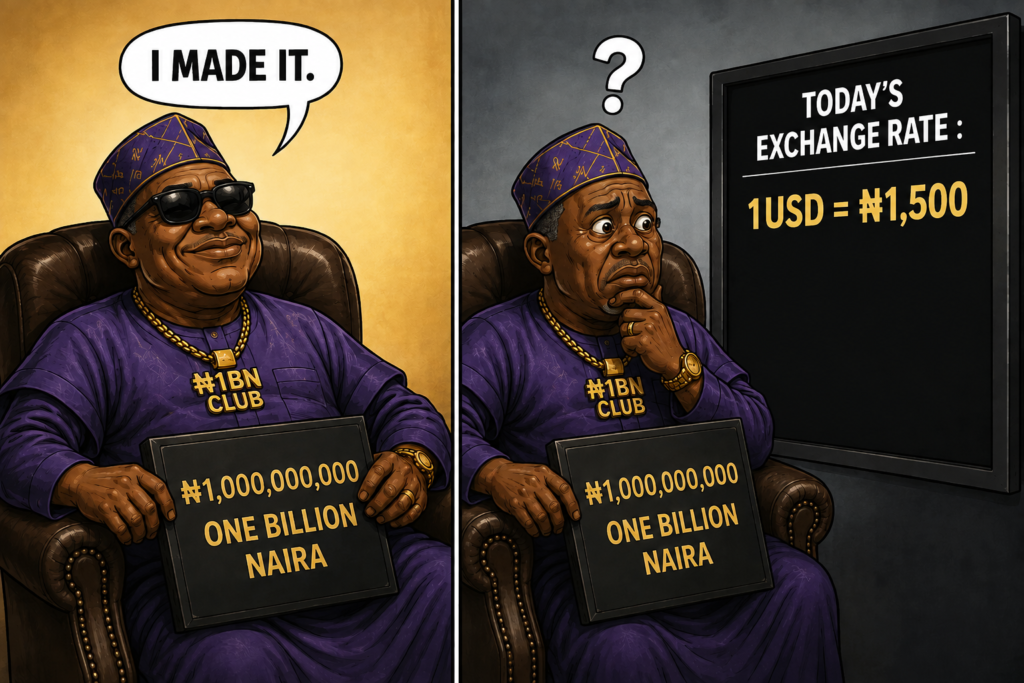
Most of our real billionaires are billionaires in naira.
And that is a very different species.
The Great Billionaire Promotion
There was a time when introducing somebody as a millionaire was enough to generate respect, curiosity and perhaps an invitation to a charity dinner.
Today, tell a Nigerian that somebody is a millionaire and the response may be:
“Okay. And?”
That is because the million has lost its magic.
The millionaire has quietly been made redundant.
A million naira can disappear these days with the speed of a magician saying, “abracadabra!”
Rent. School fees. Food. Transport. Fuel. Electricity. Medical bills. One family emergency.
Before you know what happened, your million has become a memory.
So Nigeria did what Nigeria always does when reality becomes inconvenient.
We changed the vocabulary.
We recalibrated the wealth ladder.
We upgraded those described.
The millionaire became the billionaire.
Problem solved.
Or so we thought.
Bigger Numbers, Smaller Money.
There is an economic principle behind this comedy.
When a currency loses value, the numbers get bigger. Unfortunately, the things you can buy with those numbers do not necessarily get bigger with them.
This produces one of the great illusions of modern Nigeria.
Everybody is talking in millions and billions, so one might assume everybody is swimming in money.
We are not.
We are merely swimming in larger denominations.
A salary can double and purchasing power can halve. A business can report billions in turnover and still struggle with profit.
You can earn more money and become poorer.
N5,000 could buy you a brand new Peugeot 504 in 1980. Today, that sum may not cover daily bus fare to work. If you take the unwise decision to drive, it would buy approximately 4 liters of petrol.
That is the sort of economic magic trick that deserves its own Netflix documentary.
The Billionaire Lifestyle
Nigerians have always admired the evidence of prosperity.
The house. The cars. The clothes. The parties. The jewellery.
Social media has turned wealth into theatre.
The old rich man bought a house and kept quiet.
The new rich man buys the house, unveils it, livestreams the unveiling, posts a drone shot of the roof and writes:
“God has done it again.”
We do not merely want to be rich.
We want witnesses.
In Nigeria, wealth without witnesses is almost wasted wealth.
And once enough witnesses have seen the evidence, the billionaire title follows.
Nobody needs to check the balance sheet.
The Range Rover has spoken.
But Who Is Really Rich?
There is a small complication.
A person can look rich and not be rich.
He can own a mansion and owe the bank. Drive a convoy and have a cash-flow problem. Wear a watch worth millions and struggle to pay a supplier.
And he can be called a billionaire by ten newspapers without having a fraction of a billion naira available to spend.
This matters because in today’s Nigeria, calling somebody rich is not merely flattery.
It can be an invitation.
Kidnappers do not necessarily require audited accounts. They only require the belief that you have money.
And sometimes the media helpfully supply the information.
“Billionaire businessman lives in…”
Thank you very much.
“Billionaire businessman owns…”
Excellent.
“Billionaire businessman travels regularly…”
At this point, the kidnappers may not need Google Maps.
The Politics of Big Numbers
Government has joined the billionaire conversation.
Or perhaps government created it in the first place.
Everything is now big.
Big budgets. Big contracts. Big allocations. Big promises.
We have become a nation of very big numbers.
But a trillion naira sounds enormous until you remember that the value of money is not measured by the number of zeros attached to it.
A larger budget is not necessarily a richer government.
A bigger salary is not necessarily a better salary.
Higher revenue is not necessarily greater prosperity.
While growing up in the 1970s, entire state budgets (there were only 12 states then) were in hundreds of thousands only. Today, each state (all 36 of them) announces a budget in trillions. Yet everyone agrees that the “good old days” were far better.
The number can grow while the experience shrinks.
The Joke Has Come Full Circle
There was a time when Nigerians travelled around West Africa and looked rather smugly at currencies with many zeros.
We wondered how our neighbours managed to conduct everyday transactions with such enormous-looking denominations.
The naira was strong enough to make us feel like economic aristocrats.
Those were the days.
Today, the joke has changed direction.
You can travel with wads of naira notes and still feel poor.
The bundle is impressive.
The purchasing power is not.
The notes have become heavier while the wallet has become lighter.
What goes around comes around.
Even currencies have a sense of humour.
The New Definition of Wealth
Perhaps we should stop asking who is a millionaire or billionaire and ask a more useful question:
What can your money still do?
Can it pay the rent without drama?
Feed the family without calculation?
Educate the children?
Survive an emergency?
Generate enough income to replace itself?
That is wealth.
Everything else may simply be arithmetic.
And this is Nigeria’s great economic irony.
We have not necessarily become a nation of billionaires.
We have become a nation where billion has become the new million. Or far less.
The numbers have grown.
The zeros have multiplied.
But somewhere between the first zero and the last one, purchasing power quietly disappeared.
So congratulations, Nigeria.
We have finally solved poverty—at least mathematically.
We now have an army of billionaires.
Unfortunately, the supermarket cashier has not received the memo.
And she knows exactly what it is worth.
End note:
As I was about to publish this post, a newsflash dropped on my phone: “Kidnappers of Billionaire Businessman Raise Ransom Demand to N1.5 Billion.” My fear has come to pass. The kidnappers are monitoring the news. They want a bigger chunk of the pie. Our billionaire economy has made yet another prime victim. Who will save us from ourselves?
