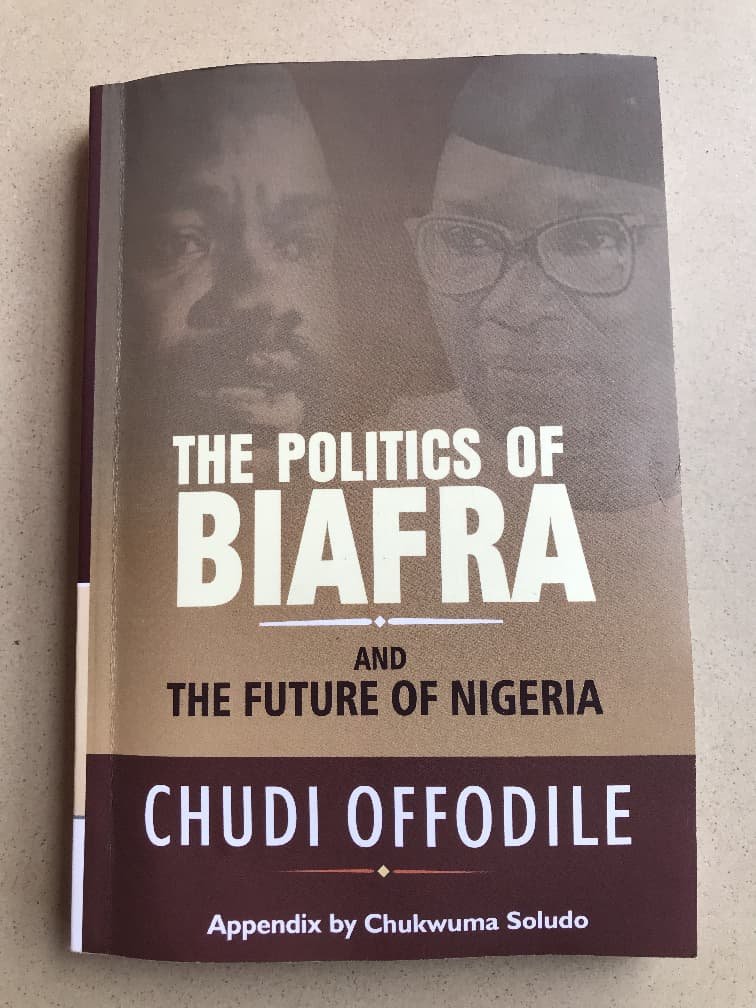
This energetic and deeply reflective book recalls two memorable interventions in Nigeria’s intellectual history. The first is Sonala Olumhense’s 1985 poem, Because I Love You, published in The Guardian Nigeria. The second is Emeka Ojukwu’s 1988 memoir, Because I Am Involved. Both works addressed Nigeria in heartfelt yet critical tones. They were driven by frustration, yes, but also by commitment. That same spirit of troubled belonging largely frames Offodile’s 297-page excursion into one of Nigeria’s most contested histories.
Though first published in 2016, the book still feels remarkably fresh. Its continuing relevance derives not only from the enduring centrality of the Biafra question, but also from the maturity and balance with which Offodile approaches his subject.
One mark of serious commentary is the ability to anticipate future developments. Writing a decade ago, Offodile argued that the revival of separatist sentiment in 1999, symbolised by Movement for the Actualisation of the Sovereign State of Biafra (MASSOB) under Ralph Uwazurike, was partly influenced by the political conspiracy that frustrated Alex Ekwueme’s presidential bid. The circumstances of the People’s Democratic Party convention in Jos in 1999 left many in the Southeast feeling betrayed.
Offodile writes that “collective injury or pain inflicted on a people is not easily assuaged,” suggesting that MASSOB emerged, at least in part, as a response to that outcome. This insight helps illuminate later political developments, including the regional enthusiasm for Peter Obi’s presidential campaigns and the sympathy many southeasterners feel toward Nnamdi Kanu’s agitation.
The Politics of Biafra and the Future of Nigeria is therefore more than a war book. It is a liberal historical inquiry into statehood and nationhood. Offodile guides the reader through historical narratives, power struggles, ethnic identity, personal ambition, political alliances, social justice, constitutionalism, and development. Parts of the work are expository, others analytical, and still others exhortative.
His accounts of the sometimes uneasy relationships between Nnamdi Azikiwe and the Ojukwu family, and between Louis Ojukwu and his son Emeka, are particularly compelling.
Several assumptions about the civil war era are challenged—not through rhetoric, but through careful documentation. Offodile’s prose is lucid, his reasoning clear, and his method notably balanced. He allows historical actors to speak in their own voices wherever possible.
One of the myths he contests is the popular belief that Murtala Mohammed led the July 1966 counter-coup. Drawing on authorised biographies of Yakubu Gowon and Theophilus Danjuma, Offodile argues instead that the decisive actors in Ibadan included Danjuma, Akahan, Walbe, and Captain Martin Adamu. He notes that these officers, rather than Murtala, played central operational roles in the mutiny that reshaped Nigeria’s political order.
Offodile further contends that, amid worsening crisis, Gowon increasingly appeased northern interests in order to consolidate power. Nigeria’s later military history gives this thesis some plausibility.
He also interprets the rejection of the January 1967 Aburi Accord as the product of converging elite interests. For federal permanent secretaries elevated by military rule, and for a government reluctant to devolve authority, the accord posed a threat.
Even revered figures do not escape scrutiny. Offodile portrays Obafemi Awolowo as an influential actor within the Gowon government who, at a crucial moment during the Organisation of African Unity summit in Kinshasa, took a line unfavourable to mediation by insisting on non-interference in Nigeria’s internal affairs.
Nor is Emeka Ojukwu spared. Offodile suggests that by 1968 Ojukwu, too, had become captive to the logic of power when he declared at an OAU summit that Biafra’s sovereignty was non-negotiable, despite contrary counsel from Azikiwe. Yet the author rejects the simplistic claim that Biafra itself was merely the product of Ojukwu’s ambition. Rather, he presents it as the aggregate will of a people under existential threat.
Importantly, Offodile underscores the multi-ethnic composition both of the January 1966 coup plotters and of the Biafran state itself. He highlights the roles of non-Igbo Biafrans such as Philip Effiong, N. U. Akpan, and M. T. Mbu. This broadens the narrative beyond ethnic reductionism.
Another intriguing argument links the Ogoni leadership crisis of the 1990s to unresolved wartime alignments. Offodile notes that while Ken Saro-Wiwa aligned with Nigeria during the war, other Ogoni figures identified with Biafra. Whether one accepts the full thesis or not, it is a provocative reminder that civil wars cast long shadows.
The book also identifies three broad currents of opinion among Easterners during the conflict. First were the outright opponents of Biafra, represented by Ukpabi Asika. Second were moderates such as Azikiwe, who viewed Biafra as leverage to renegotiate Nigeria. Third were diehards such as Ojukwu and Chinua Achebe, who believed negotiations became impossible after Lagos repudiated Aburi.
Among the book’s more humanising anecdotes is the revelation that Asika’s wife, Chinyere, was reportedly pro-Biafra, creating serious domestic strain. Such stories capture the emotional and moral complexity of that era.
Ultimately, Offodile argues that the futures of Biafra and Nigeria are inseparably linked. Beyond marginalisation and the distortions of quasi-unitary rule imposed by military centralism, he also identifies poor leadership in the Southeast as a factor sustaining separatist sentiment.
While acknowledging Ahmadu Bello as a committed federalist, Offodile states unequivocally that Nigeria remains redeemable if liberated from the grip of centralising forces. His preferred destination is a return—not mechanically, but democratically—to the principles of the 1963 Federal Constitution, renegotiated and accepted by the Nigerian people.
This is what gives the book its enduring significance. It is not trapped in nostalgia, grievance, or propaganda. Rather, it is an ambitious synthesis of history and possibility: a plea for Nigeria to confront its past honestly in order to imagine a more workable future.