

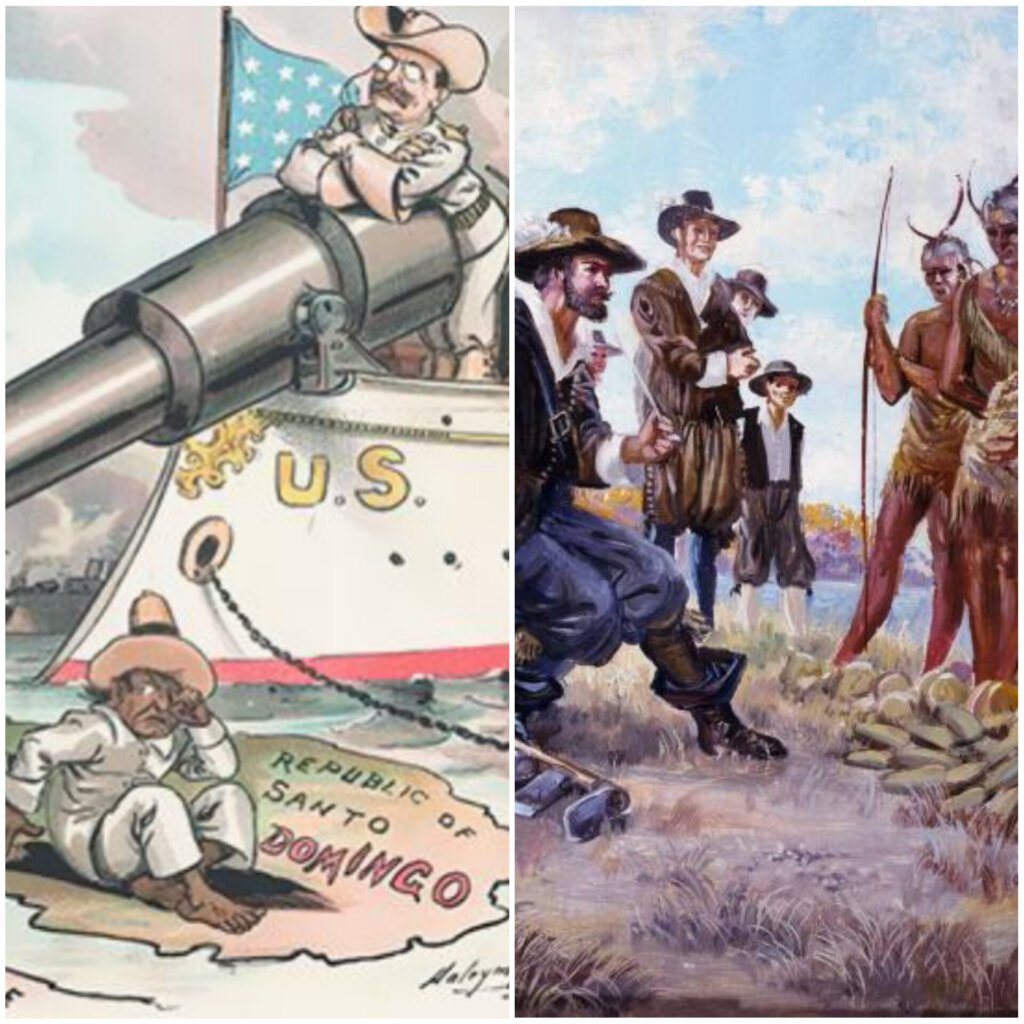
When Europe embarked on its first great wave of modern colonial expansion in the late nineteenth century, the United States was largely absent. Still grappling with the aftermath of its civil war and lagging behind Europe in industrial capacity, America opted—wisely—to remain on the sidelines. European empires carved up the world, extracted its wealth, and imposed their will with gunboats and flags. The United States watched, learned, and waited.
A century later, faced with waning economic dominance, rising geopolitical rivals, and a fast-closing window of technological supremacy, Washington appears to have reached a different conclusion. Under President Donald Trump, the United States has begun to shed the last pretence of liberal internationalism and returned to a cruder, older doctrine of power: that might makes right, and that weaker states exist to be bent, broken, or absorbed in the service of stronger ones.
In 1884, the Berlin Conference formalised Europe’s scramble for Africa, driven by a hunger for cash crops, raw materials, and precious metals to fuel industrial growth. In 2026, a new scramble is underway—this time driven by America’s thirst for oil and its urgent need for rare earth minerals critical to winning the technological race against China.
Two countries stand out as particularly vulnerable targets: Nigeria and Venezuela. Both sit atop vast oil reserves. Nigeria, in addition, is rich in valuable rare earth minerals such as lithium—resources that remain poorly regulated and often controlled by informal networks, armed groups, and local strongmen. In geopolitical terms, these are not just resource-rich states; they are weakly governed prize territories.
Penetrating Nigeria proved relatively straightforward. All Washington needed to do was exploit the country’s long-standing internal fractures. It chose religion. Suddenly, the Trump administration discovered Nigeria’s persecuted Christians, framing the country as a theatre of “Christian genocide” while the Nigerian political elite—mired in corruption and consumed by electoral calculations—stood paralysed by embarrassment and fear.
What followed was a familiar ritual. A limited military strike—symbolic rather than strategic—was carried out in northern Nigeria, far from the main theatres of terror and insurgency. A handful of alleged militants were killed. Graphic images circulated. And that was enough. Abuja, shaken and compromised, quietly entered into understandings that effectively elevated Washington from partner to overseer. Britain and France, former and aspiring colonial masters, were politely but firmly sidelined.
Venezuela, by contrast, was never going to be as pliable. Sitting virtually in America’s backyard, Caracas has long defined itself in opposition to Washington. Under Hugo Chávez—an ideological purist and relentless critic of American hypocrisy—the United States found no entry point. Chávez’s death, under circumstances that continue to provoke speculation, did little to change that reality. His successor, Nicolás Maduro, inherited not only power but defiance.
Previous U.S. administrations attempted regime change through electoral engineering—funding opposition movements and sponsoring alternative leadership. Each effort failed as the Venezuelan state entrenched itself. President Trump chose a more direct route, but even brute force required a moral disguise. Venezuela was accused of being a major conduit for narcotics into the United States; Maduro and his family were branded cartel leaders. Conveniently, little was said about America’s own insatiable demand for drugs—the demand that sustains the trade in the first place.
Few observers believed the narrative. Yet disbelief proved irrelevant. Under the cover of law enforcement and anti-narcotics rhetoric, Venezuela was militarily coerced, its leadership seized, and its sovereignty suspended. The announcement that the United States would “temporarily” administer Venezuela’s oil industry completed the picture. Colonial seizure had been reborn—this time without apology.
This is international brigandage, unapologetically executed. The United States has stopped pretending that it is motivated by democratic values, human rights, or the sanctity of international law. It has revealed itself as a predator state—a twenty-first-century champion of colonial extraction.
The British once gave this practice a name: gunboat diplomacy—the naked use of naval power to coerce weaker societies into surrendering economic assets and strategic autonomy. Hong Kong was wrested from China in 1843 at the end of the First Opium War. Lagos was forced into “protectorate” status in 1851, and Zanzibar followed in 1896 after a brief but decisive display of British military force. The pattern was clear: a show of overwhelming power, a token justification, and permanent loss of sovereignty. Today, the United States is not innovating—it is replicating the same imperial playbook, updated for the missile age.
What happens next depends on the response of the international community. Can a credible coalition emerge to restrain American excess? Will China and Russia be prepared to move beyond rhetoric and actively defend a multipolar order? Or will today’s great powers, like their European predecessors in 1884, simply cut private deals for their respective shares of the spoils?
If history is any guide, the answer may be bleak. And if that is the case, then this new scramble will not stop with Nigeria or Venezuela. It will consume weaker states, especially across the Global South—until resistance becomes inevitable, and the costs of empire once again exceed its rewards.
Victor Anazonwu, a historian, journalist and author, writes from Lagos.