There was a time—distant enough now to feel like folklore—when Nigerians believed democracy meant choice. Ballots. Competition. The occasional upset. Today, however, democracy in Nigeria increasingly resembles a carefully scripted stage play, where the ending is known, the actors are coached, and the audience is expected to applaud on cue.
The latest act in this tragicomedy is the reported delisting of the African Democratic Congress (ADC) by INEC, on the strength of an alleged court judgment procured by one Nafiu Bala. It is a move so predictable it might as well have been printed in last year’s programme notes.
The script is old, worn, and familiar: weaken the opposition, fragment its base, and ensure that when the curtain rises on Election Day, only one serious contender remains standing.
This is not governance. It is choreography.
We are told, with straight faces, that a disgruntled member of a political party may approach the courts—and presto—the entire party machinery grinds to a halt. Structures are paralyzed. Leadership is suspended. Operations are frozen. By this curious logic, the internal disagreement of one becomes the institutional paralysis of all.
At this rate, one wonders why the principle is not extended to the corporate world. Imagine an employee sues his company, and the court orders the business to shut down pending resolution. Banks close. Airlines suspend flights. Hospitals discharge patients. Because one man has a grievance.
That would be absurd.
Yet, in Nigerian jurisprudence, it is apparently sound reasoning—provided the institution in question is an opposition political party.
What, then, becomes of justice?
The very concept presupposes balance: that in granting one party a fair hearing, the rights of others are not trampled underfoot, and the broader interests of society are preserved. Justice is not meant to be a blunt instrument with which entire institutions are bludgeoned into submission. It is meant to be a scalpel—precise, measured, and fair.
If this elementary principle now requires explanation to those entrusted with interpreting the law, then we are no longer in the realm of jurisprudence. We are in something far more dangerous: the deliberate perversion of knowledge in service of power.
Let us not pretend otherwise. Nigeria’s courts are not suffering from ignorance. They are suffering from something far more insidious—a transactional relationship with truth. Outcomes are no longer merely argued; they are anticipated, negotiated, and, in many cases, paid for.
The erosion is systemic, and it has deepened alarmingly under the watch of the ruling APC since 2015.
INEC, for its part, has shed whatever illusions of independence it once wore. Its leadership now behaves less like an impartial umpire and more like an eager understudy in the ruling party’s theatre troupe. When the history of this period is written, it will not be kind in its assessment.
Consider the pattern.
Once upon a time, the PDP was not merely a dominant party; it was the party. When it transitioned into opposition, it retained enough strength to pose a credible challenge. That was before internal fractures were expertly widened and weaponized. Enter the G5 Governors and their most prominent face, Nyesom Wike—a political intervention so effective it left the PDP politically hospitalized. Today, the party lingers in what can only be described as an induced coma.
Then came the Labour Party, an unlikely but potent force in the 2023 elections.
Against all expectations, it surged—galvanizing a restless electorate and threatening to upend the established order. Many Nigerians remain convinced that it won that election, but for what can only be described as electoral alchemy—votes transmuted in the digital ether.
Alarmed, the system responded with familiar efficiency.
A certain Apampa—previously a minor figure—emerged from the wings, clutching legal filings and claiming leadership of a party he had scarcely built. The courts obliged with a series of baffling injunctions, and before long, the Labour Party was entangled in a web of legal and administrative paralysis. Another challenger neutralized.
And so, the displaced political actors did what rational actors do: they sought a new platform. The ADC became that refuge—a coalition vessel for those determined to contest the 2027 elections.
Which brings us back to the present moment.
And the sudden, convenient “delisting.”
If this sequence of events feels orchestrated, it is because it is. This is not the random chaos of a young democracy finding its feet. It is the calculated dismantling of political plurality by those who understand that the easiest election to win is the one in which there is no real opposition.
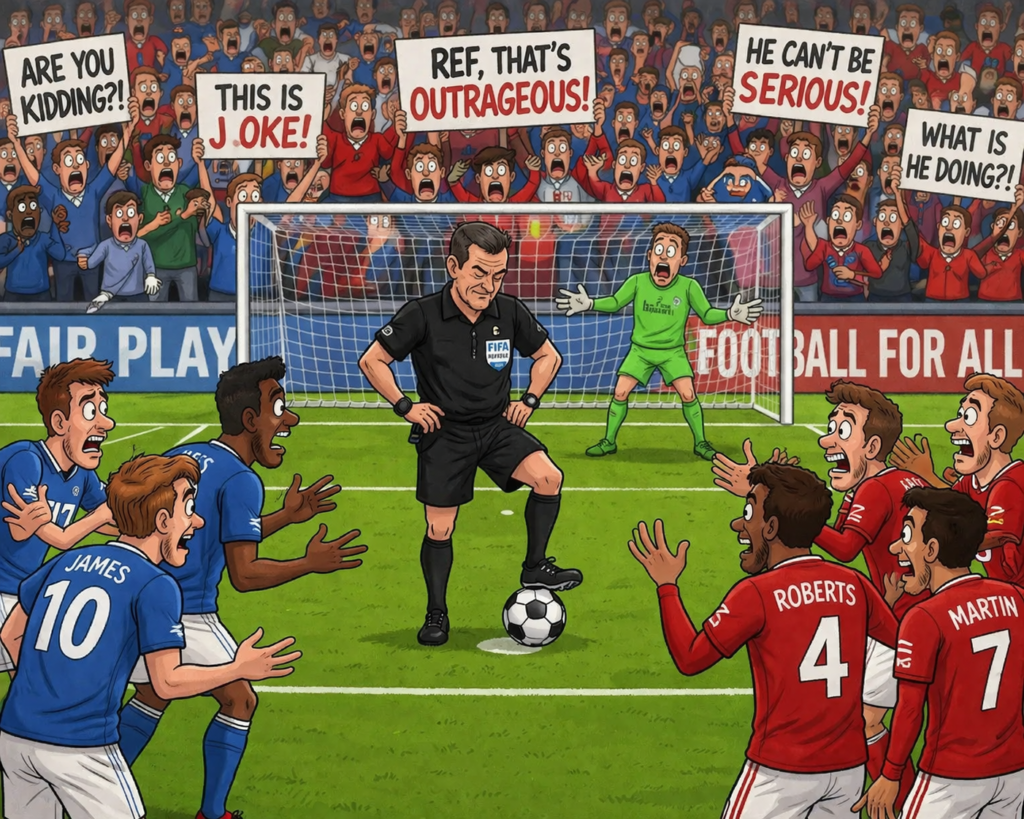
Nigerian politics under President Bola Tinubu increasingly resembles a football match in which the referee, the linesmen, and even the VAR officials are all card-carrying members of one team. Their calls are not just questionable; they are predictably partisan. Goals are disallowed at one end for phantom infractions, while blatant fouls at the other are waved on with theatrical indifference.
The crowd sees it. The television audience sees it. The outrage is real, palpable, and growing.
But outrage alone does not change scorelines.
Unless something decisive is done—by citizens, by institutions that still retain a shred of independence, by voices unwilling to be silenced—the outcome of this match is already written. Not because one team is better, but because the rules have been rewritten mid-game.
This is the tragedy of Nigeria’s democracy today: not that it is failing, but that it is being methodically unmade in plain sight.
And the most chilling part?
The architects of this travesty are not hiding. They are not even pretending anymore.
They have realized what many citizens are only beginning to grasp—that in a system where the referee scores the goals, the final whistle is merely a formality.
Victor Anazonwu is an author, social commentator and university lecturer.
