

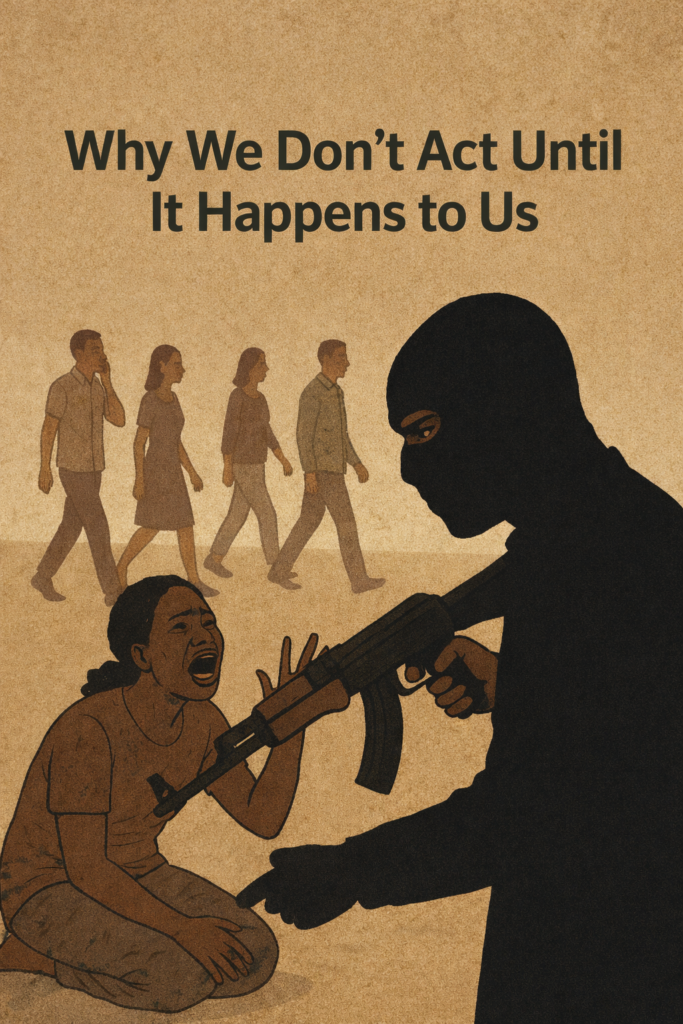
Many years ago, as a teenage student in O’Level history class, I was struck by one unsettling observation: the British conquest of what later became Nigeria was carried out by only a handful of White colonial agents and soldiers. How then did such a tiny force subdue millions across a vast territory well known for their valor and resilience? The answer, it turned out, was quite simple: The British did not conquer Nigeria. Nigerians—or more accurately ancestors of today’s Nigerians—did. How?
Once the British secured a foothold on a coastal community, they recruited young men from such a community. Those recruits eagerly provided intelligence, marched with invading troops, and operated the guns that toppled their own and neighboring kingdoms. It was the same pattern, village after village, until the entire territory fell.
Europe supplied the strategy and the technology; Africans pulled the triggers.
A century later, Nigeria is repeating the same tragic choreography—this time not just under foreign influence but under the weight of internal indifference also. Indifference to the collective good.
Across vast swathes of Northern and Middle Belt Nigeria, rural communities are being attacked, massacred, razed and displaced by terror groups chanting jihadi slogans or common criminals out on a hunt for daily bread. Most of these are not foreigners. They are Nigerians who have no sense of collective ownership or shared future in the Nigerian project. They are like a child who burns down his father’s hut while chasing rats; when the sun and rain come later in the day, he will be without a roof over his head.
The rest of the country—urban elites, political leaders, regional chieftains and even religious institutions—are not much different from the marauding youths. They remain largely unmoved by the plight of rural communities and ordinary folks displaced by systemic insecurity. In Abuja, Port Harcourt, Kano and Lagos, they are sipping tea and popping champagne. Some deny the atrocities outright. Others minimize them as exaggerated or politically motivated. Those who raise an alarm are labeled as enemies of the government of the day.
As long as violence has not reached their doorsteps, most Nigerians consider it somebody else’s problem. They carry on happily. This mindset—that suffering is unreal unless it touches us personally—has produced a dangerous moral paralysis. The same paralysis that our ancestors suffered.
At its core, this paralysis rests on three failures.
First, intellectual laziness.
The evidence of mass killings is overwhelming: eyewitness accounts, civil society reports, social media posts, news and investigative reports, and satellite images. Yet many Nigerians long ago stopped paying attention. It is easier to dismiss uncomfortable truths than confront them.
The second level of failure is at once emotional and moral. It is the absence of empathy. To deny another’s suffering simply because one is untouched is moral abdication and emotional myopia.
Third, spiritual bankruptcy. A people who cannot “mourn with those who mourn” or summon the will to say “enough!” cannot claim meaningful brotherhood or spiritual connection. Nigeria is a deeply religious society, but religiosity without empathy and morality is empty ritual. Public piety is abundant, but a hardened conscience negates it.
One incident stays with me. A Lagos-based Christian professional—well-traveled and devout—once posted online that the killings “were not Christian genocide.” His remark came shortly after U.S. officials sounded alarms about targeted attacks in the North. The backlash surprised him; he quickly deleted the post. But his ignorance exposed a wider truth: Nigerians often live in informational bubbles defined by geography, ethnicity, and personal comfort.
The pattern extends to the top leadership of national institutions. For years, the Nigerian government described the killings merely as “farmer-herder clashes.” Yet they never really bothered to settle the clashes. The Christian Association of Nigeria (CAN) responded with caution, even timidity. A once outspoken bishop began preaching “restraint,” arguing that because he could move freely in his cassock, there was no targeted persecution.
Even elected officials—some of them Christian clergy—downplayed crises in their own states. Victims were buried quietly, labeled generically, and forgotten. Until the next massacre happens.
On the Muslim side, denial takes a different shape. Many say in their hearts, “We are not the main targets,” or “Only a few of us are affected” as collateral damage. And because extremists invoke Islamic terminology, some prefer silence, fearing that speaking out will be misinterpreted as disloyalty to Islam. A few may even indulge the fantasy that if “rival” faiths are wiped out, it somehow strengthens their side of faith.
In Nigeria’s Southwest—so far spared large-scale violence—some dismiss reports from other regions as exaggerations, like a horror film that feels real for a moment but is ultimately unbelievable. Others display open schadenfreude when victims belong to rival ethnic groups. “It is not our people who were killed.”
These attitudes—across classes, faiths, regions and ethnicities—point to an unsettling truth: Nigeria suffers from systemic prejudice, a chronic malnutrition of empathy, and a shortage of national ethos.
History offers painful reminders of where such thinking leads. In 1966, more than 30,000 Igbo civilians were massacred in Northern Nigeria after a military coup led largely (but not exclusively) by Igbo officers. Between 1967 and 1970, the resulting civil war claimed an estimated 3 to 6 million Igbo lives. Others simply shrugged. Igbo claims of genocide are still dismissed. Today, some say, Biafra is happening to other Nigerians.
In 1981, the Maitatsine riots in Kano killed thousands of Christians. Most Nigerians looked away. In 1992, Zangon Kataf erupted in sectarian violence. Again, many were unconcerned.
Since 2010, the killing fields have shifted steadily south and west from Borno to Kaduna, Zamfara, Plateau, Benue, Nasarawa, Adamawa, Niger and beyond. Political elites in Abuja and Lagos live behind police high walls and cruise around in armored convoys. As long as they are safe, Nigeria is safe. No problem.
There is a near total absence of group think or collective responsibility.
But Nigeria is a revolving door. Today one group feels secure; tomorrow it is silenced and becomes expendable. A popular saying now circulates: “May Nigeria not happen to you.” But that is mere wishful thinking. What goes around comes around. The cane used to beat the older wife is not lost; it waits for the younger one.
What few realize is that seeking the good of others is the ultimate act of self-preservation. “Love thy neighbour as thyself” is not mere altruism—it is enlightened self interest.
Until Nigerians rediscover empathy and common nationhood—not as sentiments but as civic duty—we will remain trapped in cycles of violence, denial, and avoidable tragedy. Ignoring one another’s suffering only delays our own turn. The fire we watch from a distance will, eventually, reach our door.
Victor Anazonwu is a Nigerian journalist, lecturer and author based in Lagos.