
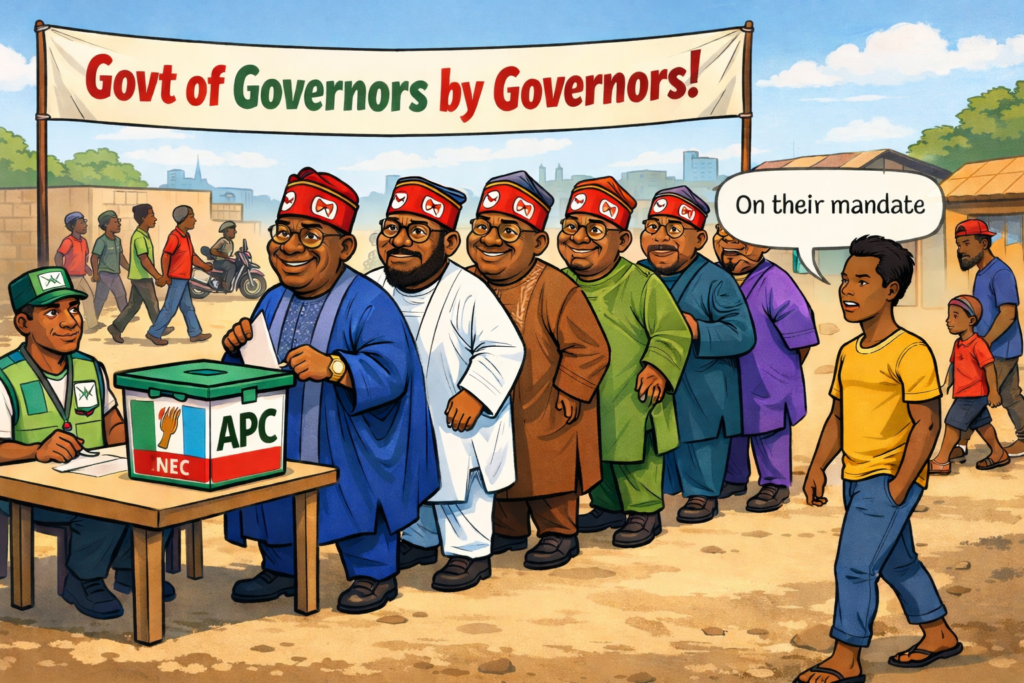
Political scientists around the world must be scrambling for their notebooks as Nigeria quietly pioneers what may become the most revolutionary upgrade to democracy since the invention of the ballot box. President Bola Ahmed Tinubu and his All Progressives Congress (APC) appear to be perfecting a remarkable new governance model: winning overwhelming electoral victories while steadily losing the affection, patience — and possibly votes — of the electorate itself.
It is a delicate, almost artistic balancing act. On one hand, public sentiment, measured through daily grumbling at fuel stations, market stalls, WhatsApp groups, and barber shops, appears to be sinking faster than the naira. On the other hand, state governors — those majestic custodians of Nigeria’s political machinery — are trooping into the ruling APC in what resembles a well-choreographed pilgrimage to Mecca, except this one involves zero religious rites and more political survival calculations. At the last count, 31 of the 36 state governors had moved.
The paradox is breathtaking.
In conventional democracies, political parties usually chase voters. In Nigeria’s emerging prototype, voters are increasingly treated as optional accessories — decorative, ceremonial, and occasionally necessary for queue formation during elections. The real courtship now happens at Government Houses, where governors are discovering the timeless wisdom that if you cannot defeat the centre, you might as well join it — preferably before federal agencies rediscover your file cabinet.
President Tinubu, widely regarded as a master strategist, seems to be writing the code for a new fundamental truth about Nigerian politics: power flows not necessarily from the ballot, but from the intricate plumbing of political structures.
Those who express surprise at this political evolution have not been paying attention. Between 1999 and 2007, Bola Ahmed Tinubu, then Governor of Lagos State, quietly prototyped and arguably patented this very template. Since that era, few individuals have risen to politically consequential positions in Lagos without the unmistakable nod of the Jagaban. The electoral voice of Nigeria’s most diverse and politically sophisticated population was ingeniously muted. Lagos effectively became a one-party state — not by performance, but by political choreography and strategic subterfuge. What was once a state-level experiment now appears to be undergoing national scale-up.
The ongoing migration of governors into the APC is therefore less about ideological conversion and more about gravitational physics. Nigerian politics has always respected the law that objects with sufficient federal mass attract surrounding political bodies, especially those facing re-election, investigation, or retirement planning.
Meanwhile, the ordinary Nigerian citizen continues to perform the ancient ritual of endurance. Security challenges remain stubbornly innovative, with terrorists, bandits, kidnappers, and insurgents displaying entrepreneurial resilience that would impress Silicon Valley venture capitalists. The economy performs a daily magic trick in which prices rise without corresponding salary inflation, creating the rare financial experience of working harder to afford less.
Taxation has also undergone a renaissance. Nigerians now enjoy a vastly diversified portfolio of levies, fees, tariffs, surcharges, and administrative appreciation tokens, ensuring that citizens participate actively in national development whether or not development participates in their lives.
Corruption, that faithful old companion of Nigerian governance, has not disappeared either. It has simply adopted a more sophisticated wardrobe and upgraded its vocabulary to phrases such as “fiscal adjustment,” “revenue optimisation,” and “strategic intervention.”
Under normal democratic circumstances, such governance headwinds might threaten a ruling party’s electoral prospects. But Nigeria is demonstrating that electoral victory may be less about voter choices, and more about logistics.
When governors control state structures, local political networks, grassroots patronage pipelines, and election-day operational machinery, the messy unpredictability of public opinion becomes, at worst, a minor technical nuisance.
Thus emerges what scholars may soon call Executive Federal Electoral Convergence — a system in which the alignment of subnational power brokers virtually guarantees national electoral outcomes, regardless of voter mood swings. It is democracy streamlined for efficiency; Elections upgraded to Selections. Government of governors by governors for governors.
Critics may argue that such a model risks transforming democracy into a spectator sport, where citizens watch election results unfold with the same level of influence they exercise over English Premier League fixtures. But proponents might counter that Nigerians have always valued stability, and what is more stable than election results that can be predicted two years in advance?
Indeed, the Tinubu doctrine appears to be quietly redefining democratic legitimacy. Instead of deriving authority from widespread voter satisfaction, legitimacy may now be sourced from elite consensus or even the sentiments of one man. This is a governance approach that dramatically reduces the volatility associated with mass participation.
This innovation carries certain efficiencies. Campaign messaging can be simplified. Rather than addressing millions of restless citizens, politicians need only maintain cordial relationships with one man, a few dozen governors and their extensive patronage ecosystems. It is governance by VIP invitation list.
Of course, history occasionally reminds political architects that citizens possess an inconvenient habit of re-entering political calculations at unexpected moments. But Nigeria’s political class seems confident that the architecture of influence, incentives, and institutional control remains sturdy enough to manage such disruptions.
As 2027 approaches, Nigerians may therefore witness the spectacle of a landslide victory engineered through structural dominance and electoral voodoo rather than popular vote — a triumph of political engineering over democratic chemistry.
If successful, Nigeria would have gifted the world a bold new democratic formula: elections without emotional dependence on voters. It would represent a triumph of system design and Machiavellian principles.
In the meantime, the Nigerian people continue their stoic national assignment — adapting, recalibrating, and sometimes laughing through the turbulence.
In a republic drifting from elections toward defections and selection, the people may not always choose who governs them, but they will always choose how those who govern them are remembered.
About the author:
Victor Anazonwu, a journalist and author, is on the Editorial Board of The Renaissance Online Magazine. He writes from Lagos.
