

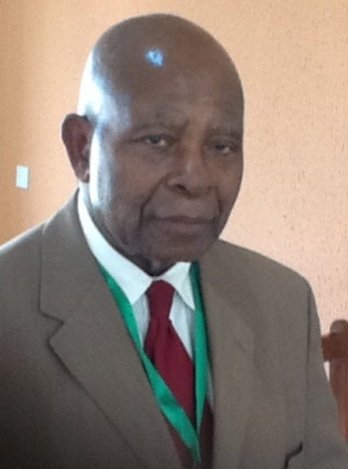
I will always remember this quiet titan.
Dr. James Ibeto Umunna—fare thee well, Baba. You spoke most powerfully through silence, remaining calm and serene amid turmoil. Yours was a rare Socratic, regal stoicism—a presence that commanded respect without noise.
In his classic article “Memories of a School Captain,” Dr. Umunna wrote words that perfectly captured his philosophy of life:
“God has given each person something. Some have intelligence, some have knowledge and wisdom. Some have money; others have riches and wealth. Nobody has everything, and nobody has nothing. Nothing is everything, and nothing is nothing.”
Dr. Umunna was School Captain in 1955. In that same piece, he recalled the morning assembly prayer of the school principal, Mr. M. C. English—a prayer that became a lifelong compass for him:
“Oh God, teach us never to run away from our duties because we are afraid we may fail.”
I first met this great Ogssian iroko in 1993, while researching and gathering materials for the Ogssian Diamond Jubilee Manual. As Chairman of the Diamond Jubilee Planning Committee, we worked closely together. To me, he was a father—one who inspired, counselled, and corrected with grace.
I vividly remember this soft-spoken gentleman listening patiently as I explained my concept. He sat in dignified silence, maintained steady eye contact, and allowed me to finish without interruption. He then asked a few thoughtful questions, smiled, and simply said that I had his full support. He added, almost prophetically, that I was about to do what no other Ogssian had done before.
Those words struck me like cold water. It was only then that the magnitude of the task truly dawned on me.
He made just one request: that I bring the manuscript to him to read and vet before it went to press. I did. As I was leaving, he handed me a letter and instructed that I open it only when I got home.
Oh, Dr. Umunna was a good man.
He blessed me continually, calling often to encourage me. That letter—opened at a moment when I was at my wit’s end—became my turning point. It felt like a letter from God, steadying my resolve and giving me the strength to plod on.
One of his enduring lessons remains etched in my soul: “You do not need to shout to be heard if you are a man of substance. In a situation where everybody is shouting, it is difficult to know who is saying what. People soon notice the man who is saying nothing—and when he speaks, they listen.”
Dr. James Ibeto Umunna wrote the Foreword to the Diamond Jubilee Manual, published in 1995. Today, that book stands as a lasting testament to his presence in the Ogssian fellowship. His articles mirror his personality—measured, thoughtful, principled—and reflect his convictions and approach to life.
As I meditated and gave thanks to God for gifting us this angel, my thoughts turned to other giants of his era—men who mentored and influenced me. I remembered Professor Ogugua Nwankiti and S. M. C. Ahuchogu, his classmates and superb cricketers. I recalled Chief Frank Ekpunobi of Enugu Railways, our neighbour in Enugu, and other distinguished members of the great 1951 set—Chike Wilson Nwizu and Theophilus Akujobi Ajoku. Their images all flashed before me as I paid my respects.
I close by returning once more to Dr. Umunna’s own words from his Foreword:
“This book will serve as a bridge between the old and the new, between information that was lost and what can be retrieved. It will serve as a bedrock on which future events will be documented. I recommend it to all students of the school, past and present, and to all who have something to do with the school.”
On a final note, in 2024 I reached out to Dr. Umunna to commiserate with him on the painful loss of his son, Uchechi Umunna—also an Ogssian. It was a deeply trying period, losing a son so vibrant and full of life.
Fare thee well, Dr. Umunna.
Thank you, Sir, for the love, the wisdom, and that letter.
And as for cricket—the foundation sport—it is alive and well.