
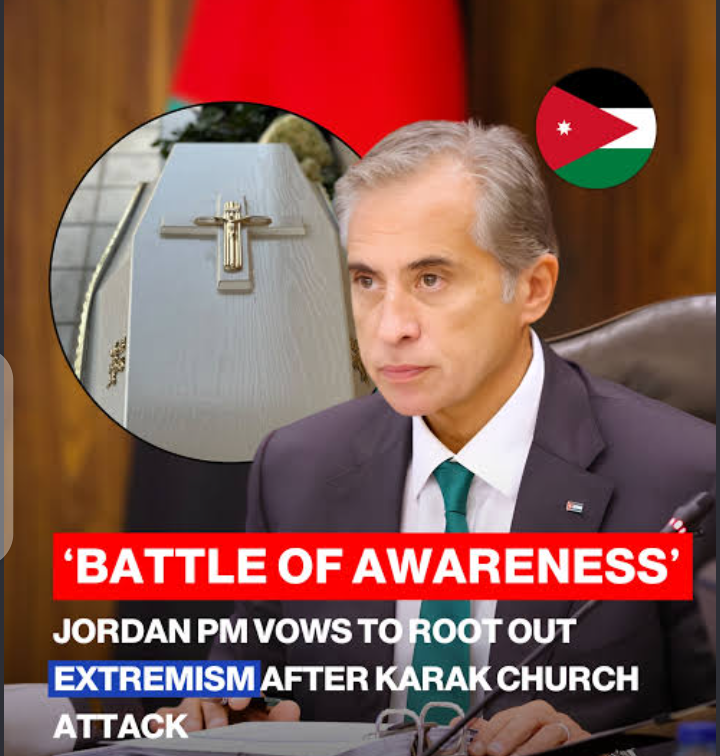
What does responsible leadership look like when terrorists attack innocent citizens? Jordan’s response to a reported church attack offers an opportunity to reflect on Nigeria’s handling of terrorism, religiously motivated violence and the demand for justice.
Following the October 24 2026 attack on a church in Jordan’s Al-Karak Governorate, reports indicated that Jordanian authorities were pursuing those responsible. By dawn of Monday, October 26, all three attackers were cornered in an abandoned building, outgunned and arrested by security forces. They were subsequently identified as two brothers and a brother-in-law with radical Islamic convictions.
The incident raises an important question for every government confronting terrorism: how can justice be delivered while protecting citizens and preserving social peace? The principle is clear: terrorism must be confronted through lawful action. Suspects must be arrested and investigated, evidence gathered, and those found guilty held accountable.
Nigeria faces longstanding security challenges. Communities across the country have suffered killings, kidnappings, destroyed homes and mass displacement. In Benue State, the June 2025 massacre in Yelwata devastated families and farming communities, renewing public demands for security and justice.
Following the killings, President Bola Tinubu directed security agencies to arrest the perpetrators. His administration also called for reconciliation and dialogue (The State House, June 15 and 18, 2025).
Dialogue is not inherently wrong. It can prevent further violence and create conditions for lasting peace. The concern arises when dialogue is perceived as an alternative to investigating crimes, protecting vulnerable communities and bringing perpetrators to justice.
Peace must not come at the expense of accountability.
Imagine losing family members, a home and a livelihood to violence, only to be told that reconciliation is the way forward. For reconciliation to be meaningful, victims must have confidence that their security matters, their suffering is acknowledged and crimes against them will not be ignored.
The people of Yelwata and other affected communities deserve more than expressions of sympathy. They deserve effective protection, transparent investigations and a justice system that treats their lives with dignity and punishes offenders according to law.
The reported bounty against a Christian pastor
The question of accountability also arises when threats against religious leaders are reported.
In April 2026, media reports alleged that an Islamic cleric offered a bounty against Pastor Emmanuel Sunday Garba, whom he accused of blasphemy. The Foundation for Investigative Journalism reported on April 18 that the alleged bounty had increased from ₦1 million to ₦2 million. Nigerian NewsDirect reported on April 20 that the Northern Christian Association called for the cleric’s arrest and prosecution. At the time of writing, no arrest has been reported or confirmed.
These are serious allegations that require impartial investigation. Their legal implications depend on available evidence and the findings of competent authorities.
One principle, however, is clear: an accusation of blasphemy does not authorise anyone to threaten another person’s life or solicit murder. No individual should be permitted to take the law into their own hands.
The appropriate response is to investigate credible threats, protect the person targeted and prosecute where evidence supports criminal charges. The same standard must apply whether the threatened person is a Christian pastor, a Muslim cleric or any other Nigerian.
The reported incident raises an important public-interest question: how effectively do Nigeria’s security institutions respond to credible threats of religiously motivated violence? The public deserves answers based on verified information about the actions taken by the relevant authorities.
Dialogue, rehabilitation and justice
Nigeria’s counterterrorism efforts have included military operations, negotiations, surrender arrangements and rehabilitation programmes. These measures serve different purposes and should be evaluated according to their results and compliance with the law.
Rehabilitation can contribute to peace when former combatants are appropriately screened and reintegration is handled responsibly. However, it must not replace investigations into serious crimes. Equally, surrender alone establishes neither guilt nor innocence; individual responsibility must be determined through evidence and due process.
The government must distinguish between perpetrators, coerced recruits, former combatants and innocent civilians. Justice requires accountability for proven wrongdoing while protecting people who have committed no crime.
This distinction is especially important in conflicts involving ethnicity and religion. Condemning violence committed by individuals or armed groups must never become an excuse to stigmatise entire communities.
Prosecution must lead to justice
There has been movement towards legal accountability in the Yelwata case. Reuters reported on February 2, 2026, that Nigerian authorities had filed terrorism charges against nine men accused in connection with the 2025 massacre.
Filing charges is an important step, but the accused remain entitled to a fair trial, and guilt must be established in court. The public interest lies in ensuring thorough investigations, fair proceedings and adequate protection for affected communities.
Jordan and Nigeria face different security circumstances. One incident cannot establish the overall effectiveness of either country’s counterterrorism strategy. Nevertheless, the obligations of government are universal: protect citizens, investigate credible allegations, prosecute offences supported by evidence and uphold the rule of law.
Dialogue has a place in peacebuilding, just as rehabilitation may contribute to ending armed conflict. Neither should excuse violence or deny victims their right to justice.
The suffering of communities in Benue, the reported bounty against Pastor Emmanuel Sunday Garba and Nigeria’s wider struggle with terrorism all underscore the importance of equal protection under the law.
Ultimately, the question is not whether the government should pursue dialogue or security operations. It is whether every Nigerian, regardless of religion, ethnicity or social standing, can count on the state for protection and justice.
Peace without accountability is fragile, and security without equal protection undermines public confidence.
Nigerians deserve a government that protects the threatened, investigates attacks impartially and ensures that the pursuit of peace never comes at the expense of justice.
**Fr Anwuchie is a Nigerian Catholic missionary based in Niger Republic.
