
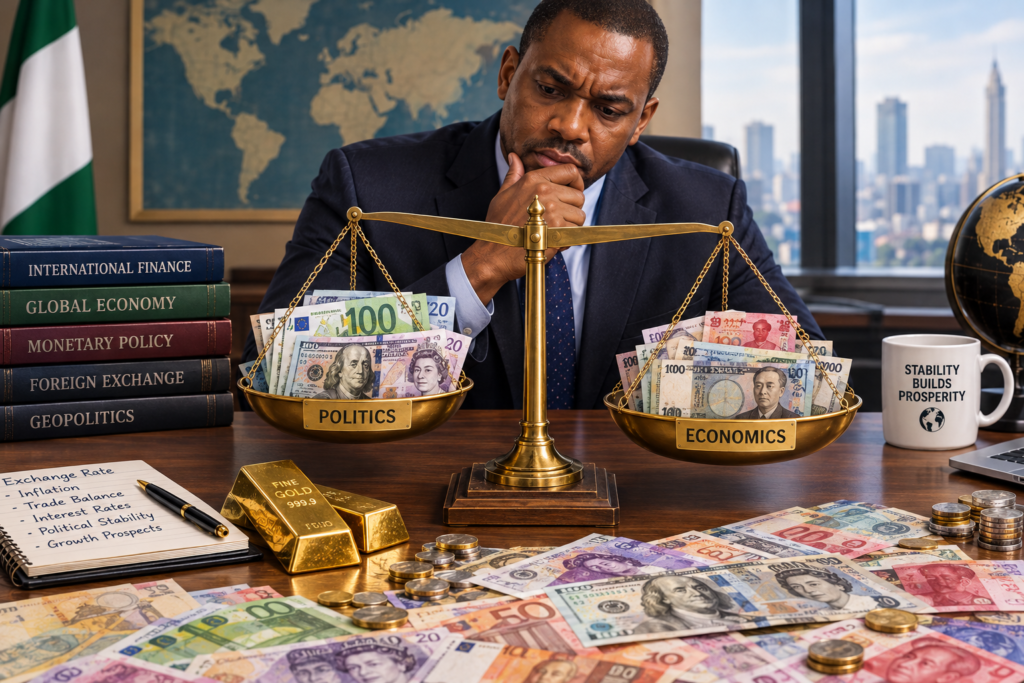
One of the most misunderstood subjects in public economics is the meaning and mechanics of currency exchange rates. Many people assume that the official exchange value of one country’s currency against another is a precise scientific measurement of national wealth, productivity, or relative economic strength. In reality, exchange rates are shaped by a far more complex interaction of economics, politics, trade strategy, market psychology, and government policy. In essence, it is much more subjective than most economists and monetary policy experts are willing to admit.
Let me illustrate. The fact that 1 British Pound exchanges for 1.32 US Dollars today does not mean that the British currency and economy are stronger or more powerful than their American counterparts. At the time of writing this article, the United States was still the world’s largest economy, with greater industrial output, technological dominance, military power, and global financial influence than the United Kingdom. So, the Pound’s nominal exchange value versus the US Dollar simply reflects how the British monetary system is historically structured and how the currency is presently managed within international markets.
Likewise, the fact that 1 US Dollar exchanges for roughly 1,500 Naira today does not mean that the American economy is about 1,500 times larger or stronger than Nigeria’s. Exchange rates are not mathematical scorecards of national value. They are, in large part, monetary and policy instruments shaped by domestic decisions and international economic realities to achieve varying goals.
At its core, a currency exchange rate may be said to reflect the relationship between demand and supply for that currency. But demand and supply themselves are influenced by deeper factors: productivity, exports, imports, inflation, investor confidence, political stability, interest rates, debt obligations, government policy decisions and market sentiments. In this sense, exchange rates are partly economic outcomes and partly political, sociological and even psychological choices.
Seychelles is a small island country of less than 135,000 people off the East Coast of Africa. That’s about the size of the smallest local government area in Lagos or the Kwali LGA of Abuja. It has no known mineral wealth or huge manufacturing capacity. It is best known for tourism and fisheries, two important but globally non-strategic sectors.
Yet the exchange rate of the US Dollar to the Seychelles Rupee as of October 13, 2026 was $1 to SCR 14.2. Does this mean that Seychelles is more productive and economically more powerful than Nigeria—since the Naira was ten times “weaker” at about $1 to N1400 on the same day? Certainly not.
What then explains the country’s relatively stronger national currency versus Nigeria’s Naira? Simple: A steady inflow of Foreign Exchange (FX) from tourism and fisheries; a low outflow of the Seychelles Rupee on imports; low national debt arising from a largely contented and self-reliant population; and prudent fiscal policy by successive governments in a stable political environment that has earned the trust of other nations and peoples of the world.
Put differently, the Seychelles Rupee (and by extension the national economy) are buoyed by a combination of national self-reliance, institutional stability and international confidence. Not bulging gold reserves. Not massive oil or mineral exports. Not roaring industrial production. Not soaring agricultural exports. Just good old contentment, plus the steady inflow of tourists who find its beaches, hotels and bars sufficiently enchanting to spend their holiday budgets on.
Nigeria lacks all three qualitative elements mentioned above at the moment—despite having a much larger economy than Seychelles.
Let’s talk about self-reliance. Nigerians rely far too much on goods and services produced in other countries than those they produce by themselves. We shop abroad for everything from cars to motorcycles, electric generators, spare parts, medicines and even schools, hospitals, holidays and religious pilgrimages. And we sell too little in exchange. Nothing says this more eloquently than that our presidents now routinely and gleefully go to Europe for their medicals and vacations. Their children all go to school abroad, and so do the children of everyone who is somebody in Nigeria today. To fund that appetite, we need the currencies of other nations.
Let’s talk about stability. The last change of government in Seychelles was on October 12, 2025 — a year ago. Former President Wavel Ramkalawan lost his re-election bid. Patrick Herminie of the United Seychelles party won the run-off with 52.7% of the vote.
There was no tension, violence or protracted dispute before, during and after the elections. Voting was across 115 islands with long, orderly queues. Celebrations were mainly flag-waving, fireworks, and singing the national anthem. The outgoing President Ramkalawan attended the results announcement, congratulated Herminie publicly, and shook his hand. He said: “I leave with a legacy that makes many presidents blush… I hope President Herminie continues to maintain such a level.” Reports described it as “a rare display of political civility.”
By contrast, election cycles in Nigeria often look and feel like civil wars. Claims and counterclaims of high-handedness, opposition meddling, voter suppression and intimidation, falsification of results and compromising of the electoral umpire are rife. Election violence and death are commonplace. Official results are disputed in courts for months.
Now, let’s talk about international confidence. It is a measure of the overall sentiments of the peoples of other nations towards a country. You could say it is how much the rest of the world trusts a country; the equivalent of national reputation.
In the Seychelles example we just discussed, a tradition of peaceful, non-violent elections increased international confidence. It signalled to investors and tourists that Seychelles is stable and democratic. Conversely, election tensions, violence and disputes reduce international confidence in Nigeria. It shows investors, business partners and tourists that the country is unstable and undemocratic. That is not counting other forms of instability like banditry, kidnapping for ransom, armed insurgency, religious violence and secessionist agitations.
Neither political stability nor International confidence is manufactured in factories, mined from the earth or grown on farmlands. They are not bottled, packaged or sold in containers. Yet, in combination, they are probably more critical determinants of national currency value and economic health than any tangible good or export.
Now, let’s look at what government economists and monetary policy experts contribute to the mix.
Governments and central banks often influence exchange rates deliberately in order to pursue national objectives. A country seeking to expand exports may intentionally allow its currency to weaken or devalue. This makes its goods cheaper and more competitive in foreign markets. China, for many years, was frequently accused by Western countries of maintaining an artificially weak currency to support its export-driven industrial growth.
However, devaluation comes with trade-offs. While exports may become cheaper abroad, imports become more expensive at home. Citizens and businesses then require more local currency to purchase technology and materials from overseas which are not available at home.
For countries heavily dependent on imports, excessive devaluation can trigger inflation, reduce living standards, weaken purchasing power, increase economic hardship, and slow down national economic momentum.
The prognosis goes further: Gainful opportunities shrink, hope wanes, real sector creativity and innovation tanks as people switch to survival mode. Prime talent migrates. It’s a vicious cycle.
This is why exchange-rate policy cannot be viewed in isolation. The net effect of currency devaluation depends largely on the productive structure of the economy.
Productivity therefore remains the foundation of currency strength while socio-political stability forms its pillars. Nations that manufacture competitively, export value-added goods, maintain stable institutions, and inspire international confidence tend to enjoy stronger and more stable currencies over time.
Germany, Japan, South Korea, Taiwan and China did not achieve monetary influence or economic power through exchange-rate manipulation alone; they first built productive economies capable of supplying global markets with desirable goods and services.
Trade balances also matter significantly. Countries that import far more than they export create persistent demand for foreign currencies, weakening their own.
Still, politics plays an undeniable role.
Currency systems are ultimately administered by human institutions—central banks, finance ministries, governments, and international financial structures. Exchange rates are influenced not only by self-reliance, stability, international confidence and economics but also by policy preferences, diplomatic alignments, and strategic calculations.
Ghana’s redenomination of the Cedi years ago illustrates this point. By removing zeros from the currency, the country simplified transactions and improved public confidence in the monetary system. Numerically, the currency appeared “stronger,” but the redenomination itself did not suddenly multiply Ghana’s productive capacity. It was largely a monetary restructuring exercise rather than a transformation of economic fundamentals. Yet it signaled a fresh confidence in national values that has translated into greater stability and some levels of growth.
This distinction is important because many developing nations often confuse cosmetic monetary reforms with genuine economic development. Adjusting exchange rates without improving productivity, industrial output, infrastructure, energy supply, education, technological capability and institutional stability at best produces superficial results.
It is like a sick man applying makeup and wearing fancy clothes instead of going to see a doctor. He may look polished, but the illness remains. He must treat the underlying condition to restore health.
Critics in many developing countries argue that international financial institutions such as the International Monetary Fund and the World Bank have historically encouraged policies that prioritize currency devaluation and market liberalization without sufficiently encouraging local production capacity or accounting for local realities. Repeated devaluations, they say, have trapped several African economies in cycles of inflation, dependency, debt, unemployment, and capital flight — allegedly where some Western policy makers want Africa to be.
There is some merit to this concern. Why, for instance, are similar policies not aggressively prescribed for economies in Europe and North America? Why did the US not devalue the dollar when its economy struggled from late 2007 to mid 2009? Why did the UK not devalue the Pound Sterling when it left the EU during Brexit? Yet, both the US and UK economies have stronger muscles to withstand devaluation since they have larger production capacities.
Still, it would be simplistic to blame external institutions alone for the economic struggles of developing countries.like Nigeria. Corruption, political instability, over-dependence on raw-material exports, weak institutions, an unbridled appetite for foreign goods and services, and a political elite too willing to sacrifice strategic economic interest to stay in power have equally contributed to the currency woes of third world nations.
African economists, public policy advisors and monetary experts have not fared better. Quite often, they appear like proxies of International Finance Organizations (IFOs), with little independence of thought and action. A wise child does not seek advice from someone who is openly suspected to have had a hand in the demise of his father.
The challenge therefore is not merely whether to devalue or defend a currency. The deeper question is whether a country is building the productive, lifestyle, institutional and emotional foundations necessary to sustain monetary stability. Everything else is cosmetic.
**Victor Anazonwu teaches Economic History at the International Center for Regional Integration and Trade Research (ICRITR), Nnamdi Azikiwe University, Awka, Nigeria.
