
History has a wicked sense of humour. Occasionally, it even repeats itself, not because the lessons are particularly difficult to understand, but because those who wield power are often too intoxicated by it to read the instructions.
Welcome to the Southeast of Nigeria, 2026, where an old colonial experiment appears to be enjoying a political revival. The uniforms have changed, the vocabulary has improved, and the Maxim guns have been replaced by ministerial appointments, governorships and the promise of federal patronage. But the underlying ambition remains remarkably familiar: control a people whose political instincts you cannot quite understand by appointing a few people willing to speak and act on your behalf.
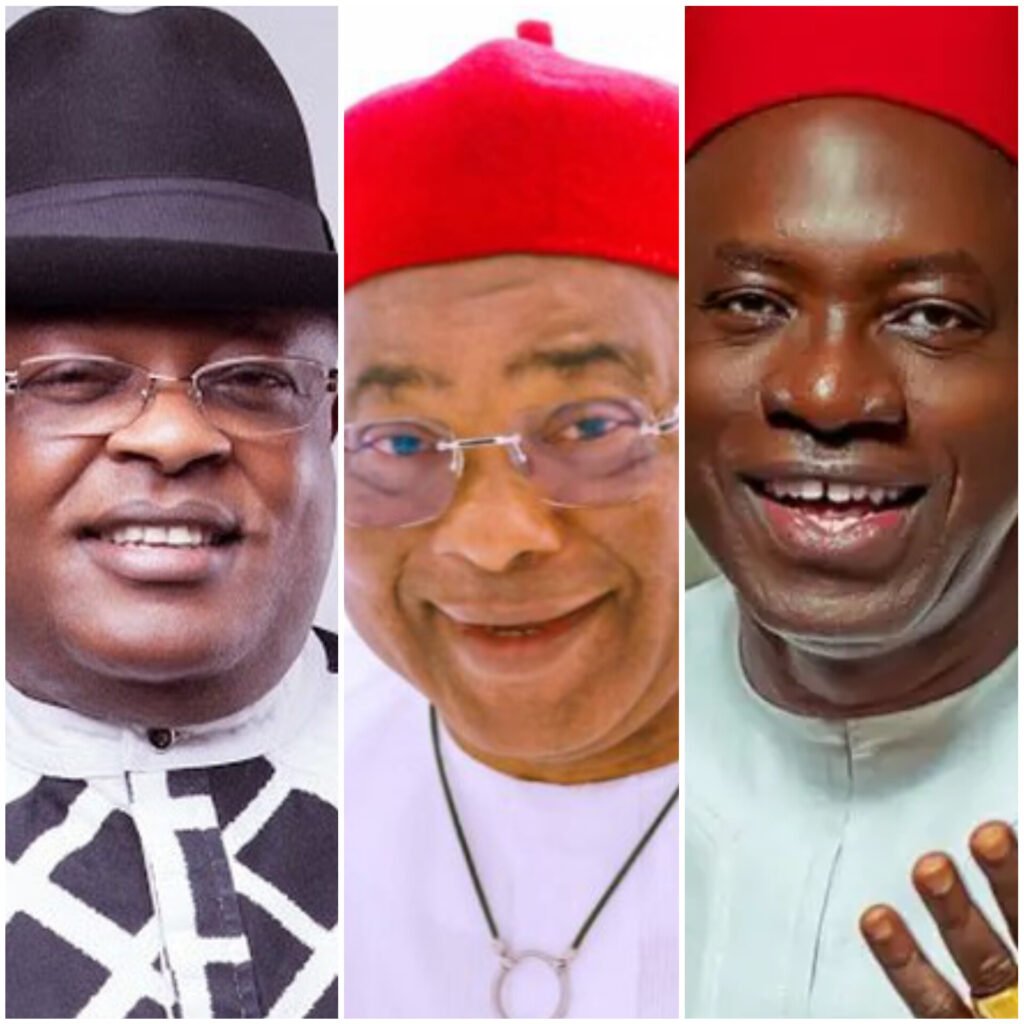
Meet the new Warrant Chiefs of the East.
A century ago, the British had a problem with the Igbo. Unlike many societies they encountered elsewhere in Africa, Igbo communities were predominantly decentralised. Authority was dispersed among village assemblies, age grades, title societies and other institutions. There was no convenient monarch in every community whom the colonial administration could bribe, intimidate or commandeer to deliver an entire population.
The British, being practical imperialists, decided that if the people had no suitable rulers, they would manufacture some.
Enter the Warrant Chiefs: locally recruited agents of an alien administration, armed with authority the people had not given them and backed by the coercive machinery of the colonial state. Their responsibilities included enforcing colonial directives and collecting taxes. Their legitimacy, however, existed largely in the imagination of the people who appointed them.
The arrangement was a masterpiece of bureaucratic wishful thinking. London supplied the warrants; the chiefs supplied the obedience; the people were expected to supply the taxes and gratitude.
They supplied neither gratitude nor the submission anticipated.
Resistance grew as the new authorities abused their powers and imposed unpopular policies. In 1929, the women of southeastern Nigeria rose in what became known as the Aba Women’s War, also widely called the Women’s Riot. Colonial forces responded with gunfire, killing scores of women. Yet the protests forced the administration to reconsider its methods, including the warrant-chief system and aspects of its taxation and native administration policies.
The women had exposed the vulnerability of an empire that mistook the power to issue orders for the ability to command consent.
The lesson should have endured: you can appoint your agents, but you cannot appoint the people who will obey them.
Apparently, the lesson has expired in Abuja.
The Return of the Imperial Imagination
Since the All Progressives Congress (APC) came to power in 2015, the Southeast has remained one of the party’s most difficult political territories. The region overwhelmingly rejected Muhammadu Buhari in 2015 and 2019 and gave Peter Obi an extraordinary degree of support in the 2023 presidential election.
Rather than treating this political disposition as a democratic reality to be understood and engaged, the APC appears increasingly interested in finding ways around it.
The strategy is hardly mysterious. Recruit influential local politicians, retain them in positions of authority, offer the prospect of political survival and federal patronage, and expect them to deliver their constituencies to the ruling party in 2027.
The contemporary roll call includes Hope Uzodimma of Imo, Dave Umahi, the former Ebonyi governor now serving as Minister of Works, Francis Nwifuru of Ebonyi, Peter Mbah of Enugu and Chukwuma Soludo of Anambra.
They are not identical in their political affiliations, ambitions or calculations. But their inclusion in this political constellation suggests that they have entered into a new secret agreement. Their respective positions make them important figures in the struggle to expand the APC’s influence in the Southeast.
Their assignment, as their critics see it, is straightforward: help the president win the region in 2027, or at least improve the ruling party’s electoral fortunes considerably.
The arrangement sounds reasonable enough. Politicians negotiate alliances every day. Governors seek federal cooperation; ministers pursue development projects; parties seek to expand their electoral bases. There is nothing inherently improper about any of this.
The difficulty begins when political leaders confuse an alliance among themselves with an instruction to the electorate.
A governor may pledge his loyalty to a president. A minister may defend the administration that appointed him. A party may promise development in exchange for electoral support.
But the voter has signed no such contract.
That small constitutional inconvenience is where the trouble begins.
The People Have Their Own Candidate
The Southeast’s political resistance is not simply an argument over appointments, federal projects or party alignment. It is also about the meaning of the 2023 election and the identity of the man many voters believe should have become president.
Peter Obi is not merely another opposition candidate in the eyes of his supporters countrywide. He has become a vehicle for their accumulated frustrations with the Nigerian political establishment and their hope that the country might be governed differently.
His supporters believe he won the 2023 presidential election and that the result was subverted by failures in the electoral process, particularly the much-criticised electronic transmission and collation of results. They regard Bola Tinubu as the principal beneficiary of that controversy and remain dissatisfied with the judicial decisions that affirmed his victory.
These are political convictions, not a formal legal record. But in a democracy, perceptions of electoral legitimacy matter, particularly when they persist across vast political constituencies.
And the APC has not exactly made the task of persuading these voters any easier.
Four years into the Tinubu administration, Nigerians are contending with punishing living costs, economic dislocation, persistent insecurity and a pervasive sense that political privilege has become increasingly detached from ordinary hardship.
The government can point to its reforms and argue that their long-term benefits justify their immediate costs. It can explain that economic recovery takes time. It can insist that the country was already in serious difficulty before Tinubu took office.
Those arguments deserve examination. But so does the experience of the citizen who must pay more for food, transport, electricity and education while wondering when reform will begin to feel like relief.
For the ordinary voter, economic statistics have limited persuasive power when the family budget has become an exercise in national emergency management.
And so the question in the Southeast (as elsewhere) is not particularly complicated: why should voters abandon a candidate they trust and can place fresh hope upon, to support an administration whose performance they find roundly disappointing?
Why should they board a vehicle that appears to have broken down by the roadside when there are other vehicles speeding by and headed their way?
The Warrant Chiefs may have answers. Unfortunately, the people appear not to be listening anymore.
A Federal Appointment Is Not a Transfer of Popular Sovereignty
The first argument is that the Southeast must align with the government at the centre to attract federal appointments and development projects.
It is the oldest bargain in Nigerian politics: vote for us and we shall remember you when the national cake is being shared.
The people have a perfectly reasonable question in return. How well has this strategy served regions that have aligned themselves with successive federal administrations? Have political loyalty and the presence of powerful ministers automatically translated into prosperity, security and better living standards for their constituents?
And why should citizens have to surrender their electoral independence to qualify for the benefits of citizenship?
Federal roads, public infrastructure, equitable appointments and development spending are not personal gifts from the president. They are obligations of government, funded by public resources.
A region should not have to vote for the ruling party to qualify for fair treatment. If that is the price of development, then federalism has quietly become a protection racket.
The second argument is more revealing: the Southeast cannot determine the outcome of a presidential election, so its voters might as well support the likely winner.
This is political mathematics of the laziest kind. It assumes that because a region cannot single-handedly decide a national election, its votes have no value.
But if the votes are so inconsequential, why are influential politicians being mobilised to secure them?
Why the meetings, the speeches, the political manoeuvres and the desperate courtship?
Apparently, the votes are simultaneously worthless and indispensable.
There is a word for this kind of reasoning. It is not mathematics.
It is desperation wearing an arithmetic costume.
Besides, elections are not merely exercises in predicting the winner. They are also opportunities for citizens to register their preferences, reward good performance, punish bad governance and establish the boundaries of acceptable political conduct.
A vote is not wasted simply because it fails to elect the candidate who receives it. Sometimes, the vote is the message.
And sometimes, the message is precisely what those in power do not wish to hear.
When the Records Refuse to Cooperate
The third line of attack concerns Obi’s record as governor of Anambra State between 2006 and 2014.
His critics have challenged his claims about leaving substantial financial resources for his successor and governing without conventional borrowing. The resulting controversy has generated competing accounts of state finances, investments and loans.
The details matter, and they should be subjected to independent scrutiny. Public records are not sacred merely because politicians publish them, and a politician’s claim does not become true simply because his supporters repeat it enthusiastically.
But the same standard must apply to his accusers.
If the allegation is that Obi left no money, produce the accounts. If the claim is that he borrowed recklessly, identify the facilities, the obligations and the beneficiaries. If investments were liquidated, explain what happened to the proceeds. If debts were incurred, distinguish state borrowing from federally negotiated, project-specific facilities involving multiple states.
Numbers do not become evidence merely because they are arranged in an official-looking table.
Nor does a press conference become an audit because a commissioner is standing behind the microphone.
Obi’s supporters maintain that he left substantial investments and financial assets for his successor. The banks in which he claimed to have left the monies are still in operation. Some living witnesses have spoken up. They point to the state’s investments in businesses, including a brewery in which Anambra held an interest, as evidence of a long-term approach to public finance. They also dispute the characterisation of certain multilateral facilities as borrowing by the former governor.
These claims should be verified against audited accounts, loan agreements and investment records. That is how a serious public argument is settled.
But when a campaign intended to discredit a political opponent produces more questions than answers, it risks achieving the opposite of its objective.
The more determined the prosecution, the more curious the jury becomes.
And the more the accusers insist that the public must accept their version of events, the more the public may want to inspect the exhibits.
The tragedy of political propaganda is that it sometimes sends citizens to the library when all it wanted was for them to visit the polling booth.
Divide and Rule: The Colonial Special
When persuasion fails, the temptation to divide the opposition becomes irresistible.
The British understood this principle. They exploited local rivalries, patronised selected leaders and used administrative boundaries and political appointments to manage populations whose unity threatened imperial convenience.
It was an old game, and the colonial administration played it repeatedly.
Today, the Southeast’s political disagreements provide ample material for anyone tempted to revive it.
Regional rivalries exist. Communities have competing interests. Political leaders nurse ambitions. Historical grievances can be manipulated. No society is immune to these weaknesses.
But there is a difference between acknowledging disagreements and deliberately inflaming them for electoral advantage.
One particularly familiar strategy is to suggest that the region’s political future must be determined by a contest among its constituent states or communities, rather than by the collective judgement of its citizens.
The argument is usually dressed in the language of dignity, fairness and historical grievance. It may even invoke the need to resist domination by neighbouring communities.
Yet the underlying question remains: who benefits when neighbours who have lived together for generations are persuaded to regard one another as political enemies?
The answer is rarely the ordinary citizen.
A community that votes against its own interests merely to spite another community has not achieved political liberation. It has outsourced its judgement to resentment.
And a politician who discovers ethnic solidarity only when his personal ambitions are threatened should expect the electorate to ask where that solidarity was when it mattered most.
The new Warrant Chiefs may find that the people are less interested in inherited quarrels than in the practical business of survival and good governance for motherland.
There are bills to pay, businesses to run, children to educate and roads to travel. Political vendettas are an expensive luxury for people already struggling to afford necessities.
The Trouble With Manufactured Consent
The central problem facing the APC in the Southeast is not that its politicians lack influence. It is that influence has limits.
A governor commands a state administration. A minister controls a federal portfolio. A party controls nominations, campaign machinery and access to resources.
But none of these powers automatically confers ownership of the electorate. Only performance, impact and genuine connection with the people does.
The mistake is to assume that because a politician can control a political structure, he can control the people associated with it.
The distinction is fundamental.
Political structures can be assembled through patronage, appointments, alliances and negotiations. Political consent must be earned.
A governor may bring supporters to a rally. He may persuade local politicians to defect. He may secure endorsements from traditional rulers, business leaders and community organisations. He may even fill a stadium with party faithful.
None of these achievements necessarily predicts how a secret ballot will be cast.
The polling booth is a wonderfully democratic institution. It is one of the few places where a poor trader and a powerful governor can exercise precisely the same formal voting power, and where the former can disappoint the latter without having to explain himself.
That is why the secret ballot remains such an irritant to politicians who prefer their constituencies obedient.
It introduces an inconvenient element into the grand machinery of political control: the individual conscience.
And conscience, unlike a political appointment, does not come with a letter of acceptance.
A Century Later, the Question Remains
The approaching 2027 election will test more than the APC’s ability to expand its footprint in the Southeast. It will test the capacity of its political leaders to distinguish persuasion from coercion, alliance from ownership, and public service from personal political survival.
There is also a temptation, whenever the Warrant Chief analogy is invoked, to assume that history must repeat itself in precisely the same fashion.
It need not.
The Aba Women’s War was a specific historical event, rooted in the abuses of colonial administration, fears surrounding taxation and census practices, and the wider exclusion of women from systems of authority that profoundly affected their lives. Its participants were not merely responding to an abstract struggle over political representation; they were resisting a system that threatened their economic security and social standing.
Its enduring significance lies not in the inevitability of another uprising, but in the warning it offers to governments that mistake administrative authority for popular legitimacy.
The women demonstrated that people who appear politically powerless can organise, resist and force a powerful government to reconsider its assumptions.
Their courage helped expose the limits of colonial rule. It also became part of the wider history of resistance that would shape political consciousness in Nigeria, culminating in independence.
Today, the circumstances are different. Nigeria is an independent country operating under a constitutional democracy. Political competition is conducted through parties and elections, however imperfect those institutions may be.
The appropriate lesson from 1929 is therefore not the inevitability of violence. It is a warning against arrogance that makes peaceful political disagreement seem intolerable.
If the new Warrant Chiefs fail, it will not necessarily mean that the Southeast has rejected federal cooperation or condemned every politician who works with the APC. It will mean that voters have exercised their right to make a choice their political leaders dislike.
That, after all, is what democracy is supposed to permit. And that, also, is in keeping with Igbo political temperaments.
As the 2027 election approaches, the question is not whether the APC can appoint enough political allies to make its ambitions appear plausible. It is whether those allies can offer the electorate reasons more compelling than patronage, intimidation, ethnic division and the threat of political irrelevance. It is why a party in power for 12 years is struggling to point to tangible achievements to justify re-election.
The British Empire, with its military superiority, administrative machinery and imperial confidence, discovered that the answer to this question could not simply be decreed.
A century later, Abuja has access to more sophisticated instruments of political influence. It has ministries, budgets, party structures, campaign consultants and an almost inexhaustible supply of political promises.
But it faces the same fundamental limitation.
You can appoint a chief. You can give him a warrant. You can even provide him with a convoy and loads of cash. What you cannot do is appoint the people who will believe him.
And if the new Warrant Chiefs of the East have forgotten that lesson, the people may yet remind them—not with Maxim guns or colonial uprisings, but with the one instrument that still frightens political establishments everywhere: a vote they cannot control.
**Victor Anazonwu is an author, historian and public affairs commentator based in Lagos.
