
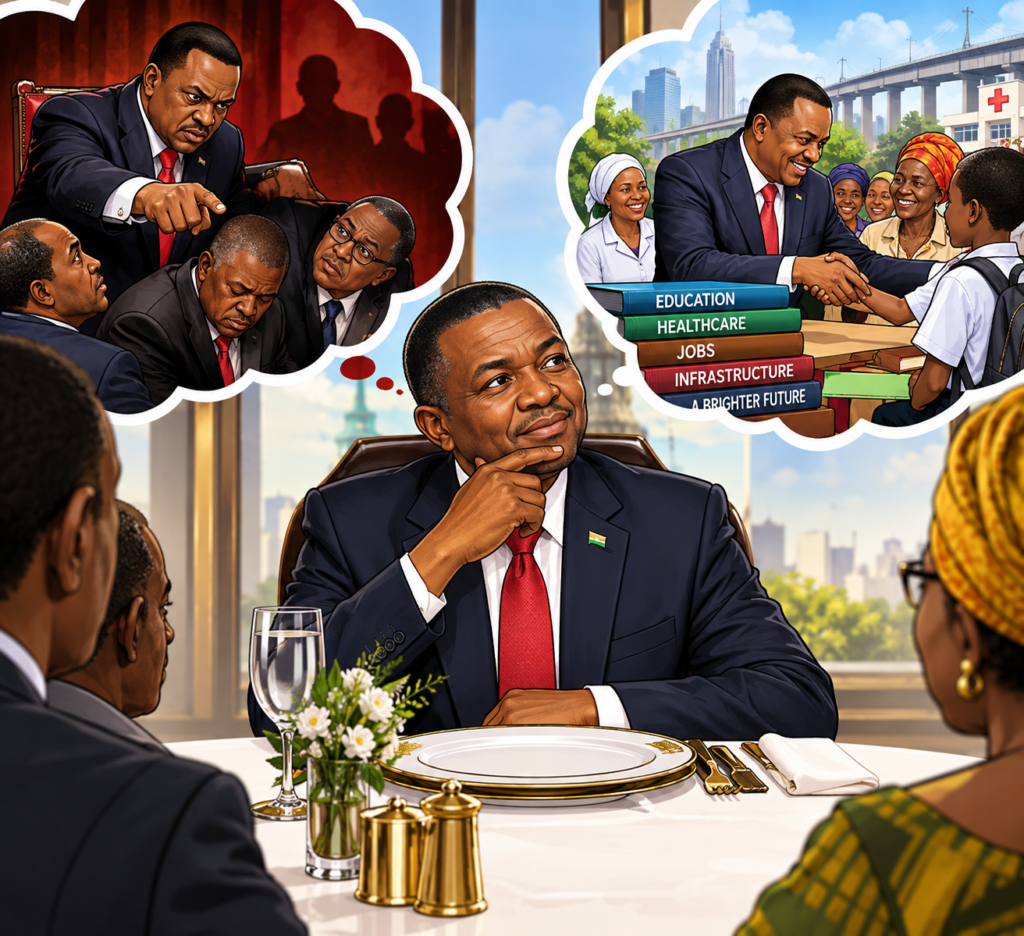
Imagine becoming President after twenty-seven years in prison. Now imagine that, among the first people you encounter in office, you come face to face with the man who once humiliated you in your darkest hour. Would you punish him? Remind him whose turn it was now? Or would you simply let the past stay buried?
A story attributed to Nelson Mandela recalls an afternoon after he became President of South Africa, dining at a restaurant with his security detail. Partway through the meal, he noticed a man at another table, hands trembling so badly a guard assumed he was ill. Mandela recognised something else entirely: he knew this man. He had been a warden at the prison where Mandela was held — and, the story goes, not merely a warden, but the very one who once answered Mandela’s desperate cries for water, after torture, by urinating on his head.
The tables had turned completely. The prisoner was now President. The warden sat before him, frightened, entirely at his mercy, bracing for whatever came next.
Mandela did not retaliate. He invited the man to join him for lunch.
If the story is true, it hands us one of the most powerful lessons in leadership ever told: you do not demonstrate power by making those who once hurt you suffer. You demonstrate it by refusing to become them.
Power Changes Hands. Character Should Not.
The most revealing test of character is what a person does the instant the power equation flips. Talking about justice is easy while you’re powerless. The real test arrives when you finally hold the power to settle old scores — when the subordinate becomes the boss, the opposition becomes the government, the persecuted becomes the one holding the instruments of state.
The only question that matters is: will you use that power to build, or to settle accounts?
History is littered with leaders who arrived promising justice and were slowly swallowed by revenge instead; who inherited grievances and legislated them into policy, inherited institutions and turned them into weapons, inherited public trust and spent it on private scores. This is precisely how nations get trapped in cycles of retaliation: one government punishes the last one’s supporters, and the next returns the favour in kind. Governance becomes an endless relay of “your turn” and “our turn” — the country advances on the calendar while staying emotionally imprisoned by yesterday.
Forgiveness Is Not Weakness
One distinction is worth holding onto here. Forgiveness doesn’t mean pretending wrongdoing never happened. It doesn’t mean abandoning accountability, halting investigation, or letting abuse continue unchecked. Justice should never be sacrificed on the altar of sentiment.
But accountability and revenge are not the same instinct. Justice asks: what is the appropriate consequence for what you’ve done? Revenge asks: how can I make you suffer, because you made me suffer? One runs on principle. The other runs on pure emotion. A mature leader knows the difference — and guards the line between them fiercely.
The Disguise Revenge Wears
Revenge rarely introduces itself honestly. It whispers instead: they did it to us, so we’re entitled to do it to them. It feels satisfying in the moment. But it sets a precedent nobody benefits from for long, because power never stays in one pair of hands forever. Today’s rule, written in anger, is tomorrow’s weapon — aimed squarely back at you. Great leadership demands something harder than defeating an enemy: the wisdom to build institutions that remain fair even once your enemies control them.
The Lesson Closer to Home
This is where the parable turns urgently relevant. We have grown far too comfortable with politics as a permanent war of retaliation. Too many political actors carry yesterday’s grievances directly into today’s governance. Too many supporters cheer when opponents are humiliated, and object only once the same instruments turn on their own side — defending institutional abuse when it favours their politician, condemning identical behaviour the moment it doesn’t. That isn’t principle. That’s partisanship.
We need leaders who understand that public office exists to improve the lives of those they serve — not to punish those who once opposed them. A President should leave behind institutions his successor cannot easily weaponise. A governor should build systems that keep working long after he’s gone. A minister should remember that today’s opponent may be tomorrow’s colleague. And every leader should hold onto one plain fact: public office is temporary, but the consequences of decisions made in it can outlive a tenure by decades.
The Greatest Victory
Perhaps the story’s deepest lesson is this: sometimes the greatest victory over an enemy isn’t defeating him — it’s refusing to let him define who you become. The warden who wronged Mandela could have lived on as a prisoner inside Mandela’s own mind, forever. Instead, Mandela’s refusal to retaliate freed them both, in different ways. He no longer needed to prove he was stronger than his tormentor. He had already won — not through greater power, but because power never corrupted his character.
That lesson travels far beyond politics, into business, family, and everyday life. When you finally hold the authority, you once craved, resist the pull to settle every old score. When you finally have the microphone, resist using it only to shout back at those who once silenced you. When the chance arrives to answer humiliation with humiliation, pause, and ask honestly: do I want justice, or do I simply want revenge?
Nations are rarely destroyed only by bad people. Sometimes they are undone by good people who, once handed power, quietly decide that revenge is owed to them.
Power can change your circumstances. Only character determines what you do with it. A mentality of retaliation keeps nations prisoners of their past. A mentality of justice, restraint, and forgiveness is what hands them a future.
**Ken Ihedioha writes from Lagos.
