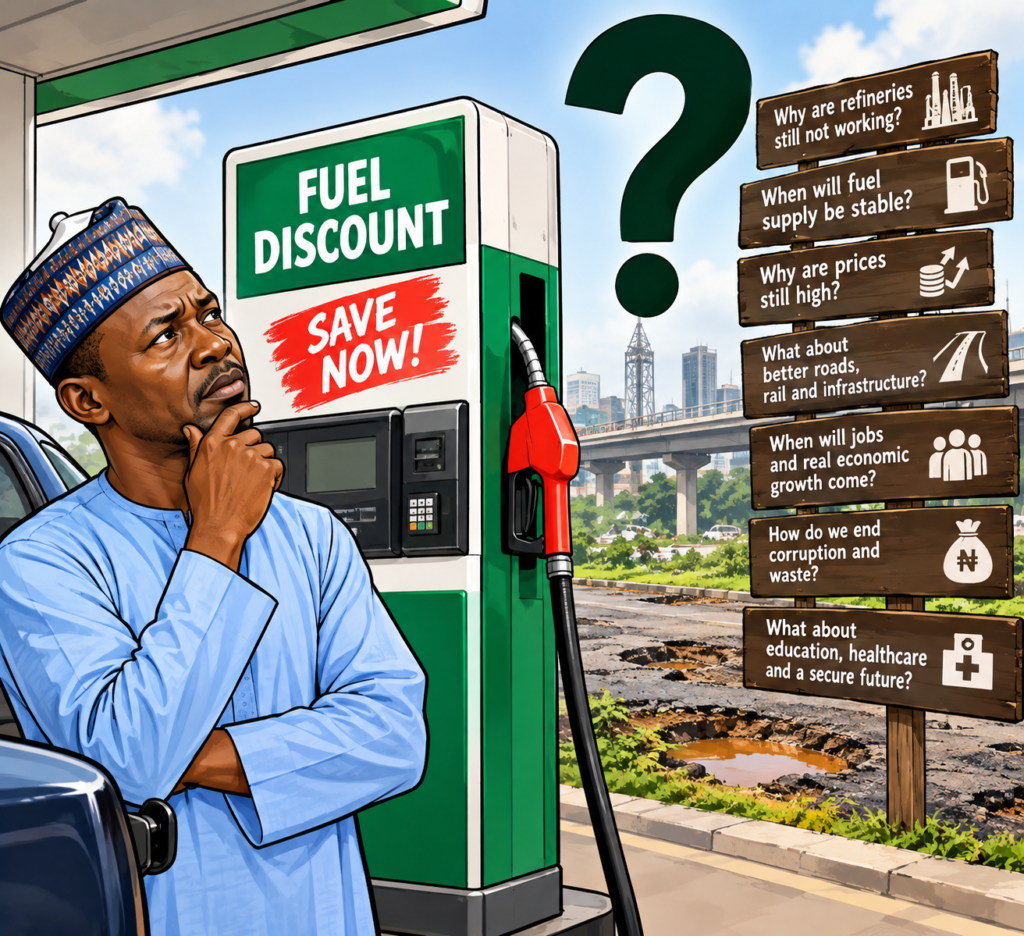
Nigeria’s 30-day petrol discount will help the commuters it reaches, but it is a pause, not a policy. The government has not said what happens when the month ends.
Every Nigerian who has queued at a filling station in recent months knows the arithmetic of hardship. The pump price moves, the bus fare follows, and by Friday the market woman’s tomatoes cost more too. So when the Federal Government announced a 30-day petrol discount this week, it was always going to be welcomed. But it deserves a closer look than a welcome.
On Thursday, Finance Minister Taiwo Oyedele told journalists in Abuja that petrol sold at NNPC stations would be discounted for 30 days “in the first instance”, with priority for public transporters. He insisted it is not a subsidy: the government is simply selling at cost. He said the step responds to a sharp rise in global energy prices, and that Abuja is working toward a N1,350 per litre ceiling on petrol’s landing cost.
Relief deserves a fair hearing. But a measure built to last one month says more about this political moment than about a plan for the year ahead.
Start with the timing. Some opposition figures have promised to restore the old subsidy if they win in 2027, and the Tinubu administration has defended the 2023 removal ever since. A discount announced under that pressure, and framed as a one-month trial, looks like electoral positioning. Atiku Abubakar called it a “panic-driven publicity stunt”. He is an interested critic, yet his question is fair: what happens on Day 31?
Then consider the label. If NNPC sells below what the market would otherwise charge, someone absorbs the gap, either NNPC’s margin or the public purse. Calling that “cost” does not make it free. Nigerians have not been told how much the discount costs, who funds it, or whether the money comes out of revenue that should reach the federation account.
Reports also differ on whether N1,350 is a pump price or a landing-cost ceiling, which tells you how thin the detail is.
The design also limits who benefits. The discount applies only at NNPC stations, so motorists who buy elsewhere, or live where NNPC has no outlet, gain little. Many Nigerians travel by keke, okada and shared minibuses whose operators buy fuel wherever they can find it. “Priority for public transporters” sounds targeted, but no registration process, quota or enforcement mechanism has been described. Without one, relief tends to go to whoever reaches the pump first. A national problem has been handed a single retail chain’s remedy.
Now set it against what households face. The National Bureau of Statistics put the average petrol price at N1,532.93 per litre in April 2026, up 18.97% in a month. Headline inflation reached 15.93% in May, with food at 17.8% and transport at 17.1%. The average city bus fare was N1,431 in May, 38.63% higher than a year earlier. Fares rarely fall as fast as they rise. A 30-day discount may slow the next increase, but it will not undo a year of compounding costs in food, rent and transport.
If operators raise fares again when the window closes, households get a short pause followed by a rebound.
The deeper problem is the contradiction with the deregulation promise. When President Tinubu declared the subsidy gone in May 2023, pump prices more than doubled within days, and the naira float that followed pushed costs higher still. Citizens were asked to endure the shock on the argument that a market-priced sector would draw in competition and domestic refining, and that the savings would fund infrastructure and social protection.
If Abuja now needs emergency price relief and a landing-cost ceiling, two things follow. Either those gains have not reached the pump, or the state is quietly setting prices again. A ceiling and a government-directed discount are price controls in all but name. And using NNPC as the delivery channel blurs the line between a commercial company and an instrument of political relief.
Nigeria has been here before. The old subsidy regime began as a cushion against price shocks, hardened into a permanent fixture, and drained public finances for decades before it was dismantled. Temporary relief has a way of becoming permanent. The risk now runs in the other direction too. If the discount simply lapses on Day 31, the government will have taught citizens to expect relief and then withdrawn it just as the 2027 campaign heats up. Either outcome is poor policy, and both come from the same omission: no exit plan.
The government has a fair reply. It did not cause the global energy shock behind recent price spikes. A full return to blanket subsidy would strain the budget. A time-limited, targeted measure is a reasonable middle path. I accept that. The criticism is not that Abuja should do nothing, but that it is doing something without telling citizens what it costs or where it leads.
Four things would turn a stunt into a policy:
Publish the cost of the discount, name who funds it, and say whether it reduces remittances to the federation account.
Publish the rules for “priority” transporters, with a way to check that the benefit reaches them and passes into fares.
State what happens on Day 31: renewal, taper or end, and the trigger for each.
Pair relief with supply fixes, so landing costs fall because the market works, not because a minister announced a number.
A month of lower prices may be an act of kindness, a political stunt to win votes, or a sign of policy capitulation. A plan is a duty. Nigerians have heard enough about hardship being temporary. They deserve an honest account of how long, and who pays.
**Emeka Ibe is a Public Policy Analyst based in Abuja
