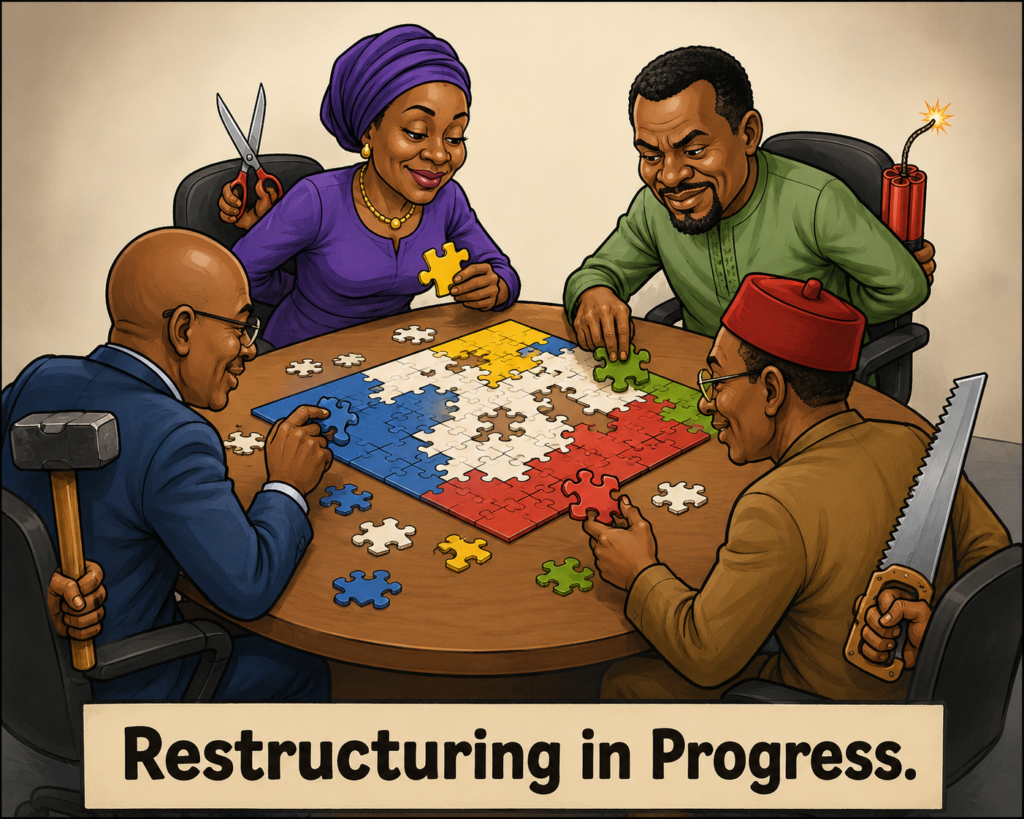
The debate over restructuring Nigeria has persisted for decades, largely because our political challenges are often viewed through the lens of ethnicity and regional identity. There remains palpable mutual distrust among ethnic nationalities, suggesting that our efforts at national integration have been incomplete. This has fuelled advocacy for restructuring Nigeria along linguistic or ethnic lines, based on the argument that more homogeneous communities are more likely to understand and live peacefully with one another.
This thinking is flawed from the very outset.
Homogeneity is an attribute that needs divergent characteristics to achieve a healthy and complementary union capable of producing sustainable human development. If all the keys of a piano were of the same tone, no harmonious music would emerge.
Human societies are similar: diversity, properly managed, can produce harmony and development. Everything is not about economics and physical infrastructure; the spiritual and social welfare of human beings must also be considered.
While restructuring along ethnic lines is understandable in a country as diverse as Nigeria, this writer believes that such an approach may fail to address our underlying challenges and could reproduce the divisions that have weakened the Nigerian project.
Nigeria is not merely a collection of ethnic groups occupying separate territories. For more than a century, Nigerians have lived, worked, traded and established families across ethnic boundaries. Intermarriage is widespread, while religious, professional, educational, commercial and social affiliations increasingly transcend ethnicity. Millions of Nigerians cannot conveniently be described as belonging exclusively to one geographical or ethnic homeland.
Lagos, Abuja, Port Harcourt, Kano, Enugu, Calabar, Ibadan, Onitsha and other cities demonstrate the extent to which Nigeria has become a network of interconnected communities.
The question should therefore not simply be: “Which ethnic group should control which territory?”
A more constructive question is: “What constitutional arrangement will enable Nigeria’s diverse peoples, states, local governments and communities to develop freely while remaining united within a common national framework?”
This writer’s answer is genuine federalism, supported by effective local governments and sustainable grassroots development.
It is the absence of true federalism that has fuelled many of the current agitations. The responsibility ultimately lies with political leadership.
The United States model provides a useful, though not perfect, reference point. American federalism recognises one national sovereignty while constitutionally distributing governmental powers between the federal government and the states. The federal government handles matters of genuinely national importance, while states retain substantial responsibility for their internal development and administration.
Nigeria requires a similarly serious rebalancing of power.
At present, the federal government exercises extensive influence over virtually every aspect of national life. In reality, we have a unitary government pretending to be a federation. The concentration of power makes control of Abuja disproportionately attractive and intensifies rabid competition among political, ethnic and regional interests for access to the centre.
A genuine federal restructuring should therefore reduce the powers of the centre and strengthen the states, or, where constitutionally appropriate, regional or geopolitical structures. The federal government should focus primarily on defence, foreign affairs, currency, immigration, interstate matters and other issues requiring national coordination.
States should assume greater responsibility for education, healthcare, policing and public safety, infrastructure, transportation, agriculture, local economic development and other matters that can be administered effectively closer to the people. They should also enjoy greater fiscal autonomy, supported by constitutional safeguards, transparency and accountability. The current situation in which Governors can become virtual Emperors must itself be addressed constitutionally.
Restructuring must extend beyond the states to the local government level. Effective local governments are essential to democratic governance and grassroots development because they are closest to the people. They should enjoy constitutionally guaranteed autonomy, predictable funding and clearly defined responsibilities in primary healthcare, basic education, sanitation, rural roads, water supply, agricultural extension, markets and community economic development.
Local administration should be strengthened through transparent elections, professional public service systems, participatory budgeting, open procurement and effective oversight. Local councils must not become mere extensions of state governments or instruments of political patronage. They should be accountable to the communities they serve.
Grassroots development should be measured not only by major projects but by improvements in everyday living conditions. Such development would help reduce rural-to-urban migration, broaden economic opportunity and give citizens a meaningful stake in democratic governance.
Genuine federalism would also allow states and regions to pursue policies suited to their circumstances and compete constructively in education, industrialisation, agriculture, technology, tourism, infrastructure and human development.
Such a system could reduce the dangerous perception that one ethnic group, or a coalition of ethnic groups, must control the federal government to determine the destiny of the entire country.
Constitutional protections for minorities, freedom of movement, property rights, citizenship rights and equality before the law must remain inviolable. Every Nigerian should be able to live, work, own property and pursue legitimate economic and political interests anywhere in the country without being treated as a “stranger” or “non-indigene.”
We must therefore distinguish between ethnic identity and national citizenship. Nigerians should be free to preserve and celebrate their languages, cultures and traditions. However, political power should principally be organised around citizenship and territorial jurisdictions, rather than permanently assigned according to ethnic ancestry.
Nigeria’s diversity is not inherently a weakness. Properly managed, it could become one of our greatest strengths. The challenge is that our constitutional structure has not sufficiently converted this diversity into productive federal competition or translated national resources into sustainable development at state and grassroots levels.
The objective of restructuring should therefore not be the fragmentation of Nigeria into ethnic enclaves. It should be the creation of a Nigeria in which no group needs to dominate the centre to feel secure, prosperous or respected, and in which every community has the institutional capacity to participate in its own development.
A restructured Nigeria should be a federation of strong, responsible and progressively competitive states, supported by autonomous and accountable local governments, operating within a smaller but effective federal government and under a Constitution that protects every citizen and community.
That is the more sustainable path: not Nigeria divided by ethnicity, but Nigeria strengthened by federalism; not a struggle to capture Abuja, but a system in which power is sufficiently dispersed to enable states, local governments and communities to develop at their own pace.
The ultimate goal should be a Nigeria in which diversity is an asset, federal power is locally restrained and focused on the international arena, state governments are empowered as instruments of strategic development, local government systems are effective vehicles of grassroots development, citizens are protected, and national unity is sustained not through domination, but through mutual benefit and constitutional fairness.
Ike Unegbe, a lawyer, writes from Lagos. He can be reached on: 08033201244
Email: ikeunegbe@gmail.com
