The world has made leadership into a trophy, and I am tired of pretending the trophy is the point. We have surrounded this ancient force with so much polished language, competency grids, and ceremonial reverence that we have suffocated the very thing we claim to celebrate. Leadership is not a prize for the worthy, not a credential to display, not a gentle ascent to higher ground. It is something far more dangerous and far more necessary than our safe little models allow. We have taken the fire that forges civilizations and turned it into a desk lamp, then congratulated ourselves on how well it illuminates the furniture. I do not want better furniture. I want the fire back.
There is a secret that the leadership industrial complex does not want you to discover. It is not a technique. It is not a framework. It is not a competency that can be benchmarked, a trait that can be assessed, or a certification that can be earned after a weekend retreat and a laminated name badge. The secret is this: leadership is not a role. It is a solvent. It dissolves the person who accepts it. And in that dissolution, if the conditions are right, something else emerges. Not a better leader. But a better possibility for everyone else.
We have been asking the wrong question for so long that we have forgotten there could be another one. The question was never “How do we produce more leaders?” The question was never even “What does leadership cost the human soul?” The real question, the one that waits behind all the others like a door we have been too frightened to open, is this: What becomes possible for the rest of us when one human being accepts the burden of becoming a passage rather than a person?
This requires nothing less than the complete annihilation of everything we currently believe.
Look around you. We have built an entire economy on the manufacture of leaders. Business schools with their case studies and cohorts and networking events disguised as education. Executive coaches with their frameworks and discovery sessions and proprietary models. Leadership academies with their ropes courses and personality inventories and trust falls. Succession planning committees with their nine-box grids and calibration sessions and forced ranking systems. Competency frameworks with their behavioral indicators and proficiency scales. Three-hundred-and-sixty-degree feedback instruments that reduce the infinite complexity of human influence to a scatter plot of colored dots. Emotional intelligence assessments. Adaptive leadership curricula. Transformational leadership models. Authentic leadership manifestos. Servant leadership workshops. Disruptive leadership playbooks. The shelves groan under the weight of books promising seven habits or five levels or three rules or one-minute solutions or zero to one thinking.
And what have we produced? Better managers, certainly. Smoother operators. People who know how to read a room, modulate their tone, align stakeholders, manage up, deliver quarterly results, craft narrative arcs for earnings calls, and survive restructurings with their careers intact. We have produced executives who are remarkably skilled at navigating the institutions they supposedly lead.
But leadership, real leadership, the kind that shifts the tectonic plates beneath an organization and rewrites what people believe is possible about themselves and their work, remains as rare as it ever was. Rarer, perhaps, because we have become so adept at mistaking the credential for the capacity, the title for the thing itself, the performance of leadership for its actual substance. We have confused the map for the territory, the costume for the calling, the LinkedIn profile for the life.
Here is the inversion that should shatter the paradigm. Leadership is not about having. It is not about the corner office, the platform, the deference, the legacy, the biography, the TED talk, the airport book, the keynote fee. Those are distractions. They are the glittering debris that floats on the surface while the real action happens in the depths, invisible and unacknowledged and absolutely essential.
The leader is not the sculptor. The leader is the medium. The leader is not the architect of meaning but the passage through which meaning moves from potential to actual, from the private longing of individuals to the shared destiny of a group.
This is not metaphor. This is mechanics. And we have been getting the mechanics wrong because we have been looking at the wrong machine.
When a human being accepts leadership, something immediate and invisible begins. They arrive carrying their own expectations. Dreams of transformation, visions of legacy, the hunger to prove themselves worthy of the confidence placed in them. They are, in other words, human. They want what humans want. Recognition. Significance. The affirmation that their abilities matter. The satisfaction of seeing their ideas take shape in the world.
But the moment they step into the role, they collide with a thousand other expectations that have nothing to do with their dreams. The employee wants security and a promotion and fair treatment. The board wants growth and risk mitigation and predictable returns. The customer wants miracles at a discount and immediate service. The community wants responsibility and transparency and jobs. The family wants presence and patience and attention. The investors want returns. The regulators want compliance. The media wants a story. Everyone wants something, and most of it is incompatible not just with the leader’s vision but with everyone else’s needs.
Conventional wisdom says this is the burden of leadership. The self-help literature tells us to set boundaries, build resilience, practice self-care, delegate effectively, find mentors, maintain work-life balance, develop emotional agility, and remember to sleep eight hours. The consulting firms sell us change management processes as if the problem were procedural. The coaches teach us to reframe our thinking as if the problem were cognitive. The wellness industry sells us meditation apps as if the problem were stress. The human resources departments schedule resilience training as if the problem were a skills gap.
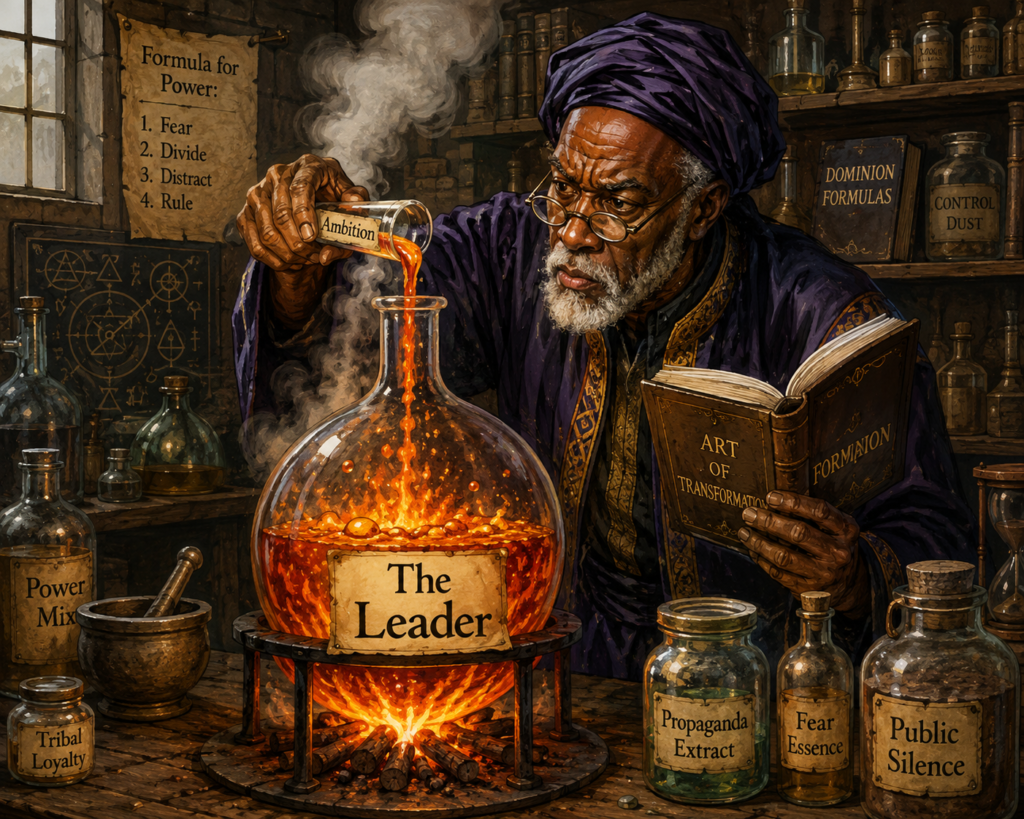
These are not wrong exactly. They are simply irrelevant to the phenomenon they claim to address. They treat the crucible as an illness to be managed rather than the very engine of transformation. They are palliatives offered to a patient who is not sick but metamorphosing. And in their well-meaning irrelevance, they are almost insulting. Imagine telling the retort that it needs better boundaries with the fire. Imagine advising the chrysalis to practice self-care during the dissolution. Imagine sending the ore to a weekend workshop on resilience before smelting. The transformation requires the heat. The heat is not the obstacle. The heat is the method.
Because here is what no one tells you, and what you cannot learn from any book or biography or keynote address or Harvard case study. The collision is not a problem. The collision is the point.
The leader stands at the nexus of irreconcilable hopes not because the system is broken but because the system is alive. The friction generates heat. The heat transforms substance. The leader who understands this stops trying to resolve the tension and instead becomes its steward. Not its solver. Its steward. This is a completely different orientation, and it requires a completely different kind of human being.
The leader does not bring peace. The leader holds the conflict at sufficient temperature and pressure until something crystallizes that neither side imagined. Not compromise. Not consensus. But emergent meaning. A third thing that could only be born from that specific collision, at that specific moment, through that specific human being who refused to collapse under the weight.
We have been describing leadership as if the leader were a container into which people pour their hopes, fears, frustrations, and projections. That description is half right, and because it is only half right, it has led us dangerously astray. A container is not merely a bin. A container is a boundary that creates the conditions for transformation. The retort does not simply hold the reagent. It withstands pressure so the reagent can become something else. The crucible does not merely contain the metal. It endures the temperature that purifies it. The leader does not merely absorb the psychological debris of an organization. The leader holds it at a temperature where it can transmute.
This is the missing link that repositions leadership from personal ordeal to civilizational function. The leader is the necessary interface between individual human longing and collective human meaning. Without this interface, organizations are merely transactions. Movements are merely crowds. Societies are merely aggregations of self-interest bumping against one another in increasingly sophisticated ways. The leader is the one who, by accepting the impossible burden of being the container, creates the conditions for meaning to precipitate out of chaos.
And here is the part that should stop every leadership expert in their tracks. This meaning is the elixir. Not for the leader. For everyone else. The leader does not drink from the cup. The leader is the cup. The value flows through, not to.
Think about what this means for how we have organized our entire approach to developing leaders. We assess them for potential. We train them for competence. We promote them for results. We coach them for resilience. We measure them against competencies that were obsolete before they were printed. And all the while, we are preparing them for a job that does not exist, or worse, we are preparing them to survive a role we have fundamentally misunderstood.
We are sending climbers to the summit when the real work happens in the furnace at the center of the mountain. We are teaching people to swim when what they need is to learn how to burn.
The greatest burden of leadership is not the complexity of the work. It is not the spreadsheets or the strategy sessions or the stakeholder presentations or the board packets. It is the invisible weight of becoming the one into whom countless people pour their unmet needs, their ancient grievances, their impossible hopes, their free-floating anxieties, and the simultaneous demand that you not harden into stone but remain porous enough for something new to pass through you. Influence purchased with solitude. Authority wrapped in suspicion. Recognition attracting criticism. Visibility inviting projection. Success raising expectations faster than capability can satisfy them. Every decision produces winners and losers. Every act of inclusion creates exclusion elsewhere. Every reform threatens someone else’s comfort. Every compromise is interpreted by another group as weakness. Every victory is immediately followed by a higher bar.
These are not unfortunate side effects. They are the heat. They are the pressure. They are the exact conditions required for the alchemy.
So the question is not how to avoid the cost. The question is not how to build resilience or maintain boundaries or preserve work-life balance. The question is what part of yourself must die so that something larger than yourself can live through you.
The death is not punitive. It is preparatory. The ego that seeks fulfillment through leadership is not evil. It is simply the wrong fuel. It burns too hot and leaves only ash. The ego that seeks control is not malicious. It is simply insufficient to the task. Control is a child’s idea of power. Real power, the kind that moves institutions and reshapes cultures and alters what people believe is possible, is the capacity to become the conditions under which others can become more fully themselves. That requires a kind of disappearing. A transparency. A surrender of the self that came to take, so that the self that came to give can finally operate without obstruction.
Those who enter leadership seeking fulfillment often leave hollow because they came to consume. They wanted the affirmation, the significance, the proof that they mattered. And leadership, cruelly, offers none of these things in any lasting form. It offers their opposites. It offers solitude where they wanted connection. It offers criticism where they wanted praise. It offers exhaustion where they wanted energy. It offers the slow realization that they are not the protagonist of the story but the page on which the story is being written, the ink that fades so the words can remain.
Those who enter prepared for sacrifice occasionally discover meaning because they came to become the passage. They did not come to be seen. They came to see others into being. The distinction is not subtle. It is the difference between consumption and consecration. And the discovery, when it comes, is that the sacrifice is not loss. It is liberation. The surrender of ego, certainty, popularity, and peace of mind removes the obstacles that were blocking the flow. The leader who has surrendered these things does not become less. The leader becomes clear. And through that clarity, something vast and needed can finally move.
I want to suggest something that will sound strange to ears trained in the current orthodoxy. We need to stop treating leadership as a subset of management, or politics, or organizational behavior, or military strategy, or sports coaching, or self-help psychology. What if it is the fundamental grammar of human possibility? The syntax by which we move from I to we, from now to next, from what is to what must be. What if every other human endeavor, commerce and art and science and governance and even love, depends for its highest expression on this invisible alchemy? What if leadership is not one profession among many but the connective tissue without which no profession can achieve its generative potential?
This is the frontier that awaits us. Not better leadership development programs. Not more emotionally intelligent executives. Not diverse slates of candidates or adaptive strategies or stakeholder capitalism, worthy though these may be. These are refinements of a model that has already failed because it asks the wrong question. The new frontier is the reclamation of leadership as sacred function. Not sacred in a religious sense, though it may be that too. Sacred in the sense of set apart for a purpose that transcends the self. The leader as the one who accepts, with full knowledge, that they will be misunderstood, resented, exhausted, and ultimately forgotten, and who chooses the crucible anyway because they have understood that their disappearance is the condition of everyone else’s emergence.
What would it look like if we organized our institutions around this truth? We would stop selecting leaders based on charisma and start selecting them based on capacity for surrender. We would stop training them in competencies and start preparing them for transfiguration. We would stop measuring their success in quarterly returns and start measuring it in the generative capacity of the people they serve. We would stop asking “Can this person lead?” and start asking “Can this person disappear without losing their center?” We would stop looking for the strongest swimmer and start looking for the one willing to become the current.
This is breathtaking not because it is beautiful but because it is true. It disrupts not by adding complexity but by stripping away the lies we have told ourselves for generations. It fills the gulf not by bridging it but by revealing that the gulf is the architecture, the necessary space in which the old self dissolves and the new possibility is born.
Leadership is the elixir that galvanizes all human endeavor into meanings that deliver value for all. Not because the leader is great, but because the leader has become small enough, transparent enough, crucible-hardened enough, to allow greatness to pass through.
The world has treated leadership as the peak of the mountain. It is actually the furnace at the center. The world has treated leadership as the answer to “How do I rise?” It is actually the answer to “How do we become more than the sum of our fears?”
The quiet terror remains. The profound personal cost remains. The exposure of character, the amplification of hidden weakness, the relentless negotiation with disappointment, all of it remains. But it is no longer tragedy. It is the necessary heat. And the allure, the strange magnetic pull that draws intelligent people toward this impossible vocation, was never wrong. We were simply magnetized by the wrong object. We thought we were drawn to power. We were actually drawn, blindly and rightly, to the possibility that someone might become the passage through which our own lives could mean more.
Leadership, then, is neither privilege nor punishment. It is consecration. It is the willing acceptance of the crucible so that the elixir can be produced, not for the one in the fire, but for everyone waiting outside it, thirsty for something they cannot name, holding vessels they do not yet know how to fill.
The leader is the one who says: Burn me. I have understood what I am for.
And in that burning, everything else catches light.
About the Author:
Dr. Charles Ugwu is a contrarian thinker writing from Kigali
