
There is something wonderfully predictable about Nigerian conversations, nowadays—just as it is predictable for the British to talk about the weather.
Gather two or more Nigerians in the same room and, sooner or later, someone will diagnose the country. The consultation usually begins with inflation, proceeds briskly through insecurity, pauses briefly at electricity (or lack thereof), and ends with corruption. Nobody leaves cured, but everybody leaves convinced that Nigeria has become even more Nigerian.
It was during one such national therapy session that a friend asked a deceptively simple question.
“If the Presidency says it is investigating serious allegations against one of its top officials,” he wondered, “why does that official remain comfortably in office while the investigation is going on? Isn’t that like asking a referee to continue officiating after betting on the match?”
The question lingered.
Not because it was original.
But because it was obvious.
Recent controversies involving senior presidential aides and ministers have followed a remarkably familiar script. Allegations surface. Official denials arrive. Investigations are announced. Public attention intensifies. Yet the officials concerned continue to exercise all the powers of their offices while the investigations grind on.
In many democracies, stepping aside temporarily is not necessarily an admission of guilt. It is simply an acknowledgement that public confidence matters and that investigations should proceed without any appearance of undue influence.
In police and criminal investigation it is standard practice. The crime scene is cordoned off, usually with yellow tape. No thoroughfare. No one lifts a pin until the procedure is completed. That way, evidence is preserved and there’s a good chance of finding a trail to the perpetrators.
The Tinubu administration appears to prefer a different philosophy.
Stand by your people.
Close ranks.
Keep them in office.
Keep moving.
Whether one considers that admirable loyalty or poor institutional judgment depends largely on where one is standing.
This pattern did not begin with the latest controversy. It has appeared often enough to provoke an uncomfortable question.
Is this merely coincidence?
Or is it a governing philosophy?
Consider the recurring controversies surrounding some of the administration’s most prominent figures. Whether the issues involve political disputes, questions over official conduct, or allegations that generate intense public scrutiny, one feature seems remarkably consistent: the Presidency seldom appears eager to create visible distance between itself and the embattled official. Even when there is blood on the floor.
The controversies accumulate.
The confidence remains.
The silence endures.
One begins to wonder whether controversy has quietly become an unofficial qualification for political longevity.
Nigerian politics increasingly resembles a badly run secondary school.
The principal delivers stirring lectures on discipline every Monday morning.
Yet somehow the boys who break windows, organise midnight raids on the kitchen and bully the juniors always end up wearing the prefect’s badge.
The puzzle is not that scandals happen.
Politics has never been a monastery.
The real mystery is why some scandals appear to function as career-enhancement programmes.
Perhaps, however, we are asking the wrong question.
Perhaps this is not primarily about President Tinubu and his henchmen.
Perhaps it is about power itself.
Psychologists have spent decades studying why leaders choose the company they keep.
One explanation is deflection.
Human beings instinctively redirect attention away from uncomfortable scrutiny. If the public is busy discussing the latest controversy surrounding your subordinate, they are spending considerably less time discussing your own performance.
Another explanation is narcissistic leadership.
Leaders with an excessive need for admiration often feel more comfortable around people whose weaknesses guarantee dependence. Highly competent people possess an unfortunate habit: they think for themselves. They ask inconvenient questions. They occasionally disagree.
Compromised people seldom do.
Then there is what psychologists describe as mutual vulnerability.
When powerful people share political risks—or possess potentially damaging information about one another—their relationships often become unusually resilient. Loyalty is reinforced not only by affection but by shared exposure.
Sociologists use a simpler word.
Cronyism.
Reward loyalty above competence.
Protect dependence above excellence.
Build networks of obligation rather than institutions of merit.
Behavioural economists offer another insight.
They call it the sunk-cost fallacy.
Once a leader has invested political capital in appointing someone, removing that person feels like admitting a mistake. Rather than reverse course, many leaders simply invest even more political capital in defending the original decision.
Politics also has its own version of smoke and mirrors.
Every government needs headlines.
If those headlines must be unpleasant, it is politically preferable that they concern colourful ministers rather than the President himself.
The controversy becomes a firewall.
The scandal becomes a smoke machine.
The supporting cast absorbs the public outrage while the principal actor quietly exits through the side door.
History teaches that rulers have long understood this.
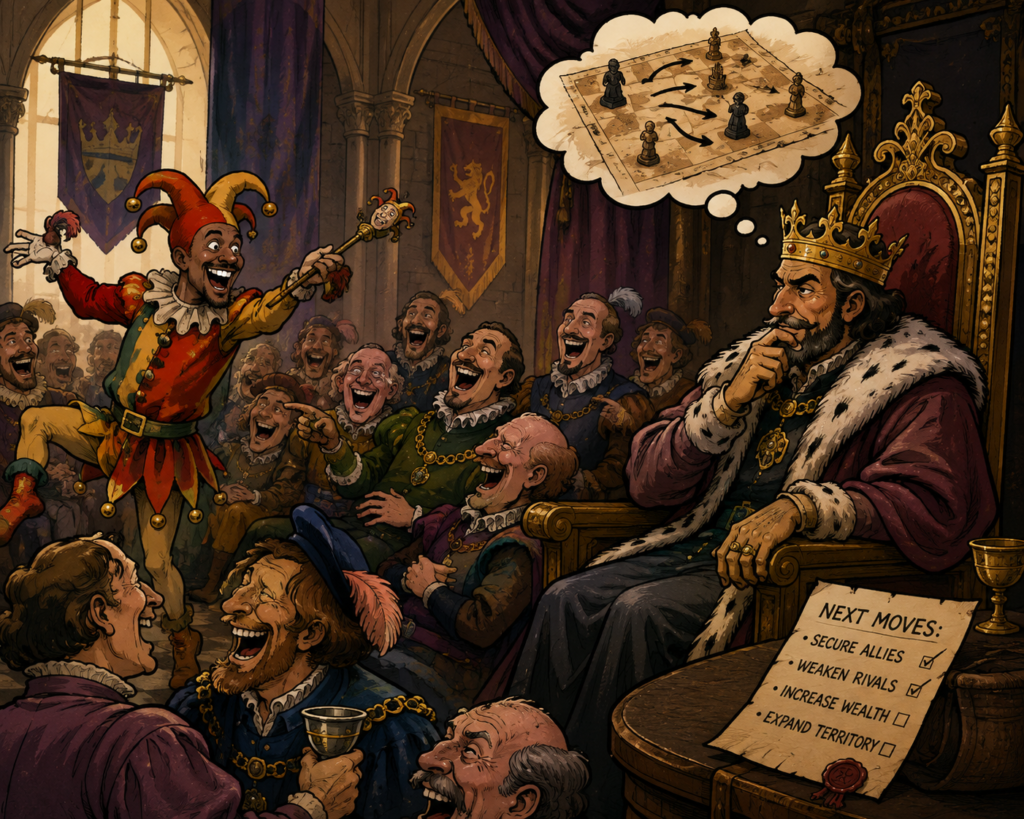
Royal courts often kept colourful jesters—not merely because they entertained but because they shaped attention and gave the king greater control over the mood in his court. Chaos has remarkable political value. When everyone around the throne appears outrageous, the monarch begins to look reassuringly moderate simply by remaining seated.
Ethical decline rarely arrives like an earthquake.
It comes like erosion.
Yesterday’s outrage becomes today’s normal.
Yesterday’s exception becomes today’s precedent.
Eventually, decency begins to look eccentric.
Yet the most revealing explanation may have nothing to do with politics.
It may have everything to do with childhood.
As a primary school pupil, I noticed something curious.
The class troublemakers naturally found one another.
The noisy children formed their own republic.
The academic stars gathered in different corners.
Nobody assigned these friendships.
No teacher designed the seating plan.
Children simply gravitated toward people who resembled themselves.
Perhaps adulthood changes less than we imagine.
Perhaps our offices merely become larger classrooms.
Political parties become bigger playgrounds.
Cabinets become adult versions of Primary Five.
We instinctively seek people who affirm us rather than challenge us.
People who make us comfortable instead of accountable.
People who reassure us that our shortcomings are perfectly ordinary.
Power only magnifies that instinct.
Indeed, one of the first casualties of power is often disagreement. Honest advisers gradually disappear. Independent thinkers become inconvenient. Friends who once spoke uncomfortable truths begin to visit less often. Before long, the leader is surrounded not by the best minds available, but by the safest voices.
We all prefer mirrors to microscopes.
Mirrors flatter.
Microscopes expose.
That is not merely a presidential temptation.
It is a human one.
Every manager who fears employing someone brighter than himself.
Every politician who mistakes loyalty for integrity.
Every businessman who promotes obedience above excellence.
Every religious leader who cannot tolerate honest dissent.
The Presidency merely magnifies what already exists within us.
The tragedy begins when an ordinary human weakness acquires extraordinary political power.
Then public office ceases to reward excellence.
It begins to reward usefulness.
Loyalty purchases immunity.
Controversy becomes job security.
Institutions become echo chambers.
And accountability quietly packs its bags.
Which brings us back to my friend’s innocent question.
Perhaps the real issue is not whether President Bola Tinubu keeps controversial company.
Perhaps the more uncomfortable question is whether any of us, entrusted with sufficient power and surrounded by enough applause, would resist the temptation to do exactly the same.
That possibility should worry us far more than any single administration.
Because governments change.
Human nature rarely does.
**Victor Anazonwu, a member of The Renaissance Online Magazine editorial board, writes from Lagos.
