
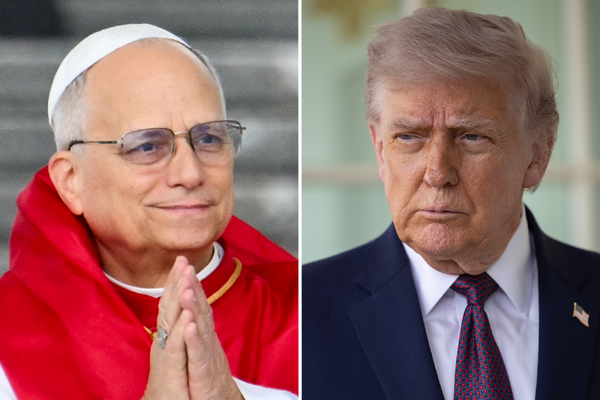
A widening rhetorical rift between Donald Trump and Pope Leo XIV (the first U.S.-born Pope, elected in 2025), has exposed a deeper fault line within global Christianity—one that pits political instinct against moral theology.
The controversy was sparked when the Pope suggested that “God does not listen to the prayers of those who wage war,” a statement that drew sharp rebuke from American political circles. J. D. Vance, a recent convert to Catholicism, publicly cautioned the pontiff against sweeping theological pronouncements and defended military action using the Church’s “Just War” tradition.
What has followed is a familiar pattern in Christian history. As in the divisions of the early Church—when the Corinthian community fractured along loyalties to figures like Paul the Apostle and Apollos—today’s believers risk aligning themselves more with personalities than with principle.
Beneath the noise lies another urgent question: how should Christians relate to Muslims in a volatile geopolitical age?
To his credit, Trump has built significant support around the defense of religious freedom. His administration elevated the plight of persecuted Christians globally, including in Nigeria, where insurgency and banditry have left many communities vulnerable. U.S. pressure, including congressional inquiries led by figures such as Riley Moore, drew renewed international attention to religious violence.
Supporters argue that this represents one of the most assertive American stances on religious liberty in recent years. Critics, however, question whether such advocacy has been entangled with nationalist or exclusionary agendas.
Within the Church, responses have also been nuanced. Voices like Robert Barron have praised efforts to protect religious expression while maintaining principled disagreements—particularly on immigration and the treatment of migrants.
Meanwhile, Pope Francis has consistently emphasized dialogue over confrontation. He has honored Christian martyrs killed by extremists and prayed for victims of violence across the Middle East, including in Syria and Palestine. Yet his willingness to engage Muslims—praying in mosques and promoting coexistence—has drawn criticism from those who see such gestures as naïve or conciliatory.
This brings us to the heart of the matter: What would Jesus do?
The Gospels offer a clear, if challenging, answer. Jesus Christ did not call for violent resistance against Roman occupation. Instead, he transformed zealots into apostles, engaged Samaritans despite deep ethnic hostility, and healed the servant of a Roman centurion—the very embodiment of imperial power.
His response to the “other” was not war, but encounter.
My own experience as a missionary in a Muslim-majority country reinforces this complexity. It is true that parts of the Muslim world must confront difficult questions about extremism and the misuse of religion. Yet it is equally true that broad generalizations obscure important realities.
Countries like Saudi Arabia, UAE, and Egypt are increasingly demonstrating intolerance for extremist violence. In Saudi Arabia, reforms under Mohammed bin Salman have introduced cautious social liberalization, including greater openness to cultural events and reduced religious policing. While far from complete, such shifts suggest that change is possible within Islamic societies.
At the same time, the case of Iran—with its record of repression and regional militancy—reminds us that not all regimes follow this trajectory. Even so, history teaches that war rarely provides lasting solutions unless all other options have failed.
The United States today stands at a crossroads of immense global and moral influence. Its leadership in defending religious freedom is significant, but it must be exercised with humility and restraint.
Equally, the Church must remain vigilant against any form of political messianism. I am referring to President Trump posting an AI image of himself as a messiah. Or assuming that because he fights against Christian genocide he now understands Christian theology and doctrine more than the Pontiff. Christianity does not anoint political saviors. Christ himself rejected such a role, even at the height of public acclaim.
The recent tensions between Washington and the Vatican are therefore regrettable—not because disagreement is unhealthy, but because the stakes are too high for polarization. Dialogue, not rivalry, must define the relationship between spiritual authority and political power.
There are grounds for cautious optimism. Trump and Pope Francis, despite past disagreements over immigration, have previously engaged in cordial dialogue at the Vatican. That precedent should guide the present moment.
In a fractured world, the path forward is neither naïve pacifism nor reflexive militarism. It is the harder road of discernment—one that balances justice with mercy, truth with humility, and conviction with dialogue.
About the author:
Fr Augustine Ikenna Anwuchie is a Nigerian Catholic Missionary priest based in Niger Republic.
